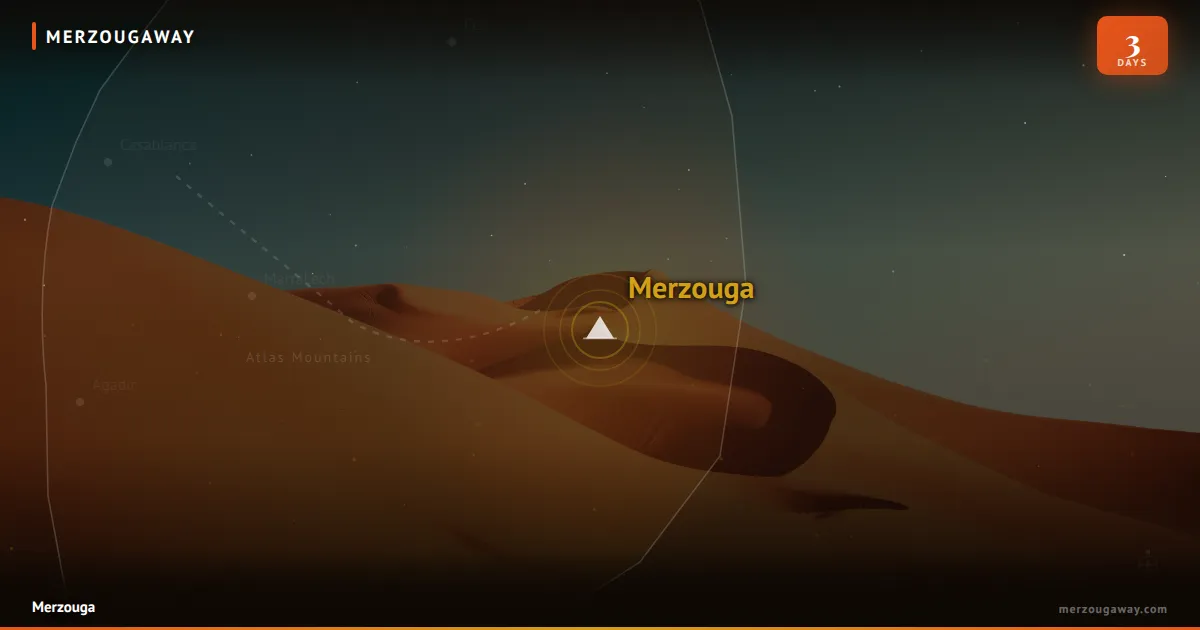
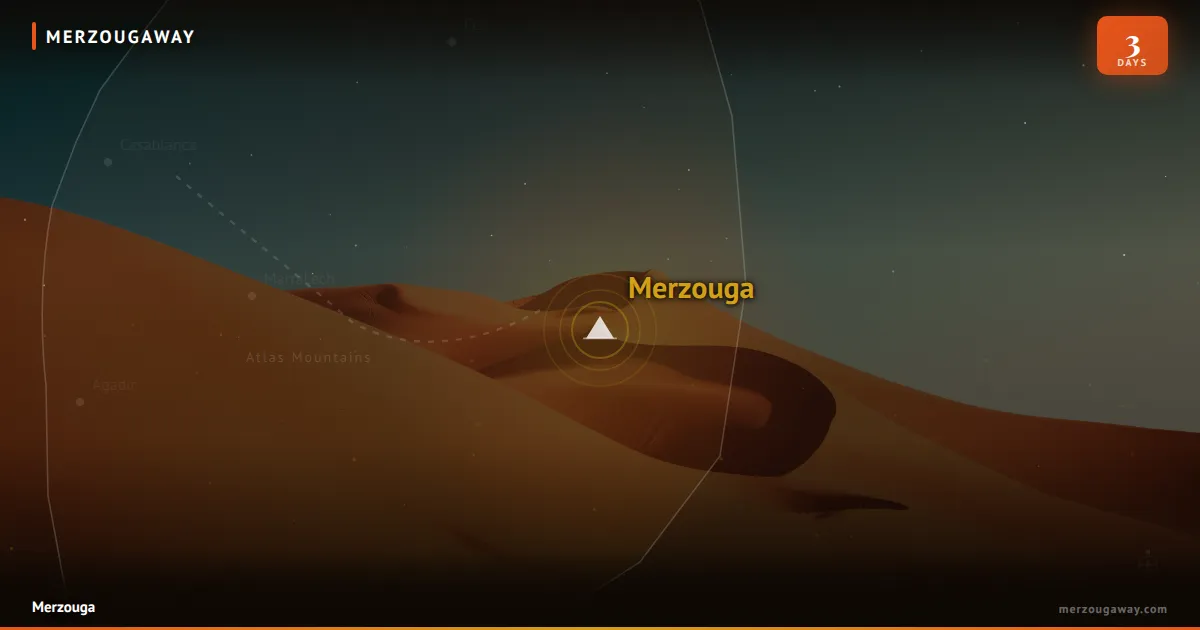
3-Day Merzouga Sahara Tour: The Ultimate Desert Adventure
Experience the magic of the Sahara with our 3-day Merzouga desert tour. Camel treks, desert camps, and unforgettable sunsets await in this once-in-a-lifetime adventure.
Three days is enough time to go from the streets of Marrakech to sleeping in the Sahara and back again, and it remains the most popular way travelers experience Erg Chebbi — long enough to actually settle into the desert rather than just glimpse it, short enough to fit into almost any Morocco itinerary. Here's what the journey actually looks like, day by day.
[!NOTE] Fast-Facts & Direct Answer Summary
Experience the magic of the Sahara with our 3-day Merzouga desert tour. Camel treks, desert camps, and unforgettable sunsets await in this once-in-a-lifetime adventure.
- Destination Focus: Authentic Moroccan culture, scenic routes, and local travel insights
- Currency & Payments: Moroccan Dirham (MAD; ~10 MAD ≈ €1 / $1.08 USD). Cash is essential outside major hotels
- Best Travel Window: October through April offers ideal temperate weather across Morocco and the desert
- Local Hospitality: Berber culture is renowned for warm hospitality, mint tea welcoming rituals, and rich musical heritage.
Day 1: Marrakech to the Dades Valley
The tour leaves Marrakech early, climbing out of the city and into the High Atlas Mountains via the Tizi n'Tichka pass, Morocco's highest paved road at 2,260 metres. The drive itself is the first highlight — switchbacks through Berber villages with the peaks still snow-capped for much of the year — before dropping down to Aït Ben Haddou, the UNESCO-listed fortified village whose red-clay towers have appeared in more films than almost any other location in Morocco. After lunch in Ouarzazate, the self-styled "Hollywood of Africa," the route continues along the Road of a Thousand Kasbahs into the Dades Valley, where the day ends with dinner and an overnight stay at a kasbah-style guesthouse looking out over the gorge.
Day 2: Into the Sahara
The second day covers the most ground and the biggest change in scenery. After breakfast, the route runs through Todra Gorge, where the canyon narrows to just a few metres between 300-metre limestone walls, then east through palm-lined valleys to Erfoud, known for its fossil workshops cutting and polishing marine fossils that are hundreds of millions of years old. Along the way, most itineraries build in a stop at Khamlia village to hear a live Gnawa music performance from the local community, and a visit to a nomadic Berber family for mint tea and conversation about desert life. By late afternoon, the flat hamada gives way abruptly to the Erg Chebbi dunes, and the group boards camels for the sunset trek into the sand — watching the dunes shift from gold to deep red as the light fades is the moment most people remember longest. The night is spent at a desert camp with proper tents, a hot shower, a traditional Moroccan dinner, and live Berber drumming around the fire under a sky with essentially no light pollution.
Day 3: Sunrise and the Return
Most guests wake before dawn to climb a nearby dune for sunrise over the Sahara, then return to camp for breakfast. The morning usually includes sandboarding on the dunes and a short 4x4 excursion to nearby oases and nomad settlements before the drive back to Marrakech begins. It's a long final day — the return covers the same 560 km as the outbound drive — with a lunch stop along the way and arrival back in Marrakech in the evening.
What's included
A private, air-conditioned vehicle and an English or French-speaking driver-guide for the full three days, one night at a guesthouse in the Dades Valley and one night in a desert camp (both with dinner and breakfast included), the sunset camel trek, and all applicable taxes and service charges.
Good to know before you go
This is a private tour, not a shared bus trip — it's your own vehicle and your own schedule for the full three days, with stops that flex around your group rather than a fixed itinerary shared with strangers. Comfortable walking shoes, warm layers for the cold desert nights, and sun protection are the essentials worth packing; the desert temperature swing between day and night surprises a lot of first-time visitors more than the daytime heat itself does.
Route Engineering: Distances, Drive Times, and Mountain Passes
Driving from Marrakech to Erg Chebbi is an expedition that crosses the geological spine of Morocco. Understanding the exact highway milestones prevents travel fatigue and helps you pace each day properly.
+------------------+---------------+----------------+--------------------------------+
| Route Leg        | Distance (km) | Realistic Time | Primary Route / Pass           |
+------------------+---------------+----------------+--------------------------------+
| Marrakech ->     | 200 km        | 4.5 - 5.0 hrs  | N9 via Tizi n'Tichka (2,260m)  |
| Ait Benhaddou    |               |                | & Ounila Valley shortcut       |
+------------------+---------------+----------------+--------------------------------+
| Ait Benhaddou -> | 130 km        | 2.0 - 2.5 hrs  | N10 through Skoura Palm Grove  |
| Dades Valley     |               |                | & Kelaat M'gouna (Rose Valley) |
+------------------+---------------+----------------+--------------------------------+
| Dades Valley ->  | 140 km        | 2.5 - 3.0 hrs  | N10 & R702 via Tinghir &       |
| Todra Gorge      |               |                | Todra Canyon (300m cliffs)     |
+------------------+---------------+----------------+--------------------------------+
| Todra Gorge ->   | 160 km        | 2.5 - 3.0 hrs  | N10 & N13 via Erfoud fossil    |
| Merzouga Dunes   |               |                | workshops & Rissani souks      |
+------------------+---------------+----------------+--------------------------------+
| Merzouga ->      | 560 km        | 9.5 - 10.5 hrs | Return via N10/N9 or Southern  |
| Marrakech        |               |                | Loop via N12 & Draa Valley N9  |
+------------------+---------------+----------------+--------------------------------+
The first major geographical hurdle is the Tizi n'Tichka pass, reaching 2,260 meters above sea level. This stretch of the N9 has undergone extensive engineering upgrades, with widened lanes, reinforced retaining walls, and improved guardrails. However, during winter months (December through February), snowfall can temporarily close the pass or mandate snow chains for heavy transport. Professional drivers monitor the Direction Générale des Routes bulletins to time the crossing before any high-elevation freezes.
Descending the southern slopes brings a dramatic shift from alpine cedar and walnut terraces to pre-Saharan desert scrub. By the time you reach Ouarzazate, the air turns noticeably dry, and the architecture transitions from stone and mortar into fortified rammed-earth (pisé) kasbahs.
The Return Dilemma: Backtracking vs. The Smart Southern Loop
On Day 3, most shared minibuses simply reverse their outbound path along the N10 and N9, subjecting passengers to 9 to 10 hours of retracing the exact same tarmac. MerzougaWay private expeditions offer an alternative: the Smart Southern Loop via the N12 highway.
Rather than heading back through Boumalne Dades and Tinghir, the southern loop routes southwest from Rissani across the volcanic stone desert (hammada) to Alnif, Tazzarine, and N'Kob. N'Kob is celebrated across southern Morocco as the "Village of 45 Kasbahs," retaining pristine earthen architecture surrounded by lush date palm groves. From N'Kob, the route connects to Tansikht and enters the magnificent Draa Valley along the N9, following Morocco's longest palm oasis through Agdz before climbing back over Tizi n'Tichka into Marrakech.
Outbound (Northern Route): Marrakech -> Tichka -> Dades -> Todra -> Merzouga
Return Option A (Standard): Merzouga -> Rissani -> Tinghir -> Ouarzazate -> Marrakech (560 km)
Return Option B (Smart Loop): Merzouga -> Rissani -> Alnif -> N'Kob -> Agdz -> Marrakech (585 km)
The Southern Loop adds merely 25 kilometers to the total journey but eliminates repetitive scenery, introduces travelers to deep Berber oasis communities, and provides sweeping views over the Jbel Saghro mountain range.
Camp Realities: Standard Bivouac vs. Deluxe Glamping
Choosing the right camp category in Erg Chebbi determines whether your Sahara overnight is an exercise in rustic endurance or an indulgent retreat under the Milky Way.
+-----------------------+-----------------------------+-----------------------------+
| Feature / Amenity     | Standard Berber Bivouac     | Luxury Desert Glamping      |
+-----------------------+-----------------------------+-----------------------------+
| Sleeping Quarters     | Traditional wool/fabric tent| Heavy canvas safari tent    |
| Bathroom Facility     | Shared external block       | En-suite private bathroom   |
| Hot Water             | Solar-dependent / limited   | Dedicated gas/electric water|
|                       |                             | heater in every tent        |
| Toilet Type           | Shared western or squat     | Private ceramic flush toilet|
| Power & Charging      | Central generator tent only | 24/7 solar + inverter ports |
| Climate Control       | Heavy camel-wool blankets   | Electric blankets or AC     |
| Dune Positioning      | Peripheral camp cordon      | Deep interior dune basin    |
| Average Price (MAD)   | 400 - 700 MAD / night       | 1,500 - 3,500 MAD / night   |
+-----------------------+-----------------------------+-----------------------------+
Standard camps are built from traditional woven goat-hair or camel-wool fabrics. While authentic, they utilize communal sanitation blocks situated 50 to 100 meters away from the sleeping tents. Navigating soft sand dunes in near-freezing temperatures in the middle of the night can be challenging.
In contrast, MerzougaWay luxury glamping setups feature spacious private suites standing on wooden flooring. Each suite includes a partitioned en-suite bathroom with running hot water, pressurized showers, hand basins with Berber copper faucets, and standard ceramic flush toilets. Electricity is provided by quiet solar battery arrays, allowing you to charge camera batteries, phones, and drones overnight without generator noise.
Budgeting in Moroccan Dirhams: Transparent Costs Breakdown
Planning your travel funds requires understanding what expenses are typically covered in a tour package versus what you must pay out-of-pocket in Moroccan Dirhams (MAD). Outside major urban centers like Marrakech, cash is the only accepted payment method for roadside cafes, entry tickets, and gratuities.
+------------------------------------+-----------------------+---------------------+
| Expense Item                       | Typical Price in MAD  | Currency Approx.    |
+------------------------------------+-----------------------+---------------------+
| Tagine / Couscous Roadside Lunch   | 70 - 110 MAD          | €6.50 - €10.00      |
| Large Bottled Water (1.5L)         | 8 - 15 MAD            | €0.75 - €1.40       |
| Berber Mint Tea / Espresso         | 10 - 20 MAD           | €0.90 - €1.85       |
| Ait Benhaddou Local Guide (opt.)   | 150 - 200 MAD / group | €14.00 - €18.50     |
| Kasbah Taourirt Entry Ticket       | 70 MAD per person     | €6.50               |
| Atlas Film Studio Tour             | 80 MAD per person     | €7.50               |
| Tip for Private Driver (per day)   | 150 - 250 MAD / day   | €14.00 - €23.00     |
| Tip for Camp Staff / Camel Trekker | 50 - 100 MAD / group  | €4.50 - €9.20       |
| Gnawa Music Donation (Khamlia)     | 20 - 50 MAD per person| €1.85 - €4.50       |
+------------------------------------+-----------------------+---------------------+
We recommend withdrawing at least 1,500 to 2,000 MAD in cash per person at an ATM in Marrakech before your morning departure. ATMs in Ouarzazate and Tinghir can experience network outages or run out of banknotes during national holidays and weekends.
Cultural Etiquette: Khamlia Gnawa and Desert Nomads
A highlight of Day 2 is visiting Khamlia village, nestled just 7 kilometers south of Merzouga. Khamlia is populated by the descendants of enslaved sub-Saharan Africans from Sudan, Mali, and Senegal who integrated into the local Amazigh tribes centuries ago. Their spiritual trance music, known as Gnawa, utilizes the guembri (a three-stringed camel-neck lute), qraqeb (heavy iron castanets), and vocal call-and-response chants.
When entering a Gnawa performance hall, guests are seated on handwoven rugs and served warm mint tea. While performances are offered without a mandatory entrance ticket, customary etiquette requires purchasing a music CD or placing a contribution of 20 to 50 MAD per person in the communal donation basket.
Similarly, when your driver coordinates a tea gathering with a semi-nomadic Berber family residing in traditional woven tents (beit) across the black desert, modest behavior is expected. Always accept the tea glass with your right hand. When photographing family members or children, always ask your driver-guide for permission first, and leave a modest token of gratitude (such as purchasing dry foodstuffs, fresh fruit, or leaving a 50 MAD tip) with the matriarch of the household.
Photography in Erg Chebbi: Golden Hour Light and Gear Care
Photographing the towering golden sand dunes of Erg Chebbi provides some of the most dramatic landscape imagery in North Africa. However, the desert environment requires specialized handling:
+---------------------+-----------------------------+------------------------------------+
| Time Window         | Lighting Character          | Photography Priorities             |
+---------------------+-----------------------------+------------------------------------+
| Sunset Golden Hour  | Warm amber glow, long dune  | Silhouette portraits, camel caravan|
| (17:00 - 18:00)     | shadows, sharp ridgelines   | lines along the dune spine         |
+---------------------+-----------------------------+------------------------------------+
| Blue Hour / Twilight| Deep indigo sky, soft sand  | Camp lanterns, bonfire sparks,     |
| (18:15 - 19:00)     | luminescence                | first evening stars and planets    |
+---------------------+-----------------------------+------------------------------------+
| Astro Night Sky     | Total darkness, unpolluted  | Milky Way core, long exposure      |
| (21:00 - 03:00)     | stellar visibility          | star trails (f/2.8, ISO 3200, 20s) |
+---------------------+-----------------------------+------------------------------------+
| Dawn Sunrise        | Crisp pink and orange hues, | Wind-swept virgin sand ripples,    |
| (06:30 - 07:15)     | low-angle horizontal light  | clean ridge shadows without tracks |
+---------------------+-----------------------------+------------------------------------+
Fine desert silica is microscopic and abrasive. Never change interchangeable lenses while standing on the open dunes, as afternoon gusts can blow fine dust onto your camera sensor. Use a fixed zoom lens or seal your camera body with a silicone cover. When walking along the dune crests, always walk on the windward side where the sand is firmly packed, avoiding the soft, steep slip-face where tripods can tip over.
Frequently Asked Questions (FAQ)
How long is the drive on a 3-day Marrakech to Merzouga tour?
The total round-trip distance is approximately 1,120 km (~700 miles). On Day 1, driving from Marrakech to Dades Gorge via Tizi n'Tichka and Ait Benhaddou takes 6 to 7 hours. Day 2 to Merzouga takes 4 to 5 hours. Day 3 returning from Merzouga to Marrakech takes 9 to 10 hours.
Where do you sleep on a 3-day tour from Marrakech to Merzouga?
Night 1 is spent in a scenic valley hotel or kasbah riad in the Dades Valley or Todra Gorge. Night 2 is spent in a luxury or standard Berber desert camp nestled directly in the Erg Chebbi sand dunes.
What is included in a private 3-day Merzouga tour with MerzougaWay?
Our private tours include an air-conditioned 4x4 or minivan, professional Berber/English-speaking driver, fuel, hotel pickup/drop-off in Marrakech, 1 night in Dades with dinner and breakfast, 1 night in a luxury desert camp with private bathroom, sunset and sunrise camel rides, and sandboarding.
Can the 3-day tour finish in Fez instead of Marrakech?
Yes! The Marrakech to Merzouga to Fez one-way desert tour is our most popular route. It avoids repeating 9 hours of mountain driving on Day 3 and seamlessly connects Morocco's two premier imperial cities.
Book Your Adventure
Ready to experience the magic of the Sahara? Contact us to book your 3-day Merzouga adventure today!
WhatsApp: +212675203319
Email: hello@merzougaway.com
Or book the 3-Day Marrakech to Merzouga Sahara Desert Tour directly — see exact pricing and departure dates.
Sahara Route & Drive-Time Estimator
Calculate realistic driving hours across the High Atlas (Tizi n'Tichka pass), compare scenic stops (Dadès, Todra, Ziz), and plan your custom desert itinerary.
MerzougaWay Team
We are a passionate team of local guides dedicated to sharing the beauty and culture of our home, Morocco. Our journey began with a simple desire to offer authentic, memorable experiences that go beyond the typical tourist trails.