Drive from Marrakech to Merzouga: Self-Drive Guide & Route
What self-driving from Marrakech to Merzouga actually involves — the Tizi n'Tichka pass, realistic timing, and why most visitors end up hiring a driver instead.
Renting a car and driving yourself from Marrakech to Merzouga is entirely possible, and a decent number of confident, experienced drivers do it every year. It's also a harder trip than it looks on a map. The route covers roughly 560 km and 9-10 hours of actual driving time one-way, and a meaningful chunk of that is spent crossing the High Atlas via the Tizi n'Tichka pass — a mountain road of tight switchbacks, real elevation change, and truck traffic on the descent, not a highway cruise. Nobody sane does this in one day each direction; plan it as a 2-3 day trip with an overnight stop, the same way an organized tour would structure it.
[!NOTE] Fast-Facts & Direct Answer Summary
A desert journey from Marrakech to Merzouga spans ~560 km across the High Atlas Mountains (Tizi n'Tichka pass, 2,260m). The drive takes 9–10 hours, making a 3-Day or 4-Day tour the minimum recommended duration for safety and comfort.
- Recommended Duration: 3 Days (Classic) or 4 Days (Relaxed & In-Depth)
- Primary Road Routes: N9 across the Atlas ➔ N10 through Dadès Valley ➔ N13 to Erg Chebbi
- Realistic Pricing: 1,800–4,500 MAD (€180–€420) per person for private tours with luxury desert camp
- Key Highlights: Aït Benhaddou UNESCO ksar, Todra Gorge canyons, sunset camel trek, and Erg Chebbi dunes
- Local Expert Tip: Avoid 2-day Merzouga tours (18–20 hours driving in 48h). Opt for Agafay Desert if you only have 1–2 days.
The route, realistically
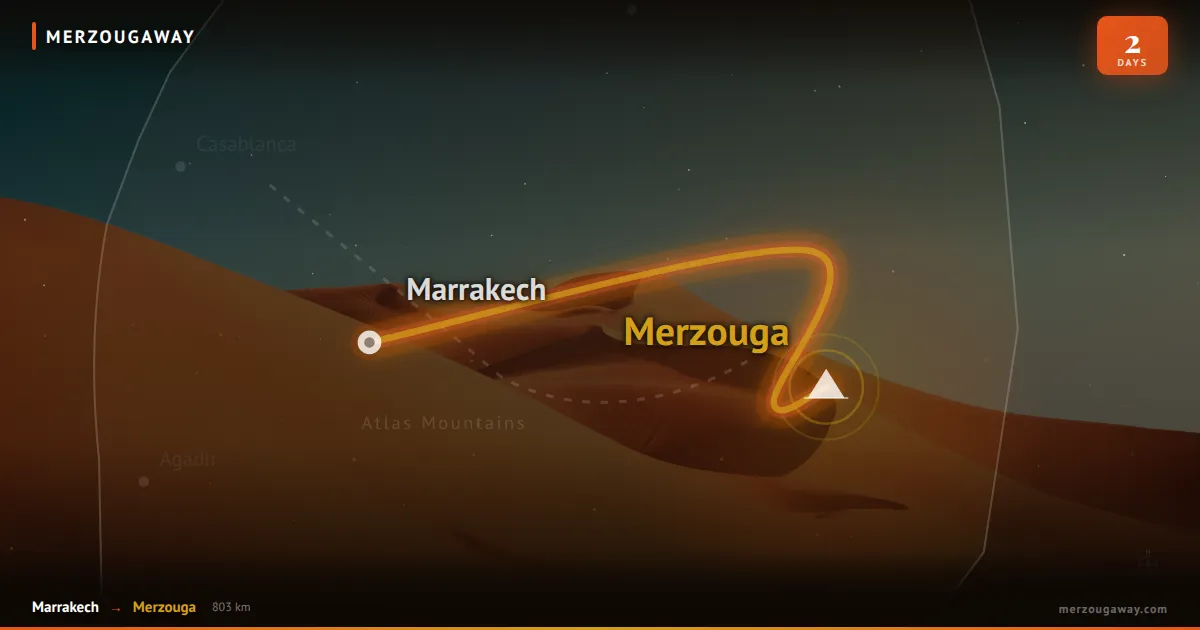
The first stretch out of Marrakech climbs into the Atlas toward the Tizi n'Tichka pass itself — well-paved but narrow and winding, with the kind of hairpin turns that demand full attention rather than scenery-gazing (let your passenger take the photos). Past the pass, the road descends toward Ait Ben Haddou and Ouarzazate, where the driving eases into flatter, more forgiving highway. Most self-drivers overnight in Ouarzazate here, which splits the trip sensibly: a demanding mountain-crossing day followed by a longer but easier desert-highway day through the Dades Valley, Erfoud, and the Ziz Valley oasis road into Merzouga. That second leg has long stretches with no fuel stations or real services, so this is the point where "fill the tank at every opportunity" stops being optional advice and becomes the rule that keeps your trip on schedule.
What actually makes this drive hard
It's not really the distance — it's the mountain section and the fatigue that builds afterward. The Tizi n'Tichka switchbacks reward low gears on the descent rather than riding the brakes, and mixing with local traffic (trucks taking the curves slower, occasional livestock or motorcycles on the shoulder) means the pass takes real concentration for a couple of hours straight. After that, the long, flat desert highway stretches can be deceptively tiring in a different way — hours of monotonous driving with the sun overhead and fewer landmarks to break up the trip. Night driving on either section is worth avoiding: lighting outside towns is minimal and animals do cross the road at dawn and dusk. If you're doing this as a group, splitting the driving matters more here than on an ordinary road trip.
Why most visitors hire a driver instead
This is exactly the calculation that leads a lot of people to book a private driver rather than self-drive: the mountain crossing plus the fatigue afterward is a genuinely demanding two days behind the wheel, on unfamiliar roads, with variable local driving norms and no backup if something goes wrong with the car in a remote stretch. A private driver removes all of that — you get someone who knows the pass, the fuel stops, and the road conditions, while you actually get to look at the Atlas Mountains instead of the road. On raw numbers, self-driving is usually still cheaper solo or as a couple — an economy rental runs roughly 250-400 MAD/day plus diesel for the ~1,120 km round trip, against a standard private driver at roughly 1,200-1,800 MAD/day per vehicle — but split across a group of three or four, a private driver often lands close enough to the self-drive cost per person that the math stops being the deciding factor and the stress-free trade-off is what actually tips it. If flexibility and total control over your schedule matter more to you than saving that mental effort, self-driving is a real and viable option — plenty of people do it and enjoy it. It's just not the "easy" choice by default, and it's worth going in with accurate expectations about the pass rather than assuming it's a straightforward long-distance highway drive.
Practical basics if you do self-drive
An international driving permit alongside your home license is worth carrying, third-party insurance is mandatory in Morocco, and a car with a bit of extra ground clearance handles the desert-highway sections more comfortably than a low sedan, though a standard 2WD car manages the main paved route fine in dry conditions. Download offline maps before you leave Marrakech — signal drops in the mountains and in stretches of the desert highway, and relying purely on live GPS is a bad plan out there. Keep a paper map or downloaded screenshots as backup, budget realistic breaks every couple of hours, and treat "how far is it to the next fuel station" as a question worth asking at every stop rather than assuming.
We run this route every week as a private guided tour, so if the idea of the mountain crossing gives you pause, or you'd simply rather sit back and enjoy the Atlas Mountains and Sahara without managing the driving, that's the alternative worth considering. Questions about either route — self-drive or private driver — are welcome.
The Complete 560-km Turn-by-Turn Road Trip Blueprint
Driving yourself from the sensory labyrinth of Marrakech to the towering golden sand dunes of Erg Chebbi is one of the world's most spectacular overland road adventures. Spanning 560 kilometers (348 miles) across Highways N9, N10, R702, and N13, the drive takes you from 450 meters elevation in the Haouz plain, climbs over the 2,260-meter alpine barrier of the High Atlas, and descends into the pre-Saharan desert basin.
The following master driving table details the essential navigation checkpoints and waypoints:
| Driving Sector & Waypoint | Distance | Driving Time | Highway Number | Recommended Activity / Rest Stop | | :--- | :--- | :--- | :--- | :--- | | Marrakech to Toufliht | 60 km | 1.0 Hour | N9 Highway | Scenic climb through pine and oak foothills; police checkpoint | | Toufliht to Taddert & Tichka Summit | 60 km | 1.5 Hours | N9 Mountain Pass | Summit photos at Tizi n'Tichka (2,260m); barbecue lunch in Taddert | | Tichka Summit to Ouarzazate | 80 km | 1.5 Hours | N9 South Descent | Detour junction for UNESCO Ksar Ait Benhaddou | | Ouarzazate to Boumalne Dades | 115 km | 1.75 Hours | N10 Highway | Skoura palm grove (Kasbah Amridil); Valley of the Roses | | Boumalne Dades to Tinghir (Todra) | 55 km | 50 Minutes | N10 Highway | Walk inside the 300-meter vertical Todra Gorge canyon | | Tinghir to Erfoud via Tinjdad | 135 km | 1.75 Hours | N10 ➔ R702 Highway | Flat desert driving; visit prehistoric fossil marble quarries | | Erfoud to Rissani and Merzouga Dunes | 55 km | 45 Minutes | N13 Highway | Rissani souk market; transfer to sunset camel trek in Merzouga |
Pacing Strategy: Why You Should Never Drive in a Single Day
While Google Maps or GPS navigation units may calculate the 560-km route as an 8.5-hour drive, attempting this journey in a single day is an exhausting and potentially hazardous endeavor:
- The Mountain Pass Bottleneck: Heavy trucks, agricultural tractors, and slow-moving buses on the Tizi n'Tichka pass frequently reduce average driving speeds to 30 to 40 km/h. Factoring in mandatory fuel stops, police checkpoints, and lunch, a direct drive takes at least 10 to 11 continuous hours behind the wheel.
- The Recommended 2-Day Split: Divide the outbound journey into two balanced, scenic days:
- Day 1: Depart Marrakech at 08:30 AM, cross the High Atlas, explore Ksar Ait Benhaddou, and check into a boutique kasbah riad with a pool in the Dades Valley or Skoura Oasis by 16:00 PM (approx. 5 to 6 hours driving).
- Day 2: Depart after breakfast, hike the magnificent Todra Gorge, explore the fossil workshops of Erfoud, and arrive at the edge of Merzouga by 16:30 PM, ready for a relaxed sunset camel trek into your luxury glamping camp (approx. 4.5 hours driving).
Road Hazards and Vehicle Selection
- Is a 4x4 Required? No. The entire 560-kilometer route along the N9, N10, R702, and N13 is fully paved with modern, well-maintained asphalt. A standard two-wheel-drive (2WD) compact rental car, hatchback, or crossover handles the drive effortlessly. Four-wheel-drive (4WD) is only required if you intend to drive directly onto the sand dunes (which rental contracts strictly forbid). When you reach Merzouga, your desert camp will provide 4x4 or camel transfers across the sand.
- Winter Alpine Conditions (Dec–Feb): Cold weather at 2,260 meters can produce morning black ice on shaded mountain switchbacks. Check weather forecasts before leaving Marrakech. If heavy snow occurs, the Royal Gendarmerie will hold traffic at Toufliht until government snowplows clear the asphalt.
Essential Vehicle Checklist and Pre-Trip Inspection
Before pointing your rental car toward the High Atlas mountains, spend 15 minutes conducting a comprehensive vehicle safety check at your Marrakech rental depot:
- Tire Tread and Pressure: Mountain switchbacks and desert gravel shoulders demand healthy tire tread. Verify that all four tires have substantial tread depth and that tire sidewalls show no bulging cracks.
- Spare Tire and Jack Verification: Open the trunk and physically verify that the spare wheel is present, fully inflated, and accompanied by a functional scissor jack, lug wrench, and reflective red warning triangle. If you get a flat tire along the desolate N12 desert highway, having a working spare wheel is essential.
- Fluid Levels and Air Conditioning: Check that engine coolant and motor oil levels are topped off, and verify that the air conditioning unit blows legitimately cold air before leaving the agency.
- Document Scrutiny: Ensure the vehicle's registration booklet (Carte Grise), valid tax sticker (Vignette), and insurance certificate (Attestation d'Assurance) are present in the glove compartment.
Emergency Breakdown Services and Roadside Mechanics
If mechanical issues arise during your 560-km journey, Morocco's rural automotive support network is surprisingly robust:
- The Ubiquitous Vulcanisateur: If your tire suffers a puncture from a sharp desert stone, look for roadside tire repair shops known as Vulcanisateurs (identifiable by stacks of old tires displayed along the road in every village). A vulcanisateur will jack up your car, submerge the tire in a water tank to locate the leak, insert a vulcanized rubber plug, and re-inflate the wheel for 30 to 50 MAD (~$3 to $5 USD) in under 15 minutes.
- Highway Service Assistance: Major national fuel plazas (Afriquia, Shell, Total) operate full-service mechanic bays capable of addressing overheating radiators, replacing blown fuses, or changing brake pads.
- Royal Gendarmerie Assistance: If your vehicle suffers a catastrophic breakdown on an open highway, dial 177 to reach the Royal Gendarmerie highway patrol, who will dispatch a licensed flatbed tow truck (Dépannage) to transport your car to the nearest town garage.
Fueling Strategy and Highway Service Plazas Along Highway N10
Managing your vehicle's fuel level across the arid pre-Saharan corridor requires proactive planning:
- Highway Service Stations: Modern full-service fuel plazas (Afriquia, Shell, Total, Winxo) are located approximately every 30 to 40 kilometers along Highway N10 through Ouarzazate, Skoura, Kelaat M'Gouna, Boumalne Dades, and Tinghir. These service areas feature clean restrooms, espresso cafes, and small convenience markets.
- The Golden Quarter-Tank Rule: Once you pass Erfoud on the approach to Rissani and Merzouga, service stations become sparse. Always top off your fuel tank in Tinghir or Erfoud, and never let your fuel gauge drop below one-quarter capacity while driving through remote desert sectors.
- Payment Realities: Major brand fuel stations in primary towns accept international credit cards (Visa and MasterCard), but electronic card terminals occasionally lose mobile data connectivity. Always carry at least 400 to 500 MAD in physical cash specifically dedicated to fuel purchases.
Packing Essential Road Trip Utilities
Preparing a small emergency driving kit ensures complete self-reliance along Highway N9 and N10:
- Navigation Hardware: While mobile phone networks cover most of the highway, download offline maps of Southern Morocco on both Google Maps and Maps.me before leaving Marrakech. Carry a sturdy dashboard phone mount and a 12V cigarette-lighter USB car charger to keep your navigation device powered continuously.
- Hydration and Snack Cache: Pack a full case of bottled water (six 1.5L bottles) in the trunk, along with moist towelettes, hand sanitizer, a small flashlight, and a bag of local dried fruits and nuts for remote mountain stretches.
Frequently Asked Questions (FAQ)
What is the most scenic stretch of the drive from Marrakech to Merzouga?
The two most dramatic stretches are the mountain ascent over the Tizi n'Tichka pass (2,260m) with sweeping views of terraced High Atlas Berber villages, and the Dades Gorge canyon road featuring towering red cliff walls and serpentine road curves.
Is there mobile GPS navigation on the road to Merzouga?
Google Maps and Maps.me work well along the primary highways, but cellular data can drop in deep mountain ravines. Always download the entire southern Morocco offline map before leaving Marrakech.
What should you do if your car breaks down between towns in southern Morocco?
Moroccans are exceptionally helpful to stranded motorists. Flag down a passing vehicle or call your rental agency's 24/7 assistance number. The Royal Gendarmerie patrols highway N9 and N10 regularly.
Are road signs written in English along the desert highway?
Road signs in Morocco are bilingual in Arabic and French, using standard international road symbols. Major destination towns (Ouarzazate, Tinghir, Erfoud, Merzouga) and highway numbers (N9, N10, N13) are clearly signposted.
What should I do about desert sand on the road near Merzouga?
On windy days, thin layers of sand can drift across Highway N13 between Rissani and Merzouga. Reduce your speed, avoid sudden braking, and never drive off the asphalt onto soft shoulders unless you are in a 4x4 with deflated tires.
Get Expert Advice:
WhatsApp: +212675203319 Email: hello@merzougaway.com Web: merzougaway.com
Last updated: August 2026.
Sahara Route & Drive-Time Estimator
Calculate realistic driving hours across the High Atlas (Tizi n'Tichka pass), compare scenic stops (Dadès, Todra, Ziz), and plan your custom desert itinerary.
MerzougaWay Team
We are a passionate team of local guides dedicated to sharing the beauty and culture of our home, Morocco. Our journey began with a simple desire to offer authentic, memorable experiences that go beyond the typical tourist trails.