Essaouira to Merzouga: Complete Tours Guide 2026
Your complete guide to traveling from the coastal charm of Essaouira to the golden dunes of Merzouga. How the route actually works, what a private multi-day trip includes, and what to expect along the way.
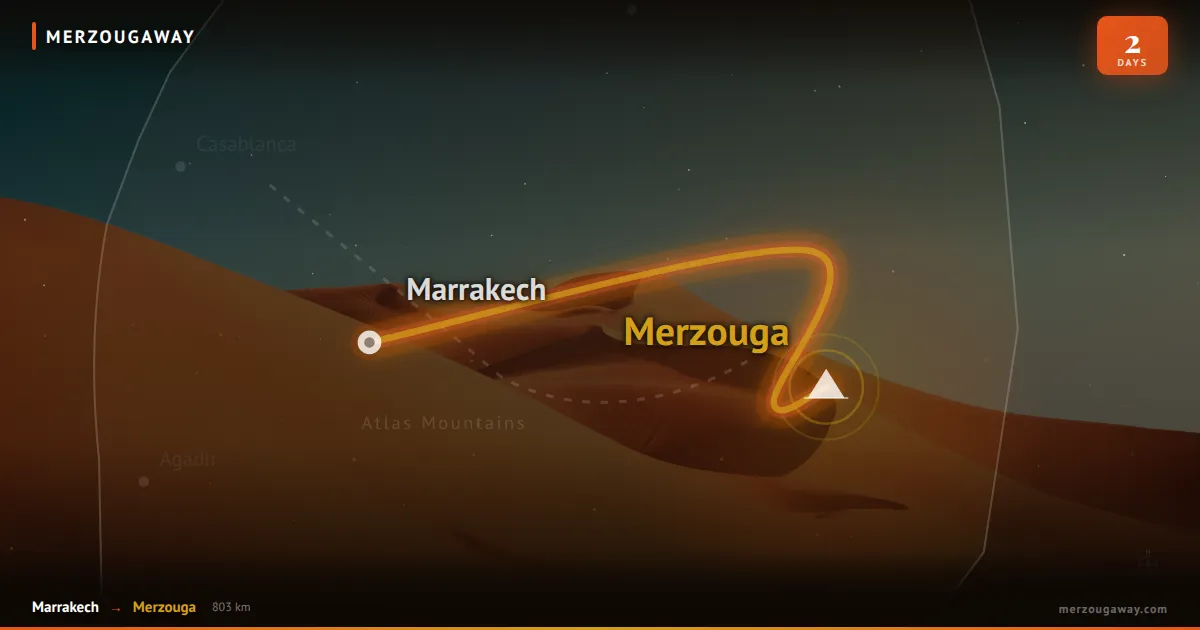
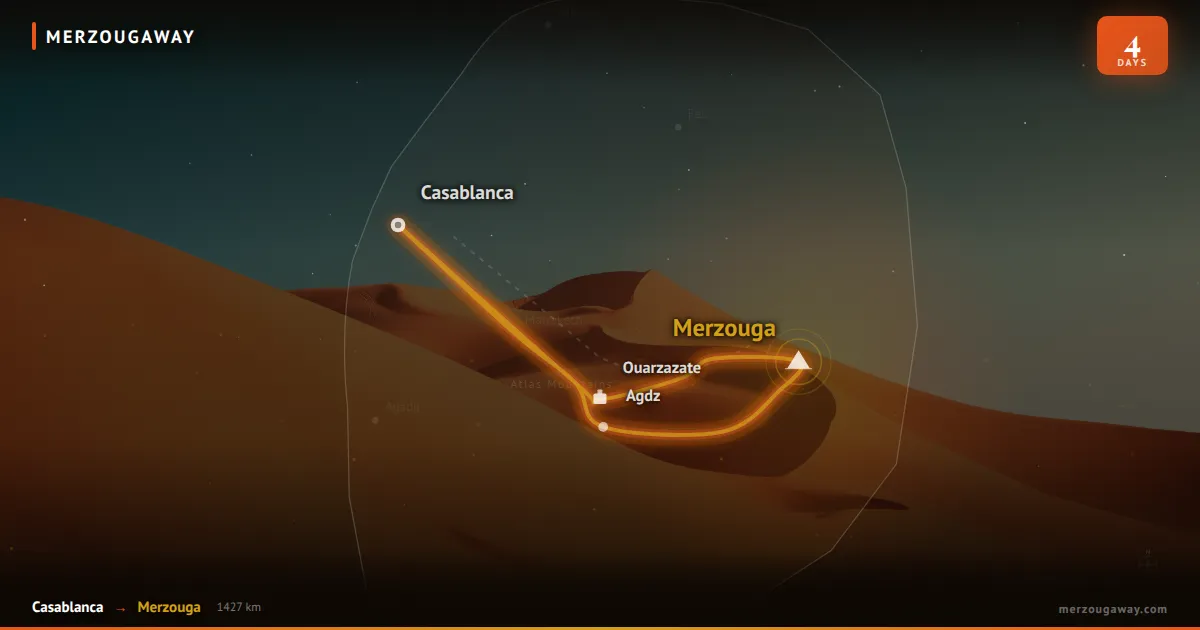
There's no direct road from Essaouira's Atlantic ramparts to the Sahara — the practical geography of Morocco means any trip between the two runs back through Marrakech first, since that's where the routes over the High Atlas begin. It's worth knowing this upfront, because it shapes how the trip actually gets planned: not as a single point-to-point transfer, but as a loop or one-way multi-day itinerary that treats Essaouira, Marrakech, and Merzouga as three stops on the same journey rather than a straight line between two points.
That loop is genuinely one of the best introductions to how varied Morocco's geography is in a single trip. You leave the ocean and the fishing port, cross back through Marrakech, climb the Tizi n'Tichka pass through the High Atlas, and drop down through kasbah country toward the Erg Chebbi dunes — coast, mountains, and desert inside a week, without ever repeating the same landscape twice.
[!NOTE] Fast-Facts & Direct Answer Summary
Your complete guide to traveling from the coastal charm of Essaouira to the golden dunes of Merzouga. How the route actually works, what a private multi-day trip includes, and what to expect along the way.
- Destination Focus: Authentic Moroccan culture, scenic routes, and local travel insights
- Currency & Payments: Moroccan Dirham (MAD; ~10 MAD ≈ €1 / $1.08 USD). Cash is essential outside major hotels
- Best Travel Window: October through April offers ideal temperate weather across Morocco and the desert
- Local Hospitality: Berber culture is renowned for warm hospitality, mint tea welcoming rituals, and rich musical heritage.
Best time to make the trip
Spring (March to May) and autumn (September to November) are the easiest months for this route specifically, because they're comfortable at both ends — mild and breezy on the Essaouira coast, and warm rather than punishing once you're down in the desert basin around Merzouga. Summer flips that comfort around: Essaouira's Atlantic location keeps it noticeably cooler than inland Morocco even in July and August, while Merzouga can climb past 40°C in the same stretch, so a summer trip on this route means genuinely different climates on either end of the same week. Winter reverses it again — the coast stays mild, but desert nights around Merzouga regularly drop close to freezing, so a warm layer that felt unnecessary in Essaouira becomes essential the moment the sun goes down over the dunes.
What this actually looks like as a private trip
Because the coast-to-desert route only makes sense as a multi-day journey, this isn't something we sell as a fixed point-to-point transfer — it's a private multi-day tour, built around your pace and starting point. The closest match to what most travelers are picturing when they search for this route is our 7-day Marrakech tour combining the Sahara, the Atlas Mountains, and Essaouira's beach, which starts from €750 per person and runs as a private round trip from Marrakech: a night in the desert with a sunset camel trek, the mountain crossing both ways, and a stretch on the coast in Essaouira at the end. If you're starting directly from Essaouira rather than Marrakech, we simply build the transfer to Marrakech into day one of the same itinerary — your private driver-guide picks you up in Essaouira and the trip runs from there.
A private multi-day desert itinerary like this typically includes an air-conditioned 4x4 or minivan with your own English-speaking driver-guide for the whole trip, accommodation each night (a mix of riads or hotels on the road and a desert camp in Merzouga), breakfast daily with dinner included at the desert camp and kasbah-area stops, the camel trek out to camp, and usually a Berber cheche and a polished fossil souvenir from the Erfoud workshops thrown in along the way. Lunches, drinks beyond water, monument entrance fees, and tips for your driver and guide are the standard exclusions — worth budgeting for separately rather than assuming they're bundled in.
What the days actually involve
The Essaouira-to-Marrakech leg is a straightforward coastal-to-inland drive, a few hours through argan country with Marrakech as the overnight stop. From Marrakech, the real mountain crossing begins: the Tizi n'Tichka pass at 2,260 metres, then Ait Ben Haddou's UNESCO-listed kasbah and Ouarzazate for the next stop. Depending on the exact itinerary, the following day or two runs through the Dades and Todra Gorges — dramatic canyon country that's as much a highlight of this route as the desert itself — before the final push into Merzouga. That's when the trip's centerpiece happens: a sunset camel trek into the Erg Chebbi dunes, a night in a desert camp under a genuinely dark sky, and sunrise from the top of a dune the next morning before the drive back begins.
Choosing between options
If you're weighing a shorter, faster version of this trip against a longer one, the trade-off is mostly about how much time you get in the mountains and gorges versus how much driving you do in a day — a longer itinerary spreads the same distance over more days with shorter driving stretches and more stops, rather than adding entirely new destinations. A private 4x4 is worth the small premium over a shared minivan if you're doing the Dades and Todra sections, since the roads there are narrower and more scenic than a highway transfer, and a private vehicle lets your guide actually stop when something's worth seeing rather than sticking to a fixed schedule.
Spending time in Essaouira first?
If you have a day or two on the coast before heading into the desert, see our 1-2 day Essaouira itinerary for the ramparts, the port-side seafood grills, and when to surf.
The Ultimate "Sea and Sand" Circuit: Essaouira to Erg Chebbi
Connecting the breezy Atlantic ramparts and bohemian art galleries of Essaouira with the monumental 150-meter golden sand dunes of Erg Chebbi in Merzouga is one of Morocco's most extraordinary travel pairings. Spanning approximately 730 kilometers (453 miles) across diverse geological landscapes, this epic journey links the cool ocean trade winds with the profound, silent majesty of the Sahara Desert.
The following master comparison table breaks down primary routing strategies connecting Essaouira to Merzouga:
| Route Variant & Geometry | Total Distance | Optimal Duration | Key Intermediate Overnight Stops | Primary Scenic Highlights | Best Suited Traveler Profile | | :--- | :--- | :--- | :--- | :--- | :--- | | Route A: Via Marrakech & High Atlas (N9 & N10) | 730 km (453 miles) | 4 to 5 Days | Night 1: Marrakech or Skoura; Night 2: Dades; Night 3: Merzouga | Ksar Ait Benhaddou, Tizi n'Tichka pass, Dades & Todra Gorges | Travelers who want to include Marrakech sightseeing on the way | | Route B: The Southern Anti-Atlas Loop (N10 & N12) | 780 km (485 miles) | 5 to 6 Days | Night 1: Taroudant; Night 2: Taznakht; Night 3: Merzouga | Saffron capital Taliouine, carpet capital Taznakht, Draa Valley | Repeat visitors, culture lovers seeking uncrowded southern valleys | | Route C: Express Transit via Marrakech High-Speed | 730 km (One-way) | 3 Days / 2 Nights | Night 1: Dades Valley; Night 2: Erg Chebbi Luxury Camp | High Atlas mountain crossing, Todra canyon, sunset camel caravan | Time-conscious travelers wanting the essential highlights |
Route A Deep Dive: The Classic Traverse via Marrakech and the High Atlas
This is the most popular routing for travelers wanting the full spectrum of Moroccan landscapes:
- Essaouira to Marrakech (R207 Highway - 180 km / 2.5 hrs): The drive leaves the Atlantic coast, winding through the UNESCO Argan Biosphere Reserve where tree-climbing goats feed on argan nuts. Visit an authentic female-run argan oil cooperative to observe traditional cold-pressing techniques before passing the outskirts of Marrakech.
- Ascending the High Atlas via Highway N9: Climb the breathtaking switchbacks of the Tizi n'Tichka Pass (2,260m), pausing at panoramic viewpoints for fresh pomegranate juice and tagines in Taddert.
- The Kasbah Corridors of Highway N10: Descend into the pre-Saharan river valleys, exploring the 11th-century earthen citadel of Ksar Ait Benhaddou, the 4,500-hectare palm grove of Skoura Oasis (Kasbah Amridil), the towering limestone cliffs of Todra Gorge, and the prehistoric marine fossil quarries of Erfoud before reaching the golden dunes of Merzouga.
Route B Deep Dive: The Remote Southern Anti-Atlas Route
For intrepid travelers seeking off-the-beaten-path authenticity, the southern loop completely bypasses Marrakech and the High Atlas mountain pass:
- Essaouira to Taroudant via the Souss Plain: Travel south along the Atlantic coastline before cutting inland through the fertile Souss Valley to Taroudant (known affectionately as "Little Marrakech" for its magnificent intact 16th-century adobe ramparts and authentic, low-pressure souks).
- Taliouine (The Saffron Capital): Climb into the Anti-Atlas mountains to Taliouine, the epicenter of North African saffron cultivation. Visit local agricultural cooperatives to purchase certified pure organic saffron threads harvested from purple crocus flowers (Crocus sativus).
- Taznakht and the N12 Desert Highway: Continue through Taznakht, Morocco's premier weaving capital famous for hand-knotted Ouaouzguita Berber wool carpets, before driving eastward along the desolate, cinematic N12 highway past Alnif and Rissani directly to Erg Chebbi.
From Atlantic Seafood to Desert Mechoui: The Culinary Transition
One of the great pleasures of linking Essaouira with Erg Chebbi is the dramatic transition in regional gastronomy:
- Essaouira Coastal Delicacies: In Essaouira, culinary life revolves around the Atlantic harbor. Savor fresh grilled sardines, sea bream, calamari, and spider crab seasoned simply with sea salt, lemon juice, and cumin at the wooden port stalls, paired with fresh crusty bread and avocado salads.
- High Atlas Mountain Sustenance: Climbing through the mountains toward Ouarzazate, dishes shift to slow-cooked clay tagines of free-range mountain chicken with preserved lemons and green olives, or beef tagine with caramelized prunes and roasted almonds.
- Saharan Desert Feasts in Erg Chebbi: In the desert oasis, savor authentic Saharan culinary traditions: Madfouna (the savory Berber "calzone" stuffed with minced beef, suet, hard-boiled eggs, almonds, and desert spices), wood-roasted Mechoui lamb, and sweet Majhoul dates harvested from the Tafilalet palm groves.
Packing for the Coastal-to-Desert Contrast
Preparing for this multi-climate journey requires versatile layering:
- Atlantic Ocean Coast (Essaouira): Year-round coastal trade winds (alizees) keep temperatures cool and breezy (18°C to 22°C / 64°F to 72°F). Bring windproof jackets, light cotton sweaters, and jeans.
- High Atlas Mountain Crossing (Tizi n'Tichka): Alpine elevation (2,260m) brings crisp mountain air. Have a warm fleece or mid-weight jacket easily accessible in the vehicle.
- Sahara Desert (Erg Chebbi): Daytime sun calls for loose, breathable linen shirts, polarized sunglasses, and a wide-brimmed hat or cotton shesh turban. Desert nights require a warm sweater, thermal base layer, or cashmere wrap to enjoy midnight stargazing around the campfire.
Detailed Day-by-Day Logistics: The 5-Day Essaouira to Desert Circuit
- Day 1: Essaouira to Marrakech & High Atlas Foothills: Depart Essaouira at 08:30 AM. Drive through the argan forest, pausing at an authentic female cooperative. Bypass downtown Marrakech and begin the climb of Highway N9 into the High Atlas, overnighting in a mountain kasbah in Taddert or Ait Benhaddou.
- Day 2: Ksar Ait Benhaddou to Dades Valley: Explore the UNESCO earthen fortress in the soft morning light. Continue through the Skoura palm oasis and the Rose Valley to Boumalne Dades. Overnight in an authentic canyon kasbah.
- Day 3: Dades Valley through Todra Gorge to Erg Chebbi: Walk through the monumental 300-meter cliffs of Todra Canyon. Continue past Tinjdad and Erfoud to Merzouga. Mount your camels for an unforgettable sunset trek into your luxury glamping suite.
- Day 4: Full Day Sahara Desert Safari: Spend the day exploring the dune perimeter by 4x4, hearing Gnawa music in Khamlia, and sharing mint tea with a nomadic family. Dine beneath the stars.
- Day 5: Return to Marrakech or Onward to Fes: Journey north through the Ziz Valley to Fes or return westward via the Draa Valley to Marrakech.
Comparing the Travel Rhythms: Coastal Wind to Desert Silence
The psychological contrast between Essaouira and Erg Chebbi provides one of Morocco's most therapeutic dualities:
- Essaouira's Vibrant Marine Energy: In Essaouira, your senses are immersed in Atlantic maritime life—the cry of seagulls overhead, crashing ocean waves against Portuguese stone ramparts, colorful fishing dories bobbing in the harbor, and lively art galleries lining whitewashed alleyways.
- The Profound Stillness of Erg Chebbi: Arriving in Erg Chebbi introduces visitors to absolute, primordial desert silence. Standing atop the high dunes at sunset, the absence of ambient mechanical noise creates a meditative peace that resets the nervous system. Sitting around the evening campfire listening to traditional Amazigh percussion under a canopy of stars completes an unforgettable transformation.
- Flexible Private Pacing: MerzougaWay's private 4x4 transfers allow you to pause whenever you desire—whether to sample roadside prickly pears, photograph a herd of camels grazing on desert scrub, or stop for fresh mint tea in an oasis hamlet.
Frequently Asked Questions (FAQ)
How far is the trip from Essaouira to the Merzouga desert?
The overland distance from Essaouira to Merzouga is approximately 730 km (450 miles). It requires 11 to 12 hours of total driving and is best structured as a 4-day or 5-day tour with overnight stops in Marrakech, Dades Valley, and Ait Benhaddou.
Can you drive from Essaouira to Merzouga via the southern route?
Yes. An alternative southern road goes via Agadir, Taroudant, Taliouine, and Taznakht (N10 highway), bypassing Marrakech entirely. This route showcases saffron valleys, argan forests, and historic southern mud-brick kasbahs.
What is the best way to travel from Essaouira to the desert?
A private 4x4 tour with MerzougaWay is the most comfortable and flexible option. Public buses require multiple transfers and overnight layovers in Marrakech.
What should I pack when traveling between coastal Essaouira and desert Merzouga?
Essaouira is breezy and maritime (often 18°C–22°C with ocean winds), while Merzouga is arid and warm by day and cold by night. Pack a windbreaker jacket for the coast alongside warm desert layers, sunglasses, and comfortable walking shoes.
Plan Your Essaouira to Merzouga Adventure
Ready to experience the magic of the Sahara? Contact us today and we'll put together a private itinerary around your dates, your starting point, and how much time you have.
Contact Information:
- Email: hello@merzougaway.com
- WhatsApp: +212675203319 / +212668534981
We're here to help you create unforgettable memories in the Moroccan desert. Contact us for personalized recommendations and special requests!
Sahara Route & Drive-Time Estimator
Calculate realistic driving hours across the High Atlas (Tizi n'Tichka pass), compare scenic stops (Dadès, Todra, Ziz), and plan your custom desert itinerary.
MerzougaWay Team
We are a passionate team of local guides dedicated to sharing the beauty and culture of our home, Morocco. Our journey began with a simple desire to offer authentic, memorable experiences that go beyond the typical tourist trails.