Marrakech to Fes via Merzouga: Epic 4-5 Day Sahara Journey Through Morocco
A 5-day private route connecting Marrakech and Fes via the Sahara and the mountain town of Ifrane — Morocco's two imperial cities and its desert in one continuous trip rather than two separate visits.
Rather than treating Marrakech and Fes as two separate trips, this route strings them together through the Sahara — roughly 800km total, spread across 5 days, ending in a genuinely different city from the one you started in rather than looping back. It works especially well if your flight home departs from Fes, Casablanca, or Tangier rather than Marrakech.
[!NOTE] Fast-Facts & Direct Answer Summary
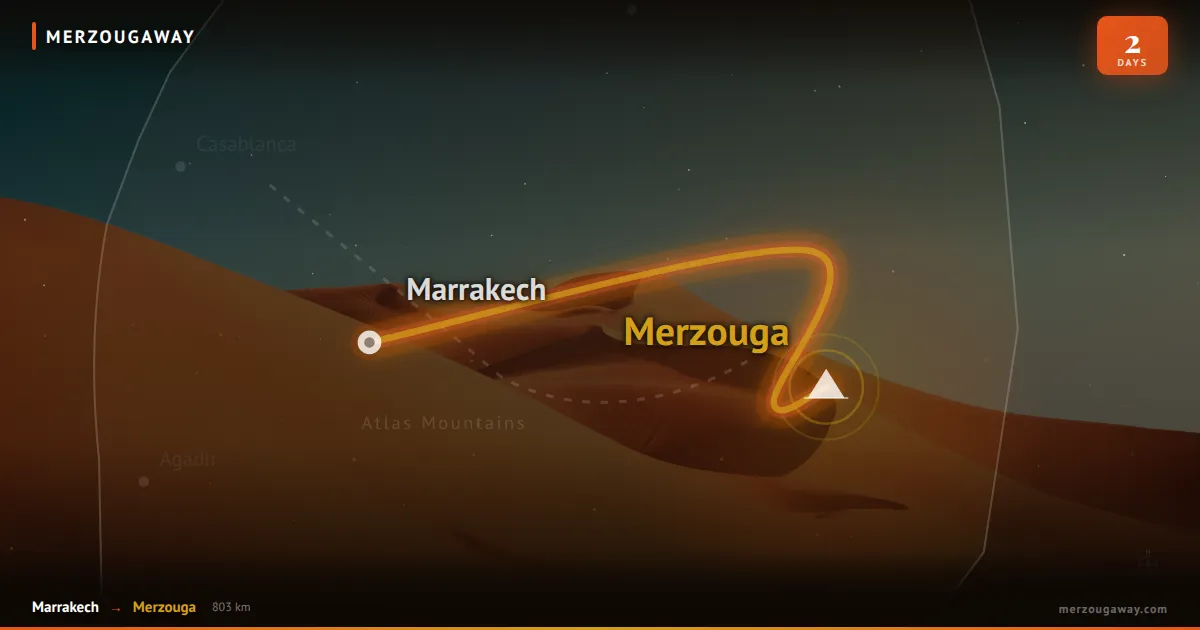
A desert journey from Marrakech to Merzouga spans ~560 km across the High Atlas Mountains (Tizi n'Tichka pass, 2,260m). The drive takes 9–10 hours, making a 3-Day or 4-Day tour the minimum recommended duration for safety and comfort.
- Recommended Duration: 3 Days (Classic) or 4 Days (Relaxed & In-Depth)
- Primary Road Routes: N9 across the Atlas ➔ N10 through Dadès Valley ➔ N13 to Erg Chebbi
- Realistic Pricing: 1,800–4,500 MAD (€180–€420) per person for private tours with luxury desert camp
- Key Highlights: Aït Benhaddou UNESCO ksar, Todra Gorge canyons, sunset camel trek, and Erg Chebbi dunes
- Local Expert Tip: Avoid 2-day Merzouga tours (18–20 hours driving in 48h). Opt for Agafay Desert if you only have 1–2 days.
The route, day by day
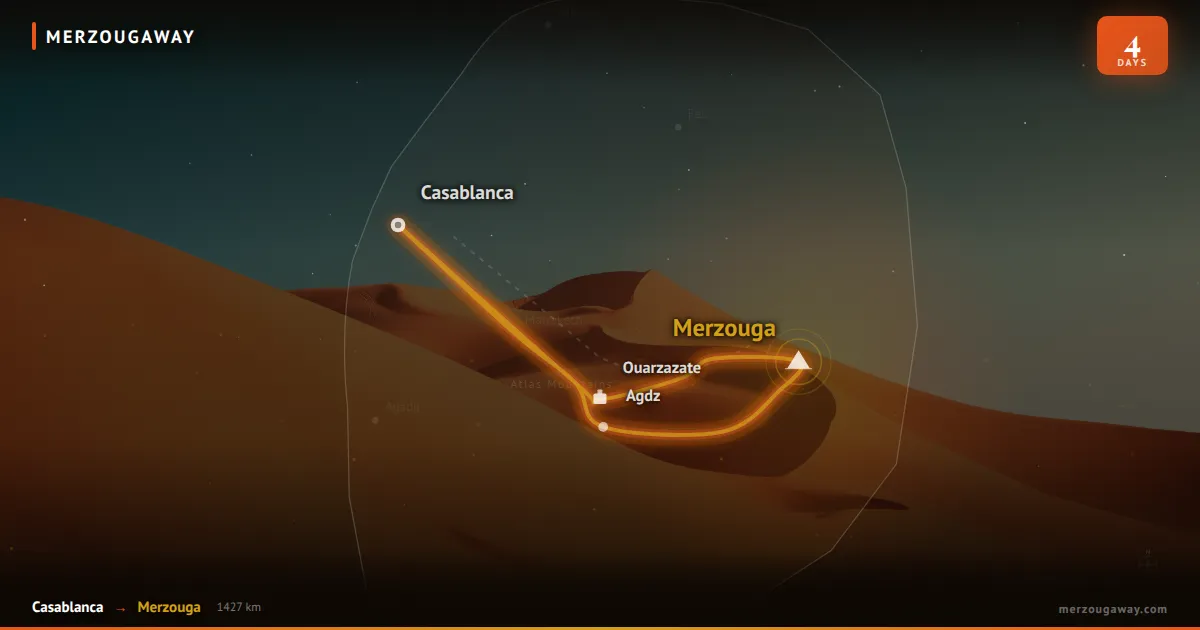
Day one is the familiar mountain crossing: Marrakech to Ouarzazate over the Tizi n'Tichka pass, with a stop at Ait Ben Haddou's UNESCO-listed kasbah along the way — roughly 200km and a full day given the stops. Day two continues east through the Dades Valley, Todgha Gorge, and the Ziz Valley oasis route into Merzouga, arriving in time for a sunset camel trek into Erg Chebbi and a Berber dinner at camp — this stretch is the longest driving day of the trip, around 260km but slower going given the terrain and stops.
Day three is a full day based at the desert camp with no driving — an optional sunrise trek, rest during the midday heat, and your choice of afternoon activity (quad biking, more camel trekking, or simply resting) before a second night under a sky with essentially no light pollution.
Day four turns north instead of retracing the route back to Marrakech: through Erfoud and Midelt into the Middle Atlas, arriving at Ifrane — a mountain town at over 1,600m elevation, built with a European-style architecture that's earned it the informal nickname "Switzerland of Morocco," and a genuinely different landscape from the desert you left that morning, complete with cedar forests. Day five is a short final push from Ifrane through more Middle Atlas forest scenery into Fes, arriving early enough to spend the afternoon in the medina.
Why go this way instead of looping back
The honest case for continuing to Fes rather than returning to Marrakech is variety: you get the High Atlas, the Sahara, the Middle Atlas cedar forests, and two genuinely different imperial cities — Marrakech's more modern, energetic medina against Fes's older, more labyrinthine one, said to be the world's largest car-free urban area — all without repeating any scenery on the way back. The tradeoff is logistics: you'll want to arrange your return flight from Fes (or continue on to Tangier/Casablanca) rather than from Marrakech, so this route suits travelers whose itinerary already has them ending in the north.
What it costs and what's included
Pricing scales mainly with vehicle and accommodation tier — a private 4x4 or minibus with a driver-guide, four nights of accommodation, all meals, the desert camp experience with two nights of camel trekking, and entrance fees to the main sites are the core of what a properly run private tour includes. Lunch is sometimes separate depending on the operator, and tips, travel insurance, and optional extras like quad biking are additional on top regardless of tier. Reversing the route (starting in Fes and ending in Marrakech) works exactly the same way if that suits your flights better.
When to go
October-November and March-April offer the most reliable combination of clear skies and comfortable temperatures across all three regions this route touches — the mountains, the desert, and the Middle Atlas. May through September brings real desert heat (regularly above 40°C), while December and early January can bring cold and occasional snow, especially around Ifrane and the High Atlas passes.
Getting ready
Pack layers rather than a single wardrobe for one climate — this trip moves through hot desert days, cold desert nights, and a genuinely cool mountain town in Ifrane, sometimes within the same 48 hours. Camel riding requires no particular fitness but causes mild soreness for most first-timers; walking throughout the trip is minimal and easy. Sunscreen and steady hydration matter throughout, not just in the desert stretch.
Why the One-Way Crossing Beats Round-Trip Backtracking
The Marrakech to Fes desert traverse is widely considered the ultimate overland road trip across Morocco. Rather than spending 10 hours backtracking over the same roads to return to Marrakech, this route connects Morocco's two most famous imperial cities via the Sahara.
+-------------------------+-----------------------------+-----------------------------+
| Feature / Metric        | 3-Day Round-Trip Marrakech  | 3-Day Marrakech to Fes      |
+-------------------------+-----------------------------+-----------------------------+
| Total Road Distance     | 1,120 km (Retraces N9/N10)  | 1,050 km (Cross-country)    |
| Day 3 Driving Hours     | 9.5 to 10.5 hours           | 7.5 to 8.5 hours            |
| Scenery Variety         | Retraces same mountain pass | High Atlas, Sahara dunes,   |
|                         | on return leg               | Ziz Gorge, Cedar Forests    |
| Departure & Arrival     | In/Out of Marrakech only    | Connects two imperial hubs  |
| Cultural Immersion      | Southern Berber kasbahs only| Southern Berber culture AND |
|                         |                             | Middle Atlas Amazigh towns  |
+-------------------------+-----------------------------+-----------------------------+
By choosing the one-way route, your third day becomes an engaging journey rather than a long drive back. You leave the red sands of Erg Chebbi and travel north through the dramatic limestone cliffs of the Ziz River canyon, crossing through Midelt for lunch, before winding through the high-altitude Middle Atlas cedar forests near Azrou and the alpine town of Ifrane, arriving in medieval Fes by evening.
Comprehensive Day-by-Day Expedition Itinerary
Below is the proven operational schedule for the 4-Day / 3-Night Marrakech to Fes crossing:
+-------+-------------------------+----------------------------------------------------+
| Day   | Route Segment           | Key Milestones & Daily Highlights                  |
+-------+-------------------------+----------------------------------------------------+
| Day 1 | Marrakech to            | Climb Tizi n'Tichka (2,260m), explore UNESCO       |
|       | Dades Valley (330 km)   | Ait Benhaddou, Ouarzazate film studios, overnight  |
|       |                         | in a scenic kasbah overlooking Dades Gorge.        |
+-------+-------------------------+----------------------------------------------------+
| Day 2 | Dades to Merzouga       | Walk under 300m limestone cliffs in Todra Gorge,   |
|       | Sahara (270 km)         | visit Erfoud fossil workshops, sunset camel trek,  |
|       |                         | luxury desert camp dinner & Berber drumming.       |
+-------+-------------------------+----------------------------------------------------+
| Day 3 | Full Erg Chebbi Safari  | 4x4 dune tour, live Gnawa music in Khamlia village,|
|       | & Nomad Immersion       | tea with nomadic family, sandboarding, second night|
|       |                         | under the desert stars.                            |
+-------+-------------------------+----------------------------------------------------+
| Day 4 | Merzouga to Fes         | Drive through the dramatic Ziz Gorge palm oasis,   |
|       | Medina (470 km)         | lunch in Midelt, see wild Barbary macaques in the  |
|       |                         | Azrou cedar forest, evening drop-off in Fes.       |
+-------+-------------------------+----------------------------------------------------+
Adding a dedicated second night in Merzouga (Day 3) transforms the experience from a rushed drive into a true Saharan exploration. It allows you to relax in the dunes during midday, take a 4x4 excursion to visit local nomad families, and enjoy an unhurried sunset camel ride without luggage in tow.
Packing Logistics for Cross-Climate Travel
Traveling from the low plains of Marrakech over the High Atlas, across the Sahara desert, and through the Middle Atlas to Fes means experiencing four distinct climate zones in a few days:
- Marrakech Plains: Warm, dry, and sunny (20°C to 28°C).
- High Atlas Pass (Tizi n'Tichka): Crisp mountain air with sudden winds and possible winter snow (0°C to 12°C).
- Erg Chebbi Dunes: Intense daytime sunshine shifting to freezing desert nights (0°C to 24°C).
- Middle Atlas Cedar Forest (Azrou/Ifrane): Cool, shaded alpine climate (5°C to 15°C).
Pack adaptable layers: a breathable base layer, a mid-weight fleece or sweater, and a windproof, warm outer jacket. You will likely wear your outer layers during the early morning camel trek and the Middle Atlas drive, while staying in light linen shirts during sunny afternoon stops.
The Middle Atlas Crossing: Ziz Gorge, Midelt, and Azrou Forests
The drive between Merzouga and Fes (Day 4 of the grand crossing) passes through remarkable geological landscapes:
+-----------------------+-----------------------------+---------------------------------+
| Highway Leg (N13)     | Landscape Highlights        | Driving Time & Stop Guidance    |
+-----------------------+-----------------------------+---------------------------------+
| Merzouga to Erfoud    | Flat desert plains, fossil  | 45 mins; visit authentic fossil |
| & Errachidia          | quarries, Ziz River valley  | workshops in Erfoud             |
+-----------------------+-----------------------------+---------------------------------+
| Ziz Gorge to Midelt   | High limestone canyon, the  | 2.5 hrs; stop at Tunnel of the  |
|                       | Legionnaire Tunnel, cliffs  | Legionnaire (*Foum Zabel*)      |
+-----------------------+-----------------------------+---------------------------------+
| Midelt over Col du    | Barren apple-growing valley,| 1.5 hrs; apple orchards, clean  |
| Zad (2,178m) to Azrou | high mountain plateau       | mountain air, roadside lunch    |
+-----------------------+-----------------------------+---------------------------------+
| Azrou Cedar Forest    | Ancient Atlas cedar trees,  | 1.0 hr; walk through forest,    |
| to Ifrane & Fes       | wild Barbary macaques       | visit alpine-style Ifrane       |
+-----------------------+-----------------------------+---------------------------------+
A key engineering marvel along the N13 is the Tunnel du Légionnaire (Foum Zabel), carved by French Foreign Legion engineers in 1928 through solid granite cliff faces to open road transit between the northern valleys and the Tafilalet desert. Exiting the northern mouth of the tunnel reveals dramatic views across the palm-filled Ziz oasis canyon.
Further north in the cedar forests of Azrou, you will encounter troops of endangered Barbary macaques (Macaca sylvanus), the only wild macaque species living outside of Asia. Travelers are welcome to observe and photograph these animals, but we urge visitors not to feed them processed snacks, which disrupt their natural foraging patterns.
Seamless Drop-off Logistics in Medieval Fes
Fes el-Bali is the world's largest contiguous car-free urban zone, containing over 9,000 narrow, winding lanes:
- Vehicle Access Limits: Vehicles cannot drive inside the medina walls. Your MerzougaWay driver drops you at the closest accessible medina gate (Bab) nearest your riad—most commonly Bab Boujeloud (The Blue Gate), Bab Rcif, or Place Batha.
- Riad Greeting & Baggage Handlers: We coordinate directly with your riad reception. A riad staff member or licensed luggage porter (koussa) meets your vehicle at the gate with a wheeled handcart to transport your luggage through the stone alleys directly to your riad door.
Hidden Stops Along the Desert Crossing
Beyond the marquee highlights of Ait Benhaddou and Erg Chebbi, several lesser-known cultural waypoints make the Marrakech to Fes traverse uniquely rewarding:
- Kasbah Amridil in Skoura: A stunning 17th-century fortified mud-brick compound nestled within a lush 25-square-kilometer palm grove. It famously appeared on the old 50 Dirham banknote and offers an exceptional museum of historic Berber agricultural tools, bread ovens, and olive oil presses.
- The Rose Valley Distilleries (Kelaat M'gouna): Renowned for Rosa damascena (Damask rose). In spring, fields of fragrant pink roses bloom along the riverbanks, where women's cooperatives distill pure organic rose water and essential oils.
- The Underground Khettara Canals in Jorf: Ancient subterranean aqueducts built centuries ago by Berber engineers to transport water from the Atlas mountains across arid desert plains without evaporation. Travelers can descend into the cool underground channels via stone stairs.
Scenic Rest and Coffee Stops on Highway N13
Covering the 470 kilometers between Merzouga and Fes offers several memorable rest stops:
- Midelt (The Apple Capital): Located on the high plateau between the Middle and High Atlas ranges, Midelt is famous for its crisp mountain apples and roadside restaurants serving roasted lamb brochettes and hot harira soup.
- Timahdite Valley: Rolling high-altitude pastures where indigenous Berber shepherds graze prized Timahdite sheep, with panoramic views of ancient volcanic cinder cones.
- Ifrane (The Alpine Oasis): Often referred to as "Little Switzerland," Ifrane sits at 1,665 meters altitude with red-roofed chalets, manicured gardens, and snowfall during winter months, offering a European architectural contrast along the route.
Balancing Stargazing and Early Sunrises in the Dunes
One of the great pleasures of an overnight in Erg Chebbi is stargazing beneath pristine dark skies. However, balancing evening stargazing with the pre-dawn camel ride requires smart scheduling:
+-----------------------+-----------------------------+---------------------------------+
| Activity Phase        | Recommended Timing          | Experience Highlights           |
+-----------------------+-----------------------------+---------------------------------+
| Fireside Drumming     | 20:30 to 22:00              | Live Gnawa rhythms, hot mint tea|
+-----------------------+-----------------------------+---------------------------------+
| Midnight Stargazing   | 22:30 to 23:30              | Dark Sky observation, Milky Way |
|                       |                             | astrophotography away from camp |
+-----------------------+-----------------------------+---------------------------------+
| Rest & Sleep          | 23:45 to 06:15              | Rest inside heated canvas suite |
+-----------------------+-----------------------------+---------------------------------+
| Dawn Sunrise Trek     | 06:30 to 07:30              | Climb the eastern dune ridge for|
|                       |                             | the first golden rays of dawn   |
+-----------------------+-----------------------------+---------------------------------+
Getting enough rest ensures you have plenty of energy for the scenic Middle Atlas drive to Fes the following morning.
Recommended Souvenirs on Highway N13
Unique artisan keepsakes to look for while crossing between Merzouga and Fes:
- Hand-Carved Cedar Woodwork from Azrou: Fragrant natural cedar boxes, chessboards, and bowls carved by local mountain craftsmen.
- Natural Mineral Fossils from Erfoud: Authentic orthoceras and goniatite specimens polished into coasters and ornamental bookends.
Frequently Asked Questions (FAQ)
How many days are needed for the Marrakech to Fes desert tour?
A 3-Day / 2-Night tour is the classic minimum, while a 4-Day / 3-Night itinerary offers the ideal, relaxed pace with extra time to explore the Dadès Valley and Ziz Canyon.
Is it better to travel from Marrakech to Fes or from Fes to Marrakech?
Both directions cover identical highlights. Starting in Marrakech is slightly more theatrical, crossing the High Atlas first and concluding in the medieval sanctuary of Fes medina.
Can the tour drop us off directly at our riad in Fes?
Yes. Your driver will coordinate with your Fes riad and meet luggage porters at the closest accessible gate of the car-free medina (such as Bab Bou Jeloud or Bab Ziat).
Planning what to do on either end of the route as well as the desert stretch in between? See our guides to things to do in Marrakech, things to do in Fes, and things to do in Merzouga.
Ready to plan your own Marrakech-to-Fes route through the Sahara?
WhatsApp: +212675203319 Email: hello@merzougaway.com
Last updated: August 2026.
Sahara Route & Drive-Time Estimator
Calculate realistic driving hours across the High Atlas (Tizi n'Tichka pass), compare scenic stops (Dadès, Todra, Ziz), and plan your custom desert itinerary.

MerzougaWay Team
We are a passionate team of local guides dedicated to sharing the beauty and culture of our home, Morocco. Our journey began with a simple desire to offer authentic, memorable experiences that go beyond the typical tourist trails.