Marrakech to Merzouga by Car: Complete Road Trip Guide 2026
What driving yourself from Marrakech to Merzouga actually involves — the real distance and timing, the Tizi n'Tichka pass, road conditions, and why most visitors end up choosing a private driver instead.
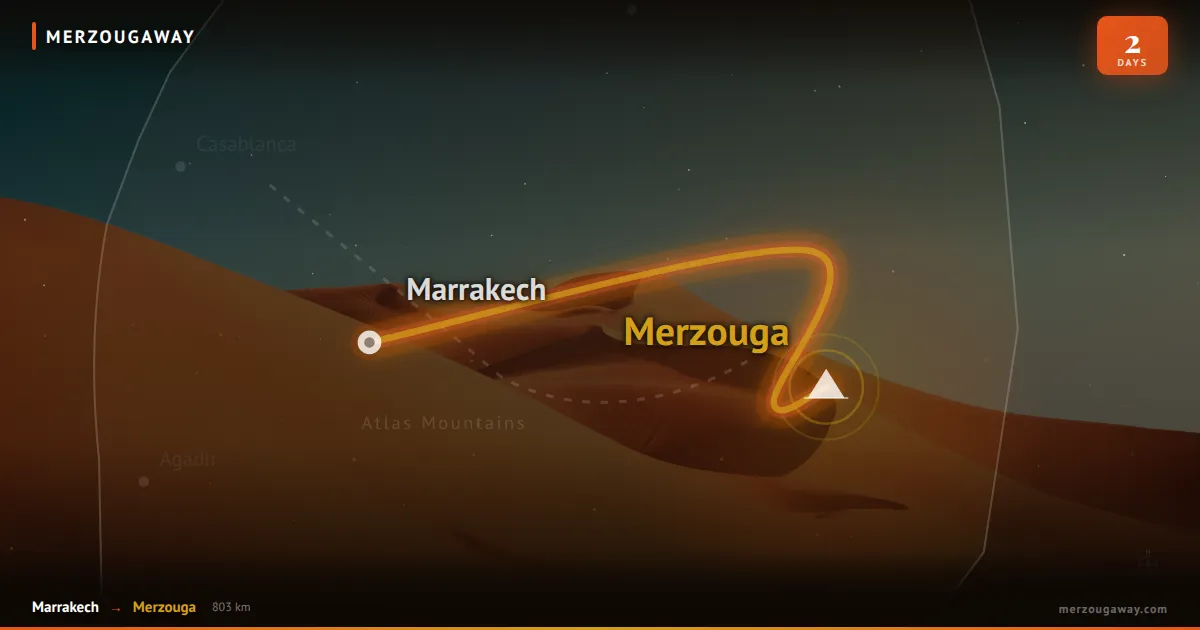
Driving yourself from Marrakech to Merzouga is a genuinely good way to see southern Morocco at your own pace, but it's worth being honest about the scale of it upfront: this is a ~560km, 9-10 hour one-way drive over the High Atlas, not a quick afternoon trip. Almost nobody does it in a single push — the standard, sensible way to cover this route is over two days, breaking the drive with an overnight around Ouarzazate or the Dades Valley before continuing on to the dunes.
[!NOTE] Fast-Facts & Direct Answer Summary
A desert journey from Marrakech to Merzouga spans ~560 km across the High Atlas Mountains (Tizi n'Tichka pass, 2,260m). The drive takes 9–10 hours, making a 3-Day or 4-Day tour the minimum recommended duration for safety and comfort.
- Recommended Duration: 3 Days (Classic) or 4 Days (Relaxed & In-Depth)
- Primary Road Routes: N9 across the Atlas ➔ N10 through Dadès Valley ➔ N13 to Erg Chebbi
- Realistic Pricing: 1,800–4,500 MAD (€180–€420) per person for private tours with luxury desert camp
- Key Highlights: Aït Benhaddou UNESCO ksar, Todra Gorge canyons, sunset camel trek, and Erg Chebbi dunes
- Local Expert Tip: Avoid 2-day Merzouga tours (18–20 hours driving in 48h). Opt for Agafay Desert if you only have 1–2 days.
The route itself
Heading south out of Marrakech, the road climbs into the High Atlas via the Tizi n'Tichka pass — at roughly 2,260 meters it's the highest point on the whole route, a genuinely dramatic stretch of switchbacks and mountain views that's worth taking slowly rather than rushing. Ait Ben Haddou, the UNESCO-listed fortified kasbah familiar from a number of film productions, sits just beyond the pass and is worth an hour or two of exploring. From there the road continues to Ouarzazate — Morocco's film-industry hub, with a couple of real studio complexes worth a stop if you have time — and then on toward the Dades Valley or Todgha Gorge country, where most self-drivers choose to spend the first night.
The second day covers the remaining stretch through Erfoud and Rissani before the dunes of Erg Chebbi come into view. Erfoud is a reasonable lunch stop and the last town with reliable fuel and services before Merzouga itself, so it's worth filling the tank there rather than pushing on and hoping.
What the driving actually feels like
The road surface for most of the route is well-maintained asphalt, but the Tizi n'Tichka crossing is genuinely demanding: dozens of hairpin turns, occasional truck traffic, and — in winter (December through February) — a real chance of snow or ice near the summit, which is the one time of year self-driving this route deserves real caution. Outside winter, the main things to manage are fatigue on a long mountain drive and the temptation to push through in one day rather than breaking it up. A standard sedan handles the great majority of the route fine; a 4x4 only really earns its keep for the last stretch into the dunes themselves, where sand can drift across the road.
Fuel stations thin out considerably past Erfoud, so top up whenever you pass through a larger town — Ouarzazate and Erfoud are the two reliable stops. Cash is worth carrying, since smaller towns and fuel stations don't always take cards. An international driving permit is required for most non-Moroccan licenses, and comprehensive rental insurance (including cover for the mountain sections) is worth confirming before you leave the rental office, not after.
Renting a car
International chains (Hertz, Europcar, Avis, and similar) operate out of Marrakech's airport and city center alongside a large number of local agencies, which are often meaningfully cheaper for the same class of vehicle — expect roughly 250-400 MAD/day for an economy car through a local agency, more for a 4x4 or through an international chain, especially if you're willing to negotiate for a multi-day rental. On top of the rental itself, budget for fuel: as of mid-2026 gasoline has sat roughly 13-14 MAD per liter, so a standard sedan covering the ~560km one-way at 7-8 L/100km burns through around 550-650 MAD in fuel each way. Whichever you choose, checking insurance coverage carefully matters more on this route than on a typical city rental, given the mountain driving involved — ask specifically whether the policy covers the unsurfaced stretches near Merzouga if you'll be driving beyond the paved road.
Why most visitors don't self-drive this one
Given the pass, the distance, and the unfamiliar road signage and driving norms, a real share of visitors who consider self-driving end up booking a private driver instead — same route, same stops, but someone who already knows the pass, the fuel stops, and the timing, while you actually look at the scenery instead of watching the road. If that sounds like a better trade than we've described here, that's exactly what we run: a private driver-guide covering this same Marrakech-to-Merzouga route over 2-4 days, with the desert camp and camel trek built in at the end rather than left for you to arrange separately.
Ready to see the route without doing the driving yourself?
- WhatsApp: +212675203319 / +212668534981
- Email: hello@merzougaway.com
Or book the 3-Day Marrakech to Merzouga Sahara Desert Tour directly.
Last updated: August 2026.
Comprehensive Road Conditions and Highway Safety Matrix
Self-driving the 560-kilometer route from Marrakech across the High Atlas mountains to the golden dunes of Merzouga is one of North Africa's premier road trips. Traversing four distinct geographical regions—the agricultural Haouz plain, the alpine switchbacks of the High Atlas, the arid "Valley of a Thousand Kasbahs," and the pre-Saharan desert plateaus—the route requires vigilant driving habits, mechanical awareness, and realistic pacing.
The following master infrastructure matrix breaks down road quality, terrain challenges, and service frequency across every highway sector:
| Highway Sector & Route | Distance & Drive Time | Asphalt Quality & Lane Profile | Mountain Terrain Hazard Level | Fuel & Mechanic Service Density | Key Navigational Landmark | | :--- | :--- | :--- | :--- | :--- | :--- | | Marrakech to Taddert (N9 North Climb) | 85 km / 1.75 hrs | Modern divided asphalt; wide paved shoulders | Low to Moderate; heavy agricultural & moped traffic | Plentiful; major stations (Afriquia, Total) every 15 km | Ait Ourir & Toufliht police checkpoints | | Taddert to Tizi n'Tichka Summit (N9 Summit) | 35 km / 1.25 hrs | Modern widened 2-to-3 lane mountain pass (2,260m) | High; tight blind curves, heavy freight trucks, winter ice | Sparse; local tire repair (vulcanisateurs) in villages | Historic French colonial marker at pass summit | | Tizi n'Tichka to Ouarzazate (N9 South Descent) | 80 km / 1.5 hrs | Smooth, wide 2-lane asphalt; gradual descent | Moderate; watch brake overheating on long grades | Good; stations at Amerzgane and Ouarzazate entry | Detour junction for Ksar Ait Benhaddou | | Ouarzazate to Tinghir / Todra (N10 Highway) | 170 km / 2.5 hrs | Flat, fast 2-lane national highway; long straightaways | Low; crosswinds, school children crossing in villages | Excellent; modern highway service plazas every 30 km | Skoura palm grove & Valley of the Roses | | Tinghir to Erfoud via Tinjdad (N10 & R702) | 145 km / 2.0 hrs | Smooth asphalt; flat desert terrain | Low; sudden sand drifts blown across road by wind | Plentiful in major oasis towns; sparse on open plains | Prehistoric fossil quarries and marble ateliers | | Erfoud to Merzouga Dunes (N13 Highway) | 55 km / 45 mins | Paved 2-lane road terminating at desert village | Low to Moderate; stray dromedary camels crossing | Plentiful in Rissani and Merzouga village | The western dune wall of Erg Chebbi |
Self-Drive Rental Car Insurance and Contract Realities
When renting a vehicle in Marrakech for a desert expedition, scrutinizing your rental agreement protects you against unexpected liability:
- Collision Damage Waiver (CDW) vs Super CDW: Standard baseline rental rates in Morocco include mandatory third-party liability insurance (Responsabilité Civile), but carry a high theft and collision deductible (franchise) typically ranging from 10,000 to 20,000 MAD (~$1,000 to $2,000 USD) held as a pre-authorization hold on your credit card. Opting for Super CDW (Zero Excess) coverage reduces your financial deductible to zero, providing total peace of mind when driving on gravel shoulders.
- Tire and Undercarriage Exclusions: Standard rental insurance policies in Morocco explicitly exclude damage to tires, wheels, and the vehicle undercarriage caused by potholes or rough gravel roads. Inspect the tires before accepting the car—confirming adequate tread depth and the presence of an inflated spare wheel and jack in the trunk.
- International Driving Permit (IDP) Requirements: Morocco legally accepts national driver's licenses issued by EU nations, the UK, the United States, Canada, and Australia, provided the license is printed in the Latin alphabet. However, carrying an International Driving Permit (IDP) alongside your domestic license is strongly recommended to prevent confusion at rural Royal Gendarmerie checkpoints.
Mountain Switchbacks and Brake Management on Tizi n'Tichka
Traversing the Tizi n'Tichka Pass (2,260 meters / 7,415 feet) is the most demanding technical sector of the drive:
- Engine Braking on Steep Descents: When descending from the summit toward Ouarzazate, avoid riding your vehicle's brakes continuously. Continuous light friction boils hydraulic brake fluid, causing catastrophic brake fade. Shift down into 2nd or 3rd gear on manual transmissions (or shift into low/manual mode on an automatic gearbox) to let engine compression control vehicle speed safely around switchbacks.
- Overtaking Heavy Commercial Trucks: Heavily loaded vegetable and phosphate trucks grind up the mountain at 15 to 25 km/h. Exercise supreme patience. Never overtake across double solid white lines or on blind corners. Wait for designated uphill passing lanes or until the truck driver signals with his right turn indicator that the road ahead is clear.
Highway Police Radar Traps and Checkpoint Protocol
Understanding how Moroccan traffic enforcement operates along Highways N9 and N10 prevents costly citations and delays:
- Speed Limit Enforcement: Moroccan highway authorities utilize precision handheld laser speed guns and automated radar camera gantries. Speed limits are strictly 60 km/h upon entering any village or municipal boundary, 80 to 100 km/h on open rural two-lane highways, and 120 km/h on motorways. Speed limits drop abruptly when approaching towns; watch for red circular speed reduction signs (80 ➔ 60) and brake immediately. Exceeding the speed limit by even 6 km/h will result in being waved over by Royal Gendarmerie officers.
- Official Fines and Payment: Standard speeding infractions incur official fines ranging from 150 MAD to 400 MAD (~$15 to $40 USD). You must pay the fine immediately in cash to the officer, who is legally required to issue an official signed, numbered carbon-copy receipt (Quittance de Paiement). Never attempt to bribe an officer; bribery is a serious criminal offense in Morocco.
- Mandatory Complete Stop at Checkpoints: Whenever you see a red-and-white sign marked "Halte Police" or "Halte Gendarmerie", you must bring your car to a complete dead stop at the white line, even if the road appears deserted. Wait until the officer gestures with his hand or speaks before rolling forward. Greet the officer courteously with "Salam Alaykum" or "Bonjour", and have your driving license, rental agreement, and passport ready.
Night Driving Hazards: Why You Must Never Drive After Dark
Seasoned desert tour operators adhere to one golden rule: never drive outside major towns after sunset:
- Unlit Rural Traffic: Hundreds of rural mopeds, agricultural tractors, and donkey carts travel along unpaved highway shoulders without operational headlights, taillights, or reflective tape, rendering them completely invisible until your headlights illuminate them from 15 meters away.
- Free-Roaming Camels: In the pre-Saharan desert sectors between Tinjdad, Erfoud, and Merzouga, herds of dromedary camels wander freely across the asphalt. Because camel fur absorbs light and their tall legs elevate their heavy bodies directly at windshield height, colliding with a camel at highway speeds causes devastating passenger cabin intrusion.
- Pedestrians on Shoulders: Villagers and school children wearing dark wool djellabas walk along unlit highway shoulders at dusk. Plan your driving schedule so that you arrive at your intermediate hotel or desert camp at least one hour before sunset.
Essential Breakdown and Emergency Contacts in Morocco
Preparing for rare roadside incidents during an independent self-drive trip ensures rapid resolution:
- Emergency Breakdown Assistance: In the event of a mechanical failure or tire blowout on an open national highway, dial 177 to reach the Royal Gendarmerie highway patrol, who will dispatch a licensed flatbed tow truck (Dépannage) from the nearest town. In urban areas, dial 19 for national police assistance.
- Rental Car Emergency Protocol: Contact your car rental company's 24/7 roadside assistance hotline immediately before allowing any third-party mechanic to conduct major engine repairs. Take clear photos of any roadside damage, potholes, or obstacles, and request a detailed receipt for any replacement parts or tire patches.
- Carrying Cash for Emergencies: Always carry a dedicated emergency cash reserve of at least 1,000 to 1,500 MAD in physical banknotes separate from your daily wallet. Rural tow truck operators and village mechanics rarely possess mobile credit card terminals, and cash ensures immediate, friendly service anywhere in the pre-Sahara.
Frequently Asked Questions (FAQ)
Is the drive from Marrakech to Merzouga fully paved?
Yes, the entire 560 km route follows paved national highways: N9 over the High Atlas Tizi n'Tichka pass, N10 through Ouarzazate, Kelaat M'gouna, and Tinghir, and N13 south through Erfoud and Rissani to Merzouga. Roads are suitable for standard 2WD rental cars.
How many hours does it take to drive from Marrakech to Merzouga without stopping?
Pure driving time without stops is approximately 8.5 to 9.5 hours. However, with mountain switchbacks, scenic photo stops at Aït Benhaddou, lunch, and fuel breaks, the journey realistically takes 11 to 12 hours if attempted in a single day—which is why breaking the trip overnight in Dades Valley is strongly recommended.
Are there gas stations along the route from Marrakech to Merzouga?
Yes, major international fuel brands (Afriquia, Shell, TotalEnergies, Winxo) operate frequently along Highway N9 and N10 in towns like Ait Ourir, Ouarzazate, Skoura, Boumalne Dades, Tinghir, and Erfoud. Always fill your tank before leaving Tinghir or Erfoud.
Are police checkpoints common on the Marrakech to Merzouga drive?
Yes, Royal Gendarmerie checkpoints are frequent, especially near town entrances, roundabouts, and mountain passes. Always come to a complete stop at the "Halte Police / Gendarmerie" sign and wait for the officer to wave you forward. Keep your passport, rental contract, and international driving permit accessible.
What is the speed limit between Marrakech and Merzouga?
Speed limits are strictly enforced with mobile laser radar guns: 60 km/h inside urban towns, 80 km/h or 100 km/h on open national highways, and 40–60 km/h on sharp mountain pass turns. Fines for speeding start at 150 to 300 MAD payable on the spot.
Sahara Route & Drive-Time Estimator
Calculate realistic driving hours across the High Atlas (Tizi n'Tichka pass), compare scenic stops (Dadès, Todra, Ziz), and plan your custom desert itinerary.
MerzougaWay Team
We are a passionate team of local guides dedicated to sharing the beauty and culture of our home, Morocco. Our journey began with a simple desire to offer authentic, memorable experiences that go beyond the typical tourist trails.