Marrakech to Merzouga Morocco: Journey Through Authentic Desert Morocco
What the Marrakech-to-Merzouga route actually teaches you about Morocco — Berber heritage, Islamic daily life, hospitality customs, and how to travel it respectfully rather than as a checklist.
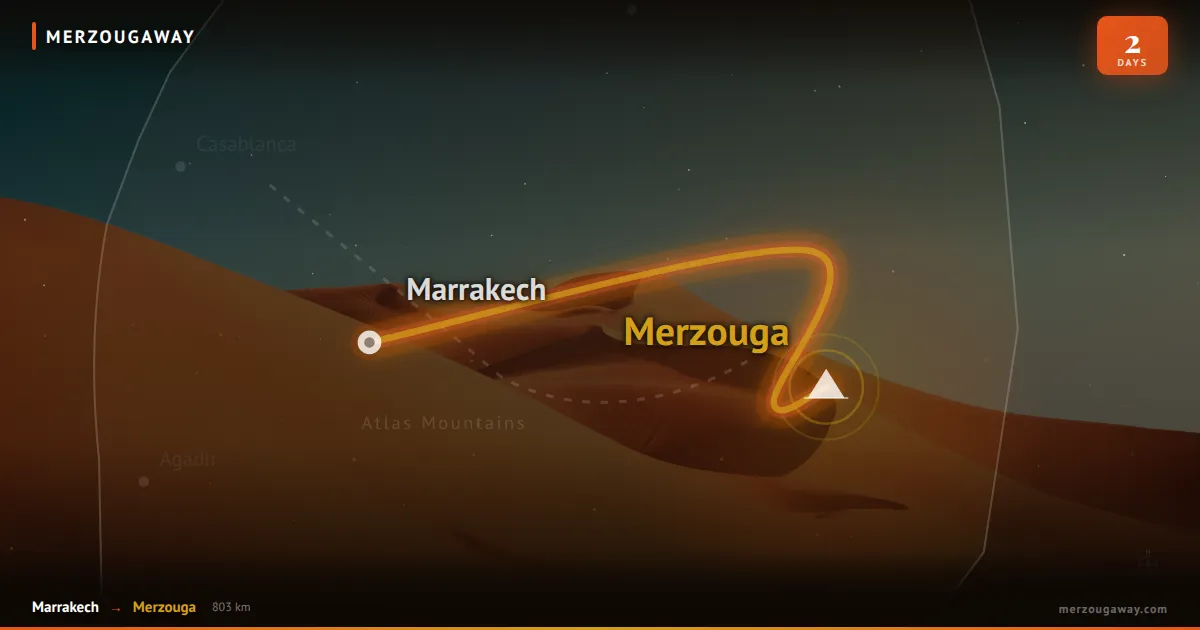
The 560 km route from Marrakech to Merzouga compresses more of Morocco's geographic and cultural range than almost any other single trip in the country — imperial city, High Atlas mountains, kasbah valleys, and Sahara dunes, each with its own layer of Berber and Islamic history behind it. It's worth understanding some of that context before you go, since it changes what you actually notice along the way.
[!NOTE] Fast-Facts & Direct Answer Summary
A desert journey from Marrakech to Merzouga spans ~560 km across the High Atlas Mountains (Tizi n'Tichka pass, 2,260m). The drive takes 9–10 hours, making a 3-Day or 4-Day tour the minimum recommended duration for safety and comfort.
- Recommended Duration: 3 Days (Classic) or 4 Days (Relaxed & In-Depth)
- Primary Road Routes: N9 across the Atlas ➔ N10 through Dadès Valley ➔ N13 to Erg Chebbi
- Realistic Pricing: 1,800–4,500 MAD (€180–€420) per person for private tours with luxury desert camp
- Key Highlights: Aït Benhaddou UNESCO ksar, Todra Gorge canyons, sunset camel trek, and Erg Chebbi dunes
- Local Expert Tip: Avoid 2-day Merzouga tours (18–20 hours driving in 48h). Opt for Agafay Desert if you only have 1–2 days.
Marrakech as a starting point
Marrakech was one of Morocco's historic imperial capitals, and its medina is a UNESCO World Heritage site in its own right — a dense maze of souks, riads, and mosques that most visitors' first real taste of Morocco comes from. Jemaa el-Fna, the main square, is worth seeing but worth seeing clearly: it's genuinely lively, but it's also the most tourist-oriented single square in the country, closer to a performance of "traditional Morocco" than an unfiltered slice of daily life. The souks around it are more real — spice, leather, and textile markets where locals still shop alongside tourists, haggling as the normal way business gets done rather than a tourist trap. What Marrakech does teach honestly about Morocco, though: that Islam is woven into daily rhythm rather than separate from it, that hospitality (tea offered freely, guests treated generously) is a genuine cultural value rather than a performance, and that tradition and modern life sit next to each other without much friction — a call to prayer and a WiFi password in the same riad courtyard.
Crossing the Atlas
The drive out of Marrakech climbs quickly into Berber mountain territory, reaching its highest point at the Tizi n'Tichka pass, just over 2,260m. This was a real trade route long before it was a tourist road — the pass historically controlled movement between the Marrakech plain and the south, and the Berber villages you pass are still functioning agricultural communities, not attractions built for visitors. Ait Ben Haddou, the fortified earthen kasbah partway down the far side, is the best-known stop on this stretch and for good reason: it's centuries old, still partly inhabited by Berber families, and a genuinely striking piece of vernacular architecture — thick mud-brick walls and small windows that make practical sense once you feel how hot the valley gets in summer. It's also been used as a filming location more times than almost anywhere else in Morocco, which is part of why it's so recognizable even to people who've never been.
The valleys and the edge of the desert
Past Ouarzazate, the road runs through the Dades and Todgha valleys — red-rock canyon country, kasbah architecture continuing, and Berber villages built around shared water sources and (further out) traditional multi-family compounds. Further east, Erfoud and Rissani mark the edge of the Sahara proper; both were historically caravan towns on the trans-Saharan trade routes that carried salt, gold, and other goods between West Africa and the Mediterranean for centuries. It's a useful thing to know before you get to Merzouga: the desert wasn't ever really isolated from the rest of the world — it was a connection point, and that history is part of what makes the small towns along this stretch feel different from purely touristic desert-adjacent settlements elsewhere.
Berber culture along the route
Berbers (increasingly referred to by the endonym Amazigh) are the indigenous people of Morocco and North Africa more broadly, predating the Arab presence that began in the 7th century. Exactly what share of Morocco's population identifies as ethnically Amazigh is genuinely contested and depends heavily on how you measure it — self-identification surveys and ethnic-ancestry estimates produce very different numbers — so treat any single percentage you read, including this one, with some skepticism. What's not in dispute is that Tamazight, the Berber language, became an official language of Morocco in the 2011 constitution, and that it's still actively spoken, especially in mountain and desert communities, alongside Arabic, French, and increasingly English among younger guides.
Along the route you'll likely encounter Berber hospitality directly — tea offered as a matter of course, which is genuinely rude to refuse outright; family-run kasbahs and guesthouses; and guides who are often themselves from Berber mountain or desert families and can explain customs firsthand rather than performing them. A few things are worth keeping in mind to travel this respectfully: ask before photographing people, dress modestly (covered shoulders and legs), accept tea when it's offered, and resist the urge to haggle hard over genuinely small amounts of money — it reads as disrespectful rather than savvy when the sums involved are trivial to you and meaningful to the person you're bargaining with.
Islam in daily life
You'll notice the five daily calls to prayer throughout the trip, some shops closing briefly around prayer times, and — if you're traveling during Ramadan — significantly altered daily rhythms, with restaurants closed during daylight hours and lively, social evening meals after sunset. Mosque architecture along the route (geometric zellige tilework, calligraphy, no figurative imagery) reflects a sophisticated visual tradition rather than a simple backdrop, and non-Muslims are generally not permitted inside working mosques — appreciate the architecture from outside and ask your guide before assuming otherwise.
A night in the desert
The Sahara portion of the trip — a night in a Berber-style tent camp near Merzouga — is where the cultural and physical journey both land at once. Camps are simple by design: shared or private bathroom depending on tier, a central dining and fire area, and evenings built around a camel trek at sunset, a shared meal, and Berber music. It's genuinely one of the more community-oriented, low-tech nights most travelers will have on a Morocco trip, and that's the point rather than an inconvenience — modern comforts recede and what's actually essential (food, warmth, company, a clear sky) becomes obvious in a way it doesn't in a city hotel.
What hospitality actually means here
Moroccan hospitality has a name — diafa — and it's a real cultural obligation rather than a marketing phrase: guests are treated generously, refusing hospitality outright is genuinely impolite, and sharing food is understood as a way of creating a bond rather than just eating. You'll likely experience this directly through free tea, guides who go beyond what's strictly required, and a general warmth that isn't performative even where tourism is the local economic backbone.
Food along the way
Expect tagines (slow-cooked stews, often lamb, chicken, or vegetable), couscous, fresh bread with nearly every meal, olives, and mint tea throughout — plus harira, a hearty chickpea-and-lentil soup that's especially common in the evenings and during Ramadan. Cooking here tends to be slow and communal rather than rushed, and meals are treated as a social occasion, not just refueling — worth slowing down for rather than treating as a pit stop.
Preparing before you go
A few Tamazight or Arabic phrases go a long way and are genuinely appreciated: "Azul" (hello, Tamazight) or "Salam alaikum" (peace be upon you, Arabic greeting), and "Shukran" (thank you). Beyond that, the most useful preparation is simply reading a bit about Berber history and Morocco's religious and social customs before you arrive, rather than relying on any single book or documentary — there's a wide range of decent, up-to-date material available, and it's worth checking recent reviews rather than taking an old recommendation at face value.
Traveling it well
The honest takeaway from this route is that Morocco's south isn't a backdrop for a tourist itinerary — it's a set of living communities balancing real economic need for tourism against a genuine desire to keep their culture intact on their own terms. Traveling it well means tipping guides fairly (tourism income genuinely matters to the families behind it), buying crafts from the people who actually make them rather than middlemen where you can, and approaching the trip with curiosity rather than treating any part of it as a photo opportunity dressed up as culture.
We run this route as a private, small-group tour with local guides, most often over 3-4 days — long enough to actually take in what's along the way rather than rushing between photo stops.
- WhatsApp: +212675203319 / +212668534981
- Email: hello@merzougaway.com
Last updated: August 2026.
🥁 Indigenous Berber Musical Traditions: Ahidous vs Gnawa Spiritual Trance
The journey from Marrakech to Erg Chebbi crosses distinct cultural and linguistic zones, where musical heritage reflects ancient trans-Saharan migrations and high-altitude mountain life:
┌─────────────────────────────────────────────────────────────────────────────────────────────┐
│                    SOUTHERN MOROCCAN MUSICAL TRADITIONS COMPARISON                          │
├─────────────────────┬──────────────────────────┬──────────────────┬─────────────────────────┤
│ MUSICAL TRADITION   │ CULTURAL ORIGINS         │ INSTRUMENTS USED │ WHERE TO EXPERIENCE     │
├─────────────────────┼──────────────────────────┼──────────────────┼─────────────────────────┤
│ Ahidous             │ Indigenous Amazigh       │ *Allun* (large   │ Middle Atlas & Dades    │
│ (Berber Circle)     │ (Chleuh & Tamazight)     │ circular frame   │ Valley village festivals│
│                     │ mountain communities     │ wooden drum)     │ & desert campfires      │
├─────────────────────┼──────────────────────────┼──────────────────┼─────────────────────────┤
│ Gnawa Spiritual     │ Trans-Saharan diaspora   │ *Gimbri* (3-str  │ Khamlia village near    │
│ Trance Music        │ (Sub-Saharan ancestors   │ bass lute) &     │ Merzouga; Dar Gnaoua    │
│                     │ from Mali & Sudan)       │ *Qraqeb* (iron)  │ in Marrakech medina     │
├─────────────────────┼──────────────────────────┼──────────────────┼─────────────────────────┤
│ Ahwash              │ High Atlas & Anti-Atlas  │ *Ganga* (bass    │ Ouarzazate, Telouet &   │
│ (Polyrhythmic Folk) │ Shilha communities       │ drum), flute,    │ Souss Valley harvest    │
│                     │ (Ait Atta confederation) │ bronze cymbals   │ celebrations            │
└─────────────────────┴──────────────────────────┴──────────────────┴─────────────────────────┘
The Living Soul of Khamlia Village
- History of the "Black Village": Located 7 kilometers south of Merzouga along the edge of the dunes, Khamlia is inhabited by approximately 400 residents whose ancestors were brought across the Sahara via trans-Saharan salt and gold caravans. The village has preserved its unique acoustic Gnawa traditions for centuries.
- Visiting the Music Zawiyas: When you visit Khamlia, you are welcomed into a simple earthen music lodge (zawiya) where elder musicians dressed in flowing white jellabas perform hypnotic polyrhythmic songs. The metallic clashing of the iron qraqeb castanets and the resonant low drone of the camel-neck gimbri induce a meditative, uplifting musical trance.
- Musician Tipping & CD Support: Entrance to Khamlia's musical halls is complimentary, and visitors are greeted with steaming glasses of sweet mint tea. It is customary to place a gratuity of 50 to 100 MAD (~€5 to €10) in the donation box or purchase a handcrafted souvenir album or music CD directly from the bandleader to support the village school and youth music academy.
- The Sacred Architecture of the Ksar (Fortified Village): Along the desert corridor between Ouarzazate and Rissani, observe the indigenous architectural mastery of the ksar (plural ksour). Constructed entirely from rammed earth (pisé), straw, and river reeds, these multi-family fortified villages provide natural thermal insulation—staying cool in 45°C summer heat and warm during freezing winter nights. Their towering corner ramparts and geometric arrow slits reflect centuries of tribal defense against desert raiders.
- The Trans-Saharan Date Palm Harvest (The Guetna): If you travel to Merzouga between October and November, you will witness the annual date harvest (Guetna). Over 40 distinct varieties of dates are harvested across the Tafilalet oasis, including the world-famous Mejhoul ("King of Dates"), prized for its succulent caramel texture and large size. Local farmers climb 20-meter palm trunks with hemp ropes to harvest heavy fruit clusters by hand.
- Berber Hospitality Customs & The Rule of Three Cups: When invited into a Berber home along the desert route, you will invariably be served gunpowder green mint tea (Atay). Tradition dictates drinking three successive glasses: "The first glass is gentle as life, the second is strong as love, the third is bitter as death." Refusing the third glass is considered impolite; relax and savor the slow ritual of desert hospitality.
- The Sacred Art of Berber Carpet Symbolism: As you pass through the High Atlas into southern oasis towns, study the geometric motifs woven into authentic Amazigh carpets. Diamonds represent female fertility and protection against the evil eye; zigzag lines symbolize flowing mountain springs and life-giving rivers; triangles echo protective amulets (hirz). Every genuine tribal rug is an unwritten autobiographical diary of the woman who wove it on her vertical wooden loom.
- Etiquette at Weekly Desert Oasis Souks: Visiting rural weekly markets in towns like Tinghir, Alnif, or Rissani offers an unfiltered glimpse of pre-Saharan barter commerce. Always greet elders with a respectful "Salam Alaykum" (peace be upon you) before asking to examine goods. Haggling is expected for handicrafts and carpets, but prices for fresh fruits, vegetables, and bread are fixed by weight.
Frequently Asked Questions (FAQ)
What indigenous cultures will I encounter on the journey to Merzouga?
You will experience the authentic heritage of the Amazigh (Berber) people of the High Atlas (Chleuh), the Draa Valley oasis communities, and the Ait Atta semi-nomadic tribes of the Sahara, as well as the sub-Saharan African Gnawa culture in Khamlia.
What is the significance of the Gnawa village of Khamlia near Merzouga?
Khamlia is a desert village settled by descendants of formerly enslaved peoples from Mali, Sudan, and Senegal. Visitors can sit in their community hall to listen to spiritual Gnawa trance music played on heavy iron castanets (qraqeb) and the three-stringed lute (guembri).
What is the cultural etiquette for taking photos of locals along the route?
Always ask permission before photographing people, especially women and elderly residents in rural villages. Offering a warm "Mumkin soura?" (May I take a photo?) and smiling shows respect. A small tip (10–20 MAD) is appreciated by street performers and snake charmers.
What is traditional Berber mint tea etiquette?
Berber whiskey (sweet green tea infused with fresh spearmint and herbs) is the supreme symbol of Moroccan desert hospitality. It is customarily poured from a height to create a frothy crown (regga). Politely accepting at least one glass is a basic sign of respect.
Sahara Route & Drive-Time Estimator
Calculate realistic driving hours across the High Atlas (Tizi n'Tichka pass), compare scenic stops (Dadès, Todra, Ziz), and plan your custom desert itinerary.

MerzougaWay Team
We are a passionate team of local guides dedicated to sharing the beauty and culture of our home, Morocco. Our journey began with a simple desire to offer authentic, memorable experiences that go beyond the typical tourist trails.