Marrakech vs Fes: Which City Should You Visit in Morocco?
Marrakech or Fes — which one deserves your time in Morocco? An honest comparison from a Marrakech-based tour operator, including which city actually gets you to the Sahara faster.
Almost every itinerary question we get starts the same way: "should we base ourselves in Marrakech or Fes?" It's a genuinely close call, and the honest answer depends less on which city is "better" and more on what kind of trip you actually want — and, if the Sahara is part of your plans, which route gets you there.
[!NOTE] Fast-Facts & Direct Answer Summary
Marrakech or Fes — which one deserves your time in Morocco? An honest comparison from a Marrakech-based tour operator, including which city actually gets you to the Sahara faster.
- Destination Focus: Authentic Moroccan culture, scenic routes, and local travel insights
- Currency & Payments: Moroccan Dirham (MAD; ~10 MAD ≈ €1 / $1.08 USD). Cash is essential outside major hotels
- Best Travel Window: October through April offers ideal temperate weather across Morocco and the desert
- Local Hospitality: Berber culture is renowned for warm hospitality, mint tea welcoming rituals, and rich musical heritage.
The Character Difference
Marrakech is Morocco's most energetic city, and it earns that reputation. Djemaa el-Fna square turns from a produce market by day into a food-stall, storyteller, and snake-charmer spectacle by night, and the surrounding souks are some of the best shopping in the country. Add the Majorelle Garden, the Bahia Palace, and a genuinely huge choice of riads and rooftop bars in Gueliz, and you get a city built for a lively, social visit — the kind of place where nightlife and people-watching are as much a part of the trip as the sights themselves.
Fes is a different experience entirely. It's Morocco's spiritual and cultural capital, home to the Al-Qarawiyyin University — founded in 859 AD, and recognized as the oldest continuously operating university in the world. Fes el-Bali, the old medina, is the largest car-free urban area on the planet, a genuine maze where donkeys still haul goods through alleys too narrow for anything else. The Chouara Tannery, with its centuries-old dyeing pits, is one of the most photographed sights in Morocco for good reason. Where Marrakech feels curated for visitors, Fes feels like a city still living its own life around you.
Which City Gets You to the Sahara Faster?
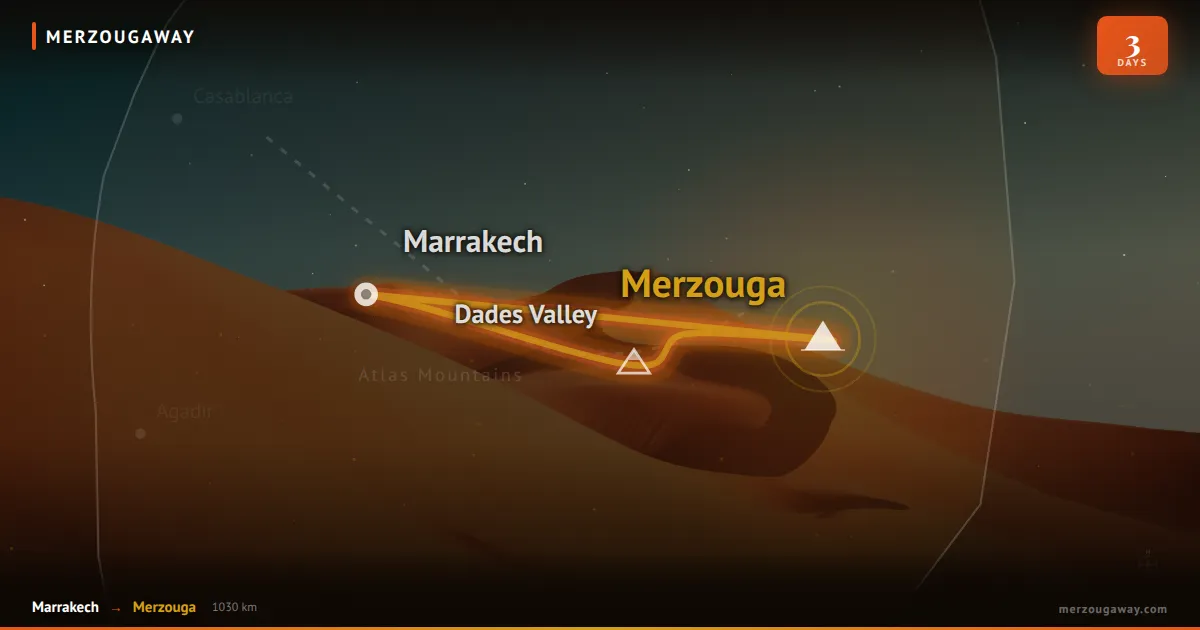
Here's the part most comparison guides miss, and it's genuinely useful if the desert is on your itinerary: Fes is closer to Merzouga than Marrakech is. The drive from Fes runs about 340 km through the Middle Atlas and the Ziz Valley — roughly 4-5 hours. From Marrakech, it's about 560 km and 9-10 hours, crossing the High Atlas via the Tizi n'Tichka Pass.
That doesn't automatically make Fes the better choice, though — the Marrakech route is the more scenic and eventful of the two, passing Aït Ben Haddou (the UNESCO-listed kasbah used in Gladiator and Game of Thrones), the Dades Gorges, and the Todra Canyon along the way, so the extra hours are mostly spent seeing things, not just driving. The Fes route through Ifrane ("Morocco's Little Switzerland") and the Ziz Valley is quieter and greener, with cedar forests and Barbary macaques rather than kasbahs and canyons.
Flight Access
Marrakech's airport (RAK) is Morocco's main international gateway, with by far the widest range of direct flight connections from Europe — for most travelers coming from outside Morocco, it's simply the easier and often cheaper city to fly into. Fes (FEZ) has its own international connections too, but noticeably fewer of them, so factor that into which city makes sense as your entry point if you're planning the trip around flights rather than the other way around.
You Don't Actually Have to Choose
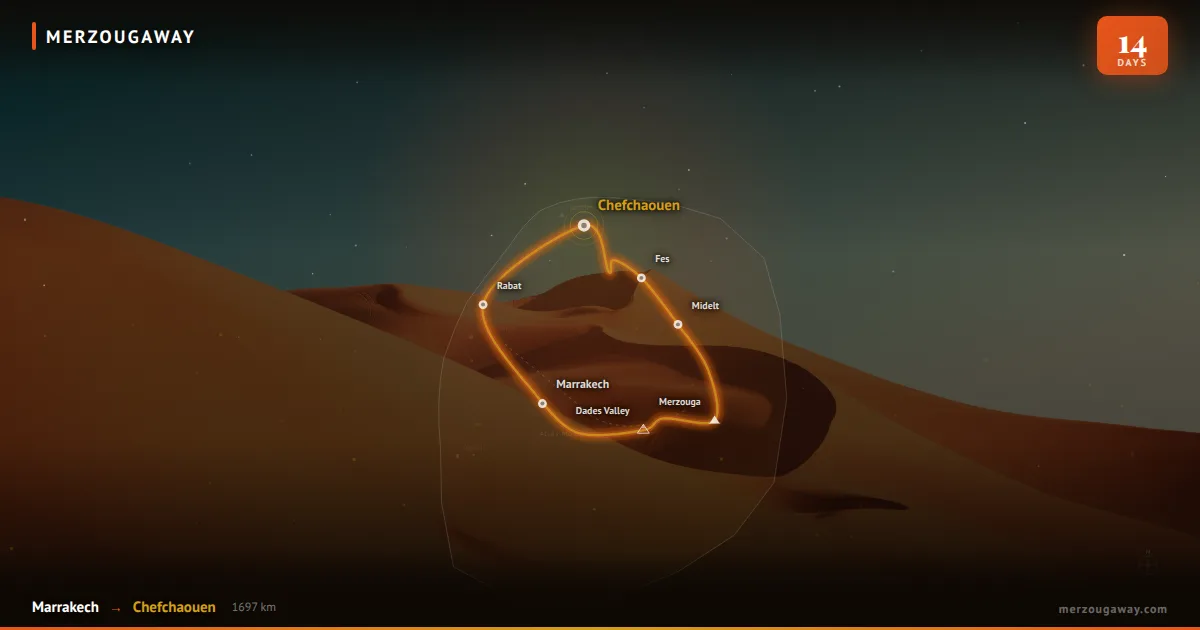
This is the part we tell people once they've read this far and are still stuck: you don't have to pick one. Since Fes and Marrakech sit on opposite ends of the desert route, a one-way tour through the Sahara lets you experience both cities without ever backtracking. Our 3-Day Marrakech to Merzouga to Fes One-Way Desert Tour does exactly this — start in Marrakech, cross the Atlas and spend a night in the dunes, then continue on to end in Fes instead of doubling back. We also run it in reverse, Fes to Merzouga to Marrakech, for travelers flying out of Marrakech instead. For the longer version of this route, see our 7, 10, and 14-day Morocco itinerary guide.
Final Verdict
If you only have a few days and want one city, choose based on what you actually want from the trip: Marrakech for energy, nightlife, and easier flight access; Fes for depth, history, and a quieter, more authentic medina experience. If you have the time, don't force yourself to choose — book a one-way desert tour between the two and get both cities plus the Sahara in a single, non-backtracking route.
The Ultimate Imperial Showdown: Marrakech vs Fes
Choosing between Morocco's two most celebrated imperial titans—Marrakech (the vibrant "Red City" of the South) and Fes (the ancient scholarly "Spiritual Heart" of the North)—is the central dilemma confronting travelers planning a Moroccan itinerary. Both cities boast UNESCO World Heritage medinas, palatial riads, and centuries of artisan heritage, yet they offer completely distinct human atmospheres, architectural rhythms, and sensory experiences.
The following master comparison matrix evaluates both imperial capitals head-to-head across key travel metrics:
| Category / Metric | Marrakech (The Red City) | Fes (The Spiritual Capital) | Winner / Best Suited For | | :--- | :--- | :--- | :--- | | Medina Atmosphere & Scale | Theatrical, high-energy, bustling; wide arterial alleys; mopeds buzz through crowds | Medieval, intimate, deeply traditional; 9,000 narrow derbs; 100% car & moped free | Fes for ancient authenticity; Marrakech for street theater & energy | | Ease of Independent Navigation | Moderate; wide avenues lead reliably to Place Jemaa el-Fna; GPS maps work well | Challenging; intricate labyrinthine dead-ends (derbs); hiring a licensed guide is wise | Marrakech is easier to navigate independently without getting lost | | Iconic Architectural Landmarks | Palais Bahia, Medersa Ben Youssef, Koutoubia Mosque, Saadian Tombs | Medersa Bou Inania, Al-Qarawiyyin (oldest university), Chouara Tannery, Bab Bou Jeloud | Tie: Marrakech excels in royal palace grandeur; Fes excels in sacred Islamic architecture | | Shopping & Souk Experience | High-pressure sales; polished boutique artisan showrooms; upscale design concepts | Raw workshop artisans; brass beaters, weavers, and leather tanners working at source | Marrakech for contemporary homewares; Fes for authentic master crafts | | Gastronomy & Dining Scene | Cosmopolitan; rooftop sunset bars, French-Moroccan fusion, vegetarian & vegan cafes | Traditional imperial gastronomy; home-cooked slow tagines, pastilla, conservative dining | Marrakech for diverse dining & nightlife; Fes for traditional culinary roots | | Proximity & Access to Merzouga Dunes | 560 km (9-10 hrs drive via High Atlas & Dades Gorge); ideal for 3-4 day loops | 470 km (7.5-8 hrs drive via Middle Atlas & Ziz Valley); faster, scenic gorge drive | Fes offers the faster overland drive; Marrakech offers dramatic Atlas passes | | Nightlife & Alcohol Availability | Liberal & vibrant; rooftop cocktail bars, jazz clubs, cabaret supper clubs in Gueliz | Conservative; alcohol restricted to licensed tourist hotels and select riads | Marrakech by a wide margin for evening entertainment and cocktails |
Medina Architecture: Open Spectacle vs Medieval Intimacy
The structural geography of both medinas reflects their differing imperial histories:
- Marrakech Medina (The Haouz Oasis Metropolis): Founded in 1070 AD by the Almoravid warrior-monks, Marrakech is constructed from the rosy-pink clay and lime soil of the surrounding plain, giving the city its iconic uniform terracotta glow. The medina is organized around immense public spaces, culminating in the world-famous Place Jemaa el-Fna—a sprawling open-air stage where snake charmers, storytellers (halqa), musicians, and food stall smoke create a sensory spectacle unmatched on earth. The primary commercial streets are wide enough to accommodate bicycles and buzzing mopeds, creating an energetic, fast-paced urban rhythm.
- Fes el-Bali (The World's Largest Car-Free Urban Zone): Founded in 789 AD by Moulay Idriss I, Fes is an extraordinarily dense medieval time capsule. Comprising over 9,000 winding alleyways (derbs) and 300 distinct quarters, Fes el-Bali is completely closed to motorized vehicles; goods are transported entirely by braying donkeys, wooden handcarts, and human foot carriers. High, blind earthen walls shelter magnificent interior courtyards adorned with 14th-century carved stucco, cedarwood corbels, and hand-cut geometric ceramic zellij tilework. Walking into Fes feels like stepping directly into the 14th century, untouched by 21st-century commercial tourism trends.
Culinary Traditions: Street Theater vs Imperial Haute Cuisine
Both cities represent the pinnacle of Moroccan culinary achievement, but their signature dishes diverge:
- The Flavors of Marrakech: Marrakech is renowned for robust, slow-cooked meat specialties rooted in nomadic and Berber cooking traditions:
- Tanjia Marrakchia: The quintessential bachelor's dish of Marrakech. Beef or lamb shank is seasoned with preserved lemon, garlic, cumin, saffron, and smen (aged fermented butter), sealed inside an earthen clay amphora jar, and slow-roasted for 6 to 8 hours in the ashes beneath a public neighborhood hammam furnace.
- Jemaa el-Fna Night Stalls: Dining at the open-air charcoal grills on the square—ordering steaming sheep's head, spicy Merguez sausages, fried calamari, and spiced ginger tea (Khoudenjal)—is an essential culinary pilgrimage.
- The Refinement of Fassi Gastronomy: Fes was the historic seat of royal imperial courts and Andalusian refugees expelled from Moorish Spain, creating an aristocratic cuisine characterized by delicate sweet-and-savory flavor balances:
- Pastilla au Pigeon (B'stilla): The crowning jewel of Fassi cuisine. Layers of paper-thin, crispy warqa pastry dough envelop a spiced, slow-cooked pigeon or shredded chicken filling infused with toasted almonds, cinnamon, saffron, and orange blossom water, dusted with powdered sugar.
- Zaalouk and Cooked Salads: Fassi feasts begin with a dozen delicate cooked vegetable mezze dishes, including smoked eggplant zaalouk, sweet caramelized pumpkin (m'asla), and tomato-cucumber salads scented with fresh coriander.
Sahara Desert Route Logistics: The Open-Jaw Solution
When planning a desert safari with MerzougaWay, travelers frequently ask whether they should depart from Marrakech or Fes:
- Marrakech to Merzouga (The Southern Scenic Route): Spans 560 km (9 to 10 driving hours). It traverses the dramatic alpine switchbacks of the Tizi n'Tichka Pass (2,260m), the UNESCO ksar of Ait Benhaddou, the palm groves of Skoura, and the towering cliffs of Dades and Todra Gorges. This is the classic 3-day/2-night or 4-day/3-night loop returning to Marrakech.
- Fes to Merzouga (The Mountain Gorge Route): Spans 470 km (7.5 to 8 driving hours). It climbs through the alpine architecture of Ifrane, the ancient cedar forests of Azrou (home to wild Barbary macaques), the apple orchards of Midelt, and the dramatic vertical canyon walls of the Ziz River Valley. It is roughly two hours faster than the Marrakech drive.
- The Master Open-Jaw Itinerary (The Best of Both Worlds): Why choose between them? The most rewarding itinerary in Morocco is the 3-Day or 4-Day Open-Jaw Desert Traverse: begin in Marrakech, cross the High Atlas and Todra Gorge to Erg Chebbi for luxury desert glamping, and then travel north through the Ziz Valley and Middle Atlas to finish in Fes (or reverse). This routes you through both imperial cities seamlessly without a single kilometer of repetitive backtracking!
Riad Architecture and Hospitality Showdown
Your accommodation experience reflects the contrasting heritage of both imperial cities:
- Marrakech Riads (Bohemian Design & Rooftop Solariums): Restored riads in Marrakech—many revived by European interior designers, architects, and artists—are celebrated for their bohemian chic aesthetics. You will find tranquil plunge pools surrounded by banana palms, pastel tadelakt plaster bathrooms, vibrant Berber textiles, and expansive rooftop terraces equipped with sun loungers, cocktail bars, and panoramic views of the Koutoubia minaret and snowy Atlas peaks.
- Fassi Dars and Palaces (Sacred Crafts & Aristocratic Splendor): Accommodations in Fes el-Bali are often historic mansions (dars) formerly owned by notable scholarly or merchant families. They showcase monumental 6-meter-high ceilings of hand-carved cedarwood, original 14th-century polychrome zellij mosaics, and intimate interior courtyards centered around whispering marble fountains. The atmosphere in a Fassi riad is serene, aristocratic, and contemplative, offering a profound escape from modern bustle.
Artisan Guilds and Souk Craftsmanship Showdown
The industrial heritage of both imperial cities is mirrored in how traditional master craftsmen (Maâlems) organize their workshops:
- The Ancient Guilds of Fes el-Bali: Fes remains the undisputed capital of traditional guild craftsmanship in the Arab world. Artisans are strictly organized into ancient professional corporations dating back to the Middle Ages: the brass and copper beaters of Place Seffarine shaping monumental couscous cauldrons by hand; the silk weavers in the kissarias operating wooden loom shuttles with foot pedals; and the leather curriers of the Chouara Tannery laboring inside stone vats filled with natural pigeon dung, limestone, and natural saffron and indigo dyes. Prices are typically lower than Marrakech, and bargaining is conducted with understated Fassi dignity.
- The Design-Forward Ateliers of Marrakech: While Marrakech possesses legendary historic artisan souks (such as Souk Haddadine for ironwork and Souk Cherratine for leather), the city has emerged as a global capital of bohemian chic interior design. In neighborhoods like Sidi Ghanem (the industrial design quarter) and the upscale concept stores of the Medina (such as Max & Jan and 33 Rue Majorelle), traditional Moroccan artisanal methods are reimagined into contemporary fashion, sculptural lighting, and designer ceramics curated for European architectural digest aesthetics.
Frequently Asked Questions (FAQ)
Is Marrakech or Fes better for first-time visitors to Morocco?
Marrakech is generally the easier first stop — more direct flights, more English spoken, and a medina that's more set up for visitors. Fes rewards travelers who want a deeper, less polished experience, and is a strong choice as a second city or for a return trip.
Which city is closer to the Sahara Desert?
Fes is closer — about 340 km (4-5 hours) to Merzouga via the Middle Atlas and Ziz Valley, compared to about 560 km (9-10 hours) from Marrakech via the High Atlas.
Can I visit both Marrakech and Fes on one trip?
Yes, and it's genuinely the best option if you have the time. A one-way desert tour connecting the two cities through Merzouga means you see both without retracing your route — see our 3-day one-way tours in either direction.
Is Fes worth visiting if I've already seen Marrakech?
Yes. Fes doesn't feel like a smaller version of Marrakech — the medina, the tannery, and the university town atmosphere are different enough that most travelers who do both consider Fes the more memorable of the two, precisely because it's less geared toward tourism.
Which city has better food?
Both are excellent, but they differ in style. Marrakech has more variety, including modern and fusion restaurants alongside traditional Moroccan food. Fes is considered by many Moroccans to have the country's best traditional cuisine — it's historically the origin of much of what's now considered classic Moroccan cooking.
For a deeper look at either city on its own, see our guides to things to do in Marrakech and things to do in Fes.
Contact Information
For more information or to plan your trip, contact us at:
Email: hello@merzougaway.com WhatsApp/Phone: +212675203319 / +212668534981
Sahara Route & Drive-Time Estimator
Calculate realistic driving hours across the High Atlas (Tizi n'Tichka pass), compare scenic stops (Dadès, Todra, Ziz), and plan your custom desert itinerary.
MerzougaWay Team
We are a passionate team of local guides dedicated to sharing the beauty and culture of our home, Morocco. Our journey began with a simple desire to offer authentic, memorable experiences that go beyond the typical tourist trails.