Merzouga, Morocco: What to Know Before You Go
A practical overview of Merzouga and the Erg Chebbi dunes — when to visit, how to get there, and what to actually expect from a Sahara trip.
Merzouga is a small village on the edge of the Sahara in southeastern Morocco, and it exists almost entirely as the gateway to the Erg Chebbi dunes — a stretch of golden sand dunes rising as high as 150 meters that's one of the most striking landscapes in the country. It's a Berber region at heart, and most of what makes a trip here memorable — the camel treks, the music, the desert camps — grows out of that local culture rather than being built for tourism from scratch.
[!NOTE] Fast-Facts & Direct Answer Summary
A practical overview of Merzouga and the Erg Chebbi dunes — when to visit, how to get there, and what to actually expect from a Sahara trip.
- Destination Focus: Authentic Moroccan culture, scenic routes, and local travel insights
- Currency & Payments: Moroccan Dirham (MAD; ~10 MAD ≈ €1 / $1.08 USD). Cash is essential outside major hotels
- Best Travel Window: October through April offers ideal temperate weather across Morocco and the desert
- Local Hospitality: Berber culture is renowned for warm hospitality, mint tea welcoming rituals, and rich musical heritage.
When to go
Spring (March-May) and autumn (September-November) are the sweet spot, with daytime temperatures around 25-30°C and cooler, comfortable evenings. Summer (June-August) is genuinely harsh, regularly exceeding 40°C, while winter nights (December-February) can drop below freezing even though the days stay mild — pack for both extremes if you're visiting outside spring or fall.
Getting there
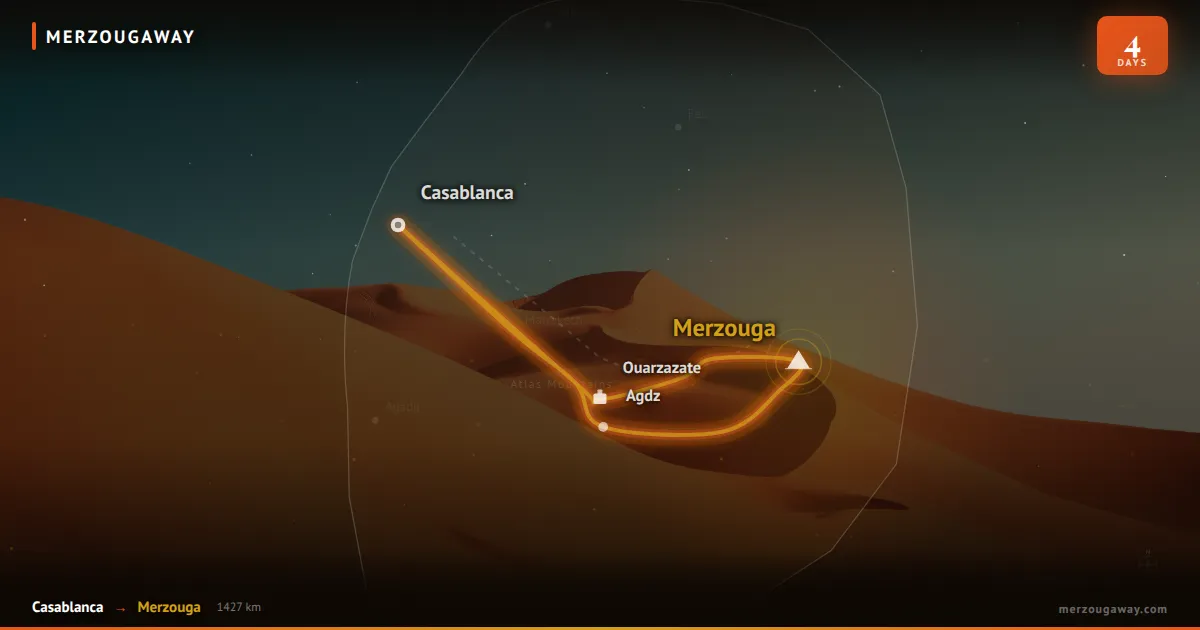
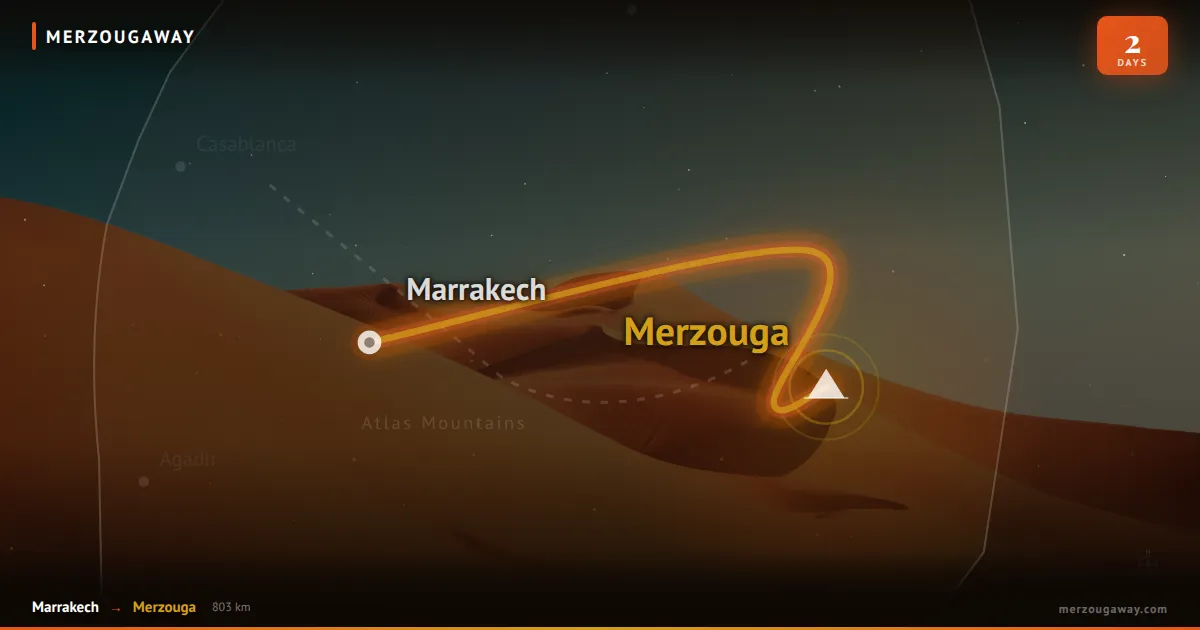
There's no airport in Merzouga itself. The nearest is Errachidia (ERH), about 2.5 hours away by road, though it has limited flight connections; most visitors instead fly into Marrakech (RAK) or Ouarzazate (OZZ) and travel overland from there. By road, it's roughly a 10-11 hour drive from Marrakech (560 km) over the High Atlas via Tizi n'Tichka, or about 7-8 hours from Fes (470 km) through the Middle Atlas — both routes are usually split across two or more days by private tours rather than driven in one push.
What's actually here
The dunes themselves are the main event, and a sunset or sunrise camel trek out to them is the trip's centerpiece for most visitors. Khamlia village, a short drive from Merzouga, is known for its Gnawa music tradition — descendants of West African communities who settled in the region generations ago, with performances that are a genuine cultural experience rather than a staged show. The desert around Merzouga is also fossil country: ancient marine fossils turn up throughout the area, and nearby Erfoud has workshops built around the trade. Merzouga Lake, when it holds water seasonally, draws flamingos and other migratory birds, though it's dependent on rainfall and isn't guaranteed to be present.
Beyond the camel trek, most visitors add a 4x4 excursion into the dunes and surrounding oases, sandboarding down the dune faces, and a night of stargazing — the lack of light pollution here makes for genuinely dark skies. Quad biking is available too, generally as a separate add-on rather than part of a standard tour package.
Where you'll sleep
Options range from luxury desert camps with private en-suite tents to simpler standard camps with shared facilities, plus budget guesthouses in the village itself for anyone not staying out in the dunes. Whatever tier you choose, book ahead for spring and autumn — the good camps fill up during peak season.
Practical notes
Dress modestly, particularly around the village, and ask before photographing people. Bargaining is normal in markets but not really a feature of camp or tour pricing. The Moroccan Dirham (MAD) is the currency, with ATMs available in Merzouga village itself. Wi-Fi at desert camps is inconsistent at best — treat a night in the dunes as a chance to disconnect rather than rely on a signal. We'd generally recommend at least 2-3 nights in the area if your schedule allows it; a single day trip is possible but means missing the sunrise, the stargazing, and the night in camp that make the desert worth the drive in the first place.
Regional Geography: Merzouga Village vs. The Greater Erg Chebbi Oasis
Many first-time visitors think Merzouga is simply a single desert camp. In reality, Merzouga is an established rural desert municipality surrounded by an interconnected network of oasis hamlets flanking the western base of the Erg Chebbi dune field.
+---------------------+-------------------+-----------------------------------------+
| Settlement / Area   | Distance from Hub | Distinctive Characteristics             |
+---------------------+-------------------+-----------------------------------------+
| Merzouga Centre     | 0 km (The Hub)    | Auberges, ATM, pharmacies, desert shops |
| Hassi Labied        | 4 km North        | Traditional palm grove & canal network  |
| Khamlia             | 7 km South        | Gnawa music cultural centre & heritage  |
| Takojt / Erg Znagui | 8 km Southwest    | Quiet, low-density desert camps         |
| Rissani             | 35 km Northwest   | Ancient Sijilmassa, major regional souk |
+---------------------+-------------------+-----------------------------------------+
Merzouga town center features a bustling main street with pharmacies, small grocery shops (hanouts), mechanical workshops specializing in 4x4 tire deflation and repairs, and outdoor cafes serving spiced Berber coffee. Hassi Labied, located just four kilometers to the north, is famous for its lush communal palmeraie. This oasis uses an ancient underground gravity irrigation channel system (khattara) that channels water directly from the High Atlas water tables to desert gardens.
Air and Rail Logistics: How to Skip the 10-Hour Mountain Drive
While the overland road trip from Marrakech or Fes is a classic Moroccan route, travelers with limited time can take advantage of regional flight connections.
+-------------------+---------------------+------------------+----------------------+
| Flight Route      | Operating Airline   | Flight Duration  | Transfer to Merzouga |
+-------------------+---------------------+------------------+----------------------+
| Casablanca (CMN)  | Royal Air Maroc     | 1 hour 10 mins   | 1.5 - 2.0 hrs drive  |
| -> Errachidia(ERH)| (RAM)               | (Direct ATR-72)  | via N13 highway      |
+-------------------+---------------------+------------------+----------------------+
| Paris Orly (ORY)  | Transavia / RAM     | 3 hours 20 mins  | 5.5 hrs drive via    |
| -> Ouarzazate(OZZ)| (Seasonal direct)   | (Direct 737)     | N10 highway          |
+-------------------+---------------------+------------------+----------------------+
| Casablanca (CMN)  | Royal Air Maroc     | 1 hour 00 mins   | 6.0 hrs drive via    |
| -> Zagora (OZG)   | (RAM)               | (Direct ATR-72)  | N12 cross-desert road|
+-------------------+---------------------+------------------+----------------------+
The premier shortcut is flying into Moulay Ali Cherif Airport in Errachidia (ERH). Royal Air Maroc operates scheduled flights from Casablanca's Mohammed V International Airport directly to Errachidia. Upon landing in Errachidia, you are only 125 kilometers away from Merzouga along the well-paved N13 highway.
MerzougaWay private drivers meet passengers directly at the Errachidia terminal doors. Within 90 minutes—passing through the stunning palm-filled Ziz Gorge and the historic town of Erfoud—you arrive at the base of the golden dunes, completely bypassing the tiring 10-hour drive over the High Atlas mountain passes.
4x4 Perimeter Safaris: Exploring Beyond the Sand Dunes
While camel trekking is the iconic Sahara experience, the real desert ecosystem extends far beyond the dunes. A comprehensive 4x4 desert safari covers a full 80-kilometer circuit around the Erg Chebbi perimeter.
+-------------------------+---------------------------------------------------------+
| Safari Waypoint         | Cultural & Natural Highlight                            |
+-------------------------+---------------------------------------------------------+
| Dayet Srji Seasonal Lake| Winter wetland hosting pink flamingos & migratory birds |
| Mifis Lead Mines        | Historic open-cast French colonial galena & lead mines  |
| Nomad Encampments       | Authentic tent dwellings of Ait Khebbach pastoralists   |
| Khamlia Village         | Live spiritual Gnawa percussion & Bambara traditions    |
| Serdrar Fossil Beds     | Marine cephalopods & ammonites dating 380M years back   |
+-------------------------+---------------------------------------------------------+
A key stop on the 4x4 perimeter safari is Dayet Srji, a seasonal rainwater lake west of Merzouga. During wet winters and early springs, this desert depression fills with water, creating a stunning visual contrast of red dunes reflected across blue water, while attracting flocks of wild pink flamingos, shelducks, and desert larks.
Continuing south brings you to the abandoned French colonial lead and zinc mines of Mifis. Here, miners extracted galena (used historically across North Africa for traditional cosmetic khol eyeliner). The elevated plateau above Mifis provides panoramic views across the full length of the Erg Chebbi dune field stretching toward the Algerian frontier.
Health, Safety, and Cash Realities in the Desert
Merzouga is a safe, welcoming desert destination, but travel logistics require basic preparation:
- Cash & ATMs: Merzouga now has two operational ATMs (one Banque Populaire and one Al Barid Bank). However, they can run out of cash during high-season holiday weekends. Always carry at least 1,000 to 1,500 MAD per person in cash from Marrakech, Fes, or Erfoud.
- Medical & Pharmacy: Merzouga village has a well-stocked pharmacy (Pharmacie Merzouga) handling common travel remedies, rehydration salts, antihistamines, and basic first aid. For emergencies, the regional hospital is located in Rissani (35 km) or Errachidia (125 km).
- Scorpions & Desert Wildlife: Wild scorpions and horned vipers hibernate during the cold winter months (November to March) and pose virtually zero risk. During hot summer nights, simply shake out your shoes before slipping them on and avoid walking barefoot across open sand away from camp lanterns.
Cellular Connectivity, Wi-Fi, and Power in the Dunes
Staying connected while traveling to the edge of the Sahara is easier than most first-time visitors expect, but coverage varies by carrier:
+---------------------+-----------------------------+-----------------------------------+
| Mobile Network      | Village Coverage (Merzouga) | Deep Dune Camp Coverage           |
+---------------------+-----------------------------+-----------------------------------+
| Maroc Telecom (IAM) | Excellent 4G+ LTE           | Strong 4G across most camps;      |
|                     | (Speed: 30 - 60 Mbps)       | high-elevation dune reception     |
+---------------------+-----------------------------+-----------------------------------+
| Orange Maroc        | Good 4G in town center      | Intermittent 3G; fades behind     |
|                     |                             | secondary high dune ridges        |
+---------------------+-----------------------------+-----------------------------------+
| Inwi                | Fair 3G/4G in town center   | Weak or no signal in interior     |
|                     |                             | dune encampments                  |
+---------------------+-----------------------------+-----------------------------------+
If reliable mobile internet is important during your travels, purchase a local Maroc Telecom physical SIM or eSIM at Casablanca or Marrakech airport upon arrival. For approximately 100 MAD (~€10), you receive 10 GB of high-speed data that works reliably along the entire desert highway and even across the top of the Erg Chebbi dunes.
While MerzougaWay luxury camps feature satellite Wi-Fi in the main lounge tents, charging your devices requires basic awareness. Tents operate on clean solar battery systems. You can easily charge laptops, smartphones, and drone batteries via standard European two-pin 220V wall outlets throughout the day and evening. However, high-wattage heating appliances like travel hair dryers or electric kettles should not be plugged into tent outlets to prevent tripping the solar inverter circuits.
Rissani Market Days: The Authentic Desert Trading Hub
Located just 35 kilometers north of Merzouga, Rissani is the historic capital of the Tafilalet oasis and the seat of the ruling Alaouite Dynasty. While Merzouga caters to desert travel, Rissani remains an authentic Saharan trading hub.
Visiting Rissani on its official souk days—Tuesday, Thursday, and Sunday—offers an incredible glimpse into rural desert life:
- The Donkey Parking Lot: Hundreds of local farmers tie their donkeys in a massive open-air corral outside the medina walls while trading produce and dates.
- The Sheep & Goat Souk: Pastoral nomads from the desert gather to bargain over livestock using traditional hand gestures.
- The Spice and Date Market: Tafilalet produces over 40 varieties of dates, including prized Majhoul (Medjool), Boufeggous, and Nebt Sayet. Prices here are less than half of what you would pay in the Marrakech souks.
- Tasting Traditional Medfouna: Rissani is the birthplace of Medfouna (Moroccan Berber pizza). Fresh bread dough is stuffed with finely minced beef, lamb fat, onions, almonds, hard-boiled eggs, and desert cumin, then baked inside a wood-fired clay oven until golden and crisp.
Dune Safety and Desert Environmental Awareness
Walking or hiking across the 150-meter-tall sand dunes of Erg Chebbi is an incredible sensory experience, but the desert environment requires basic safety precautions:
- Navigational Awareness: Large sand dunes can look identical from different angles. When walking away from camp to watch the sunrise or stargaze, always keep camp flagpoles, lantern lines, or high prominent dune ridges in direct line of sight. Never hike deep into the dunes alone at night without a flashlight.
- Hydration Protocols: The low humidity accelerates perspiration evaporation, meaning you can become dehydrated without feeling sweaty. Drink at least 2.5 to 3 liters of bottled mineral water daily.
- Footwear Realities: Fine sand heats up rapidly under mid-day sun (reaching 50°C surface temperature during summer months). Always wear closed-toe sneakers or trail shoes during daytime walks; save open sandals for the shaded camp lounge.
Local Artisanal Crafts: Authentic Desert Souvenirs
When traveling through the Tafilalet oasis and Merzouga, purchasing local handicrafts directly supports indigenous artisan families:
- Fossil Carvings from Erfoud: The quarries around Erfoud contain 380-million-year-old Devonian limestone rich in ammonites and orthoceras. Visit official artisan workshops to purchase polished fossil plates, bookends, and decorative tiles directly from the stonecutters.
- Desert Rose Crystals (Rose de Sable): Natural gypsum mineral clusters formed in desert sand basins through evaporation. Local nomadic children sell these unique crystalline formations along the base of the dunes for 10 to 30 MAD.
- Handwoven Amazigh Carpets: Tribal cooperatives in Rissani and Khamlia weave heavy wool rugs using natural plant dyes (saffron for yellow, henna for red, indigo for blue). Prices are significantly lower than in Marrakech, with the money going directly to the weaver.
Frequently Asked Questions (FAQ)
What is the best month to visit Merzouga?
October, November, March, and April are the best months to visit Merzouga. Daytime temperatures average 22°C to 28°C (72–82°F), perfect for outdoor desert activities, while nights are cool and refreshing without the freezing winter chill or oppressive summer heat.
How do I get to Merzouga from Marrakech or Fes?
From Marrakech, travel overland via Route N9 and N10 (560 km, 9–10 hours), ideally stopping overnight in Dadès or Ouarzazate. From Fes, travel south via Route N13 through Ifrane, the cedar forest of Azrou, and the dramatic Ziz Gorge (470 km, 7.5–8 hours).
What is the difference between luxury and standard desert camps in Merzouga?
Luxury desert camps feature private tents with raised real beds, private en-suite flush toilets and hot showers, electric lighting, and plush carpets. Standard camps feature shared communal bathrooms located in a separate block, simple mattress bedding, and battery lanterns.
Can I charge my phone and camera at a desert camp?
Yes. Luxury desert camps are equipped with solar-powered inverter systems and generators that provide standard 220V electrical outlets in every tent for charging cameras, phones, and drones. Standard camps typically offer USB charging stations in the main dining tent.
What should I pack for a desert camp overnight?
Pack comfortable trousers for camel riding, closed-toe walking shoes, a wide-brimmed sun hat, sunglasses, sunscreen, a warm fleece or jacket for the cold desert night, power bank, wet wipes, and a small backpack with essentials (larger suitcases remain safely secured in the transport vehicle or at the hotel base).
Planning a trip out here?
- Email: hello@merzougaway.com
- WhatsApp: +212675203319 / +212668534981
Sahara Route & Drive-Time Estimator
Calculate realistic driving hours across the High Atlas (Tizi n'Tichka pass), compare scenic stops (Dadès, Todra, Ziz), and plan your custom desert itinerary.
MerzougaWay Team
We are a passionate team of local guides dedicated to sharing the beauty and culture of our home, Morocco. Our journey began with a simple desire to offer authentic, memorable experiences that go beyond the typical tourist trails.