Merzouga Tour: The Ultimate Desert Experience in 2026
What a Merzouga desert tour actually involves — the Erg Chebbi dunes, the camel trek, the desert camp, and how to choose between a 2-day escape and a longer, slower private itinerary.
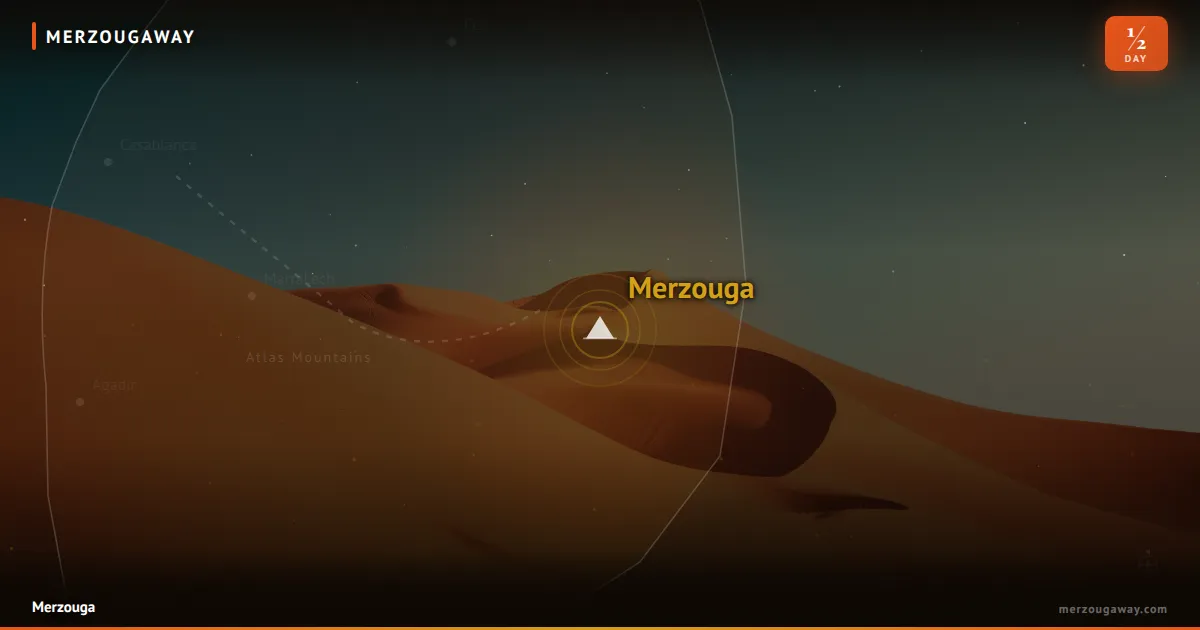
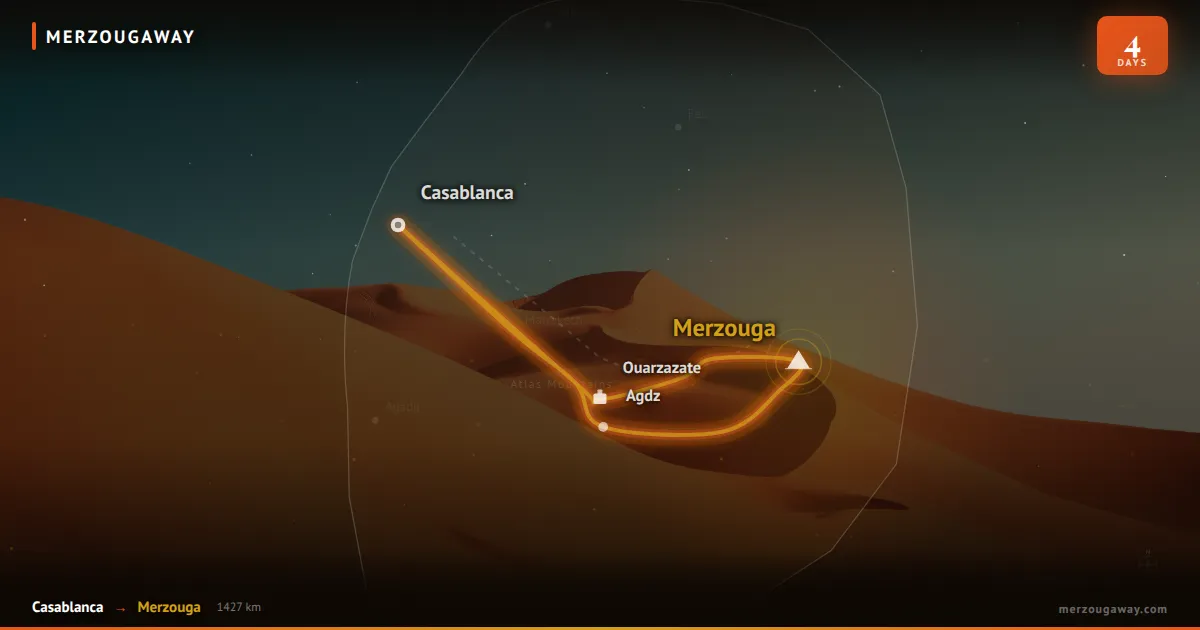
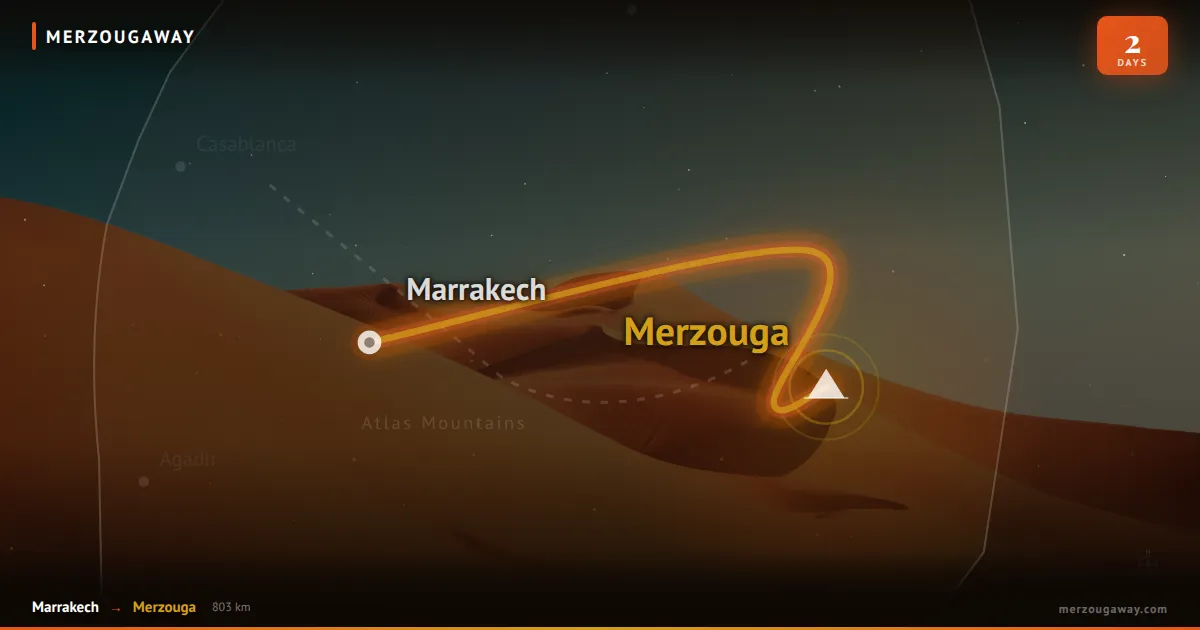
Merzouga sits right at the edge of Erg Chebbi, the tallest and most photographed dune field in Morocco — some crests reach roughly 150 metres, and the light on them at sunrise and sunset is the reason most people put a Sahara trip on their itinerary in the first place. It's also a genuinely remote destination: there's no airport in Merzouga itself and no direct train, so every version of this trip involves a road journey, usually as part of a multi-day tour rather than a quick add-on to a city stay. The nearest airport is Errachidia (ERH), still around two hours away by road, with Marrakech and Ouarzazate as the more common — if longer — starting points for the overland route in.
[!NOTE] Fast-Facts & Direct Answer Summary
What a Merzouga desert tour actually involves — the Erg Chebbi dunes, the camel trek, the desert camp, and how to choose between a 2-day escape and a longer, slower private itinerary.
- Destination Focus: Authentic Moroccan culture, scenic routes, and local travel insights
- Currency & Payments: Moroccan Dirham (MAD; ~10 MAD ≈ €1 / $1.08 USD). Cash is essential outside major hotels
- Best Travel Window: October through April offers ideal temperate weather across Morocco and the desert
- Local Hospitality: Berber culture is renowned for warm hospitality, mint tea welcoming rituals, and rich musical heritage.
What makes Merzouga worth the trip
Beyond the dunes themselves, the area around Merzouga is home to Berber and, in nearby Khamlia, sub-Saharan Gnawa communities whose music and hospitality are as much a part of the experience as the landscape — a stop in Khamlia for a Gnawa performance is one of the more memorable, less-expected parts of most itineraries. The activities cluster around a few core experiences: the camel trek into the dunes at sunset or sunrise, a 4x4 excursion out to nomad settlements and oasis towns, sandboarding and quad biking for a more physical add-on, and stargazing, which needs no equipment or booking at all given how dark the skies are this far from any city lighting.
When to go
Spring (March-May) and autumn (September-November) are the most comfortable seasons, with warm days, cooler nights, and — in spring particularly — a chance of desert bloom after rain. Winter (December-February) brings genuinely cold nights, cold enough that a heated tent with proper blankets matters far more than it would elsewhere in Morocco, though the days themselves stay pleasant and the clear winter skies make for some of the best stargazing of the year. Summer (June-August) is the one season worth planning around carefully: daytime temperatures can climb toward 45-50°C, uncomfortable enough that camel treks and camp activities shift to early morning and evening, with the hottest hours spent resting at camp. Sandstorms are occasional rather than common, more likely in late spring, and rarely disruptive enough to cancel a trip outright.
The different ways to do this trip
Every tour we run to Merzouga is private — your own vehicle and driver-guide, not a shared bus with a fixed schedule — but the length and style still vary a fair amount. A standard 2-3 day tour from Marrakech or Fes covers the essentials: the mountain or Middle Atlas crossing, a sunset camel trek, one night in a desert camp, and a sunrise before heading back. A longer, more immersive version adds a second night in the desert, deeper 4x4 exploration, or extra stops along the route like Todra Gorge or the Dades Valley's rock formations, and works well if you'd rather move slowly than tick boxes. At the upper end, some travelers add a private camp upgrade — proper en-suite tents, more elaborate camp dining — without changing the underlying itinerary much at all.
A typical 2-3 day version runs roughly like this: day one covers the drive itself with stops at kasbahs, valleys, or gorges along the way, arriving in Merzouga in time for a sunset camel trek into Erg Chebbi and a night at camp with a traditional dinner and Berber music around the fire. Day two starts before dawn for those who want the dune sunrise (worth setting an alarm for), followed by a Berber breakfast at camp, a visit to a nomad family or Khamlia village, and optional sandboarding or a 4x4 excursion, before the return drive or a continuation on to Fes. A third day, where included, is usually a slower return leg with additional stops rather than new activities.
What to pack
Desert packing comes down to managing a wider temperature swing than the daytime heat suggests: light, breathable clothing for the day, a genuinely warm layer for camp evenings, and a scarf or shesh that does double duty against sun and blown sand. Comfortable closed shoes matter more than sandals once you're off the main paths, and a headlamp is worth having since desert camps are dimly lit after dinner. Sunglasses with real UV protection, a high-SPF sunscreen, a reusable water bottle, and a charged camera or phone round out the list — the night sky and the dune sunrise are the two moments people most regret not being ready to photograph.
2025/2026 Desert Travel Trends: Modern Luxury in the Ancient Dunes
The Sahara Desert experience around Merzouga and Erg Chebbi has undergone a remarkable transformation in recent years. What was once an arduous, spartan backpacking expedition has matured into a world-class luxury eco-travel destination that harmonizes ancient nomadic traditions with state-of-the-art sustainable hospitality.
Travelers exploring Merzouga in 2025 and 2026 benefit from major infrastructure and technological evolutions:
- Silent Solar Microgrids and Battery Energy Storage: Top-tier luxury desert camps (such as MerzougaWay) have replaced noisy, fume-belching diesel generators with silent solar photovoltaic arrays coupled with high-capacity lithium iron phosphate (LiFePO4) battery banks. Guests enjoy 24-hour whisper-quiet electricity, in-tent reverse-cycle heating and air conditioning, and multiple high-speed USB device charging stations powered entirely by clean Saharan sunlight.
- High-Speed Starlink Satellite Connectivity: Remote desert isolation no longer means complete digital blackout. Premier desert camps utilize Starlink satellite receivers, providing ultra-low-latency broadband Wi-Fi across camp common areas and guest suites—allowing remote executives and digital nomads to manage video calls and upload high-res travel photography from the base of 150-meter sand dunes.
- Regional Aviation Expansion (Errachidia - ERH): Direct regional flight options connecting Casablanca Mohammed V Airport (CMN) to Errachidia Airport (ERH) via Royal Air Maroc have expanded. Discerning luxury travelers can now bypass 10 hours of mountain pass driving, landing just 1.5 hours' drive from the desert dunes on a sleek Embraer regional jet.
Master Experience Matrix: The 5 Signature Sahara Adventures
To maximize your desert journey, the following structured matrix compares the five definitive signature activities in Erg Chebbi:
| Desert Experience | Duration | Physical Exertion Level | Ideal Time of Day | Sensory & Cultural Highlight | Recommended Gear & Attire | | :--- | :--- | :--- | :--- | :--- | :--- | | Sunset Dromedary Camel Caravan | 1.5 to 2.0 Hours | Mild; gentle swaying movement | 16:30 to 18:30 PM (Golden Hour) | Silent rhythmic trek across glowing orange sand crests | Breathable linen pants, sunglasses, indigo Berber turban (Tagelmust) | | Bortle Class 1 Celestial Stargazing | 1.0 to 3.0 Hours | Zero; relaxing seated comfort | 22:00 PM to 01:00 AM (Deep Night) | Billion-star Milky Way view; viewing Jupiter & Saturn via telescope | Warm fleece or down jacket, wool beanie, closed shoes | | High-Performance Dune Buggy Safari | 1.0 to 3.0 Hours | Moderate to High; active driving | Morning (07:30) or Late Afternoon (16:30) | Conquering 150m dune faces and drifting across dry lakebeds | Snug dust goggles, long sleeves, closed running shoes, neck scarf | | Khamlia Gnawa Cultural Immersion | 1.5 to 2.0 Hours | Low; seated musical performance | Midday or Afternoon (11:00 to 15:00) | Hypnotic trance rhythms, iron castanets (qraqeb), and hot mint tea | Modest respectful clothing covering shoulders and knees | | Sandboarding on Lalla Merzouga | 1.0 to 2.0 Hours | High (climbing dunes on foot) | Early Morning (Firm, cool sand crust) | Surfing down 35-degree golden slipfaces at exhilarating speeds | Lightweight barefoot or athletic socks, sunglasses, action camera |
Season-by-Season Sahara Travel Calendar
Understanding seasonal climate dynamics ensures you pack appropriately and set realistic expectations:
- Autumn Perfection (September through November): The undisputed golden window for desert travel. Midsummer heatwaves have broken, leaving daytime temperatures pleasantly warm (28°C to 34°C / 82°F to 93°F) and night temperatures delightful for outdoor campfire dining (16°C to 20°C / 61°F to 68°F). September coincides with the annual Tafilalet date harvest festival.
- Crisp Winter Tranquility (December through February): Characterized by crystal-clear blue skies, crisp atmospheric transparency, and brilliant sunshine (18°C to 21°C / 64°F to 70°F). However, nighttime temperatures drop precipitously to near-freezing (0°C to 5°C / 32°F to 41°F). Luxury heated glamping tents and warm down jackets are mandatory.
- Spring Desert Blossoms (March through May): Moderate daytime warmth (25°C to 30°C / 77°F to 86°F) and blooming desert flora. Occasional spring desert winds can create brief sand dust storms (Sirocco); carrying a traditional cotton tagelmust scarf is essential.
- Summer Survival (June through August): Extreme desert heat with midday temperatures exceeding 42°C to 45°C (108°F to 113°F). All outdoor activities (camel treks, dune buggies) must take place at early dawn (06:00 to 08:30 AM) or dusk. Luxury camps with air conditioning and swimming pools are critical for comfortable afternoon siestas.
Sustainable and Community-Centered Tourism
At MerzougaWay, our operations are guided by deep indigenous stewardship of the Sahara:
- Direct Community Employment: All our guides, camel handlers, 4x4 chauffeurs, and camp culinary staff are native Amazigh inhabitants of Merzouga, Hassi Labied, and Khamlia, ensuring that your tourism dollars directly support local desert families, schools, and medical care.
- Ecological Water and Waste Management: Desert water is a sacred, finite resource. Our luxury camps utilize water-saving aerated showerheads, gravity-fed graywater filtration, and subterranean closed septic systems that prevent contamination of the fragile pre-Saharan aquifer.
Indigenous Cultural Etiquette: Engaging with Desert Amazigh Communities
Experiencing the authentic Sahara means connecting with the indigenous Amazigh families who have inhabited these dunes for generations:
- Welcoming Ritual of Berber Mint Tea: In desert culture, hospitality is sacred. When you are invited into an Amazigh home or nomadic tent, declining tea is considered impolite. The tea ceremony—boiling green gunpowder tea with fresh mint leaves and sugar cubes, poured from high above into small glasses to create a frothy crown (regga)—is an expression of peace and friendship. Sip slowly, savor the sweetness, and accept at least two or three ceremonial rounds.
- Respectful Photography Norms: The vast desert landscape is irresistible to photographers, but always ask courteous verbal permission ("Mumkin soura?") before taking close-up portraits of nomad elders, women, or children tending goats. If an elder politely declines with a hand over their chest, smile, bow your head respectfully, and put your camera away.
- Fair Trade Souk Shopping in Rissani: When purchasing handcrafted desert souvenirs—such as hand-knotted camel-wool rugs, silver Tuareg jewelry, or desert spices—patronize local artisans and cooperatives directly in Rissani and Merzouga village rather than tourist souvenir shops in Marrakech. Your purchases directly sustain rural desert craftsmanship.
Astronomical Heritage of the Sahara: Navigating by the Stars
The desert night sky has guided nomadic Amazigh caravans across the Sahara for millennia:
- Indigenous Celestial Navigation: Long before GPS satellites existed, Berber caravan masters (Khabirs) crossed thousands of kilometers of trackless desert dunes by reading stellar constellations. During evening campfires, our Amazigh elders explain how their ancestors used Polaris (the North Star / Tagelmust n Tignawin) and the Pleiades cluster to maintain perfect dead-reckoning navigation across the shifting sand seas.
- Telescopic Deep-Sky Exploration: MerzougaWay luxury camps feature high-aperture computerized astronomical telescopes. Guests can observe the cloud bands and Galilean moons of Jupiter, the magnificent ring system of Saturn, the Orion Nebula, and distant spiral galaxies with crystal-clear magnification, guided by knowledgeable local hosts passionate about dark-sky astronomy.
Connecting with the Spirit of the Sahara Through Silence
Beyond thrilling adventure activities, the greatest gift of Erg Chebbi is its profound, acoustic tranquility:
- The Miracle of Desert Silence: In our hyper-connected, noisy modern world, true acoustic silence is virtually extinct. Step away from your camp tents onto an adjacent sand ridge, sit quietly, and listen. The absence of aircraft, traffic, machinery, and electronic hums is breathtaking. The only sound is the subtle whisper of sand grains shifting in the breeze and the gentle beat of your own heart. This deep stillness calms the nervous system and creates unforgettable psychological clarity.
Morning Desert Contemplation and Dune Ridge Walks
Before leaving camp or embarking on the day's excursions, take time for an early morning stroll along the dune crests. When the morning sun first touches the sand, the crests are cool and firm, allowing you to walk effortlessly along the ridge lines without sinking. Look for delicate desert tracks in the sand—the tiny footprints of desert jerboas, fennec foxes, and desert beetles who emerged during the cool night hours—providing a fascinating window into the hidden biodiversity of Erg Chebbi.
Frequently Asked Questions (FAQ)
What makes a Merzouga desert tour the ultimate Morocco experience?
It combines dramatic mountain crossings through the High Atlas, walking between the 300-meter sheer cliffs of Todra Gorge, camel trekking across towering golden dunes, authentic Amazigh campfire music, and sleeping under a canopy of millions of stars.
What should I pack for a desert tour in Merzouga?
Essential packing items include sunglasses, sunscreen, a warm fleece jacket for night, breathable long cotton pants, closed sneakers, portable power bank, lip balm with SPF, and a Berber cotton scarf.
Are bathroom facilities available during long drives to Merzouga?
Yes. Drivers pause every 2 to 2.5 hours at clean roadside cafés, restaurants, and service stations that offer clean restrooms, bottled water, espresso coffee, and fresh orange juice.
Can I visit nomad families living in the desert?
Yes. MerzougaWay tours include a respectful visit to indigenous nomad families living in traditional handwoven wool tents behind the dunes, where you can share mint tea and learn about their traditional pastoral way of life.
Booking your Merzouga tour
If you want the full range of options — 2-day, 3-day, or longer, with either a standard or upgraded desert camp — our 3-day Marrakech to Merzouga tour is the most popular starting point and can be adjusted to a shorter or longer itinerary depending on your dates.
Contact Us
Ready to book, or want a custom itinerary built around your travel dates and starting city? Get in touch and we'll put together a plan and quote.
- WhatsApp: +212 675 203 319 / +212 668 534 981
- Email: hello@merzougaway.com
Last updated: July 2026.
Sahara Route & Drive-Time Estimator
Calculate realistic driving hours across the High Atlas (Tizi n'Tichka pass), compare scenic stops (Dadès, Todra, Ziz), and plan your custom desert itinerary.
MerzougaWay Team
We are a passionate team of local guides dedicated to sharing the beauty and culture of our home, Morocco. Our journey began with a simple desire to offer authentic, memorable experiences that go beyond the typical tourist trails.