Merzouga Tours: Complete Guide to Desert Adventures 2026
How to choose between a 2-day, 3-day, or family-paced private Merzouga desert tour — real routes, real inclusions, and what actually changes the price.
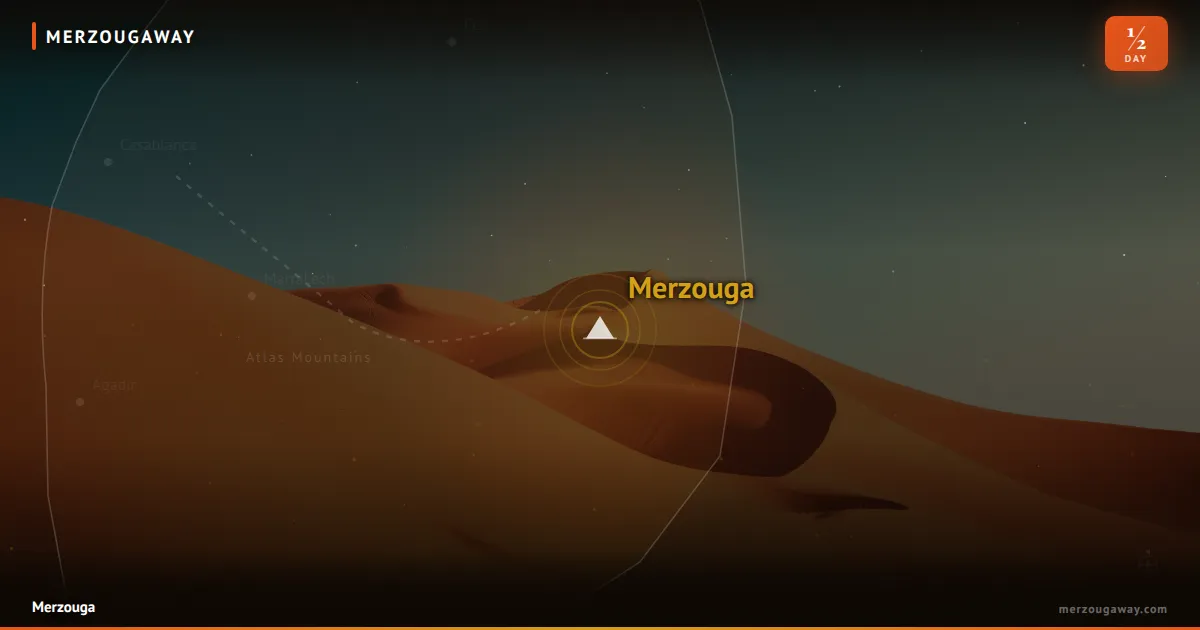
Merzouga sits at the edge of Erg Chebbi, the tallest and most photographed dune field in Morocco, and almost nobody just shows up there on a whim — there's no airport in Merzouga itself (the nearest is Errachidia, roughly two hours away by road) and no train link, so getting there is a deliberate overland trip, usually from Marrakech or Fes. That drive is actually part of what makes the desert feel earned rather than just visited. This guide walks through how our private tours are structured, what genuinely differs between them, and how to pick the right one for your trip.
[!NOTE] Fast-Facts & Direct Answer Summary
How to choose between a 2-day, 3-day, or family-paced private Merzouga desert tour — real routes, real inclusions, and what actually changes the price.
- Destination Focus: Authentic Moroccan culture, scenic routes, and local travel insights
- Currency & Payments: Moroccan Dirham (MAD; ~10 MAD ≈ €1 / $1.08 USD). Cash is essential outside major hotels
- Best Travel Window: October through April offers ideal temperate weather across Morocco and the desert
- Local Hospitality: Berber culture is renowned for warm hospitality, mint tea welcoming rituals, and rich musical heritage.
Private tours, not group departures
Every tour we run is private — your own vehicle, your own driver-guide, and a pace set by your group rather than a fixed departure roster of strangers. That matters more than it might sound: it means the itinerary can flex around your interests (linger longer at Aït Ben Haddou, skip a stop you don't care about, start earlier if you want a quieter photo window), and it means the price scales with your group size rather than a per-seat rate on a shared coach. If you're travelling solo, as a couple, or as a family, we'll size the vehicle and camp arrangement to match.
The core routes
Most travelers reach Merzouga from one of two starting points, and the right route mostly comes down to where the rest of your Morocco trip already has you.
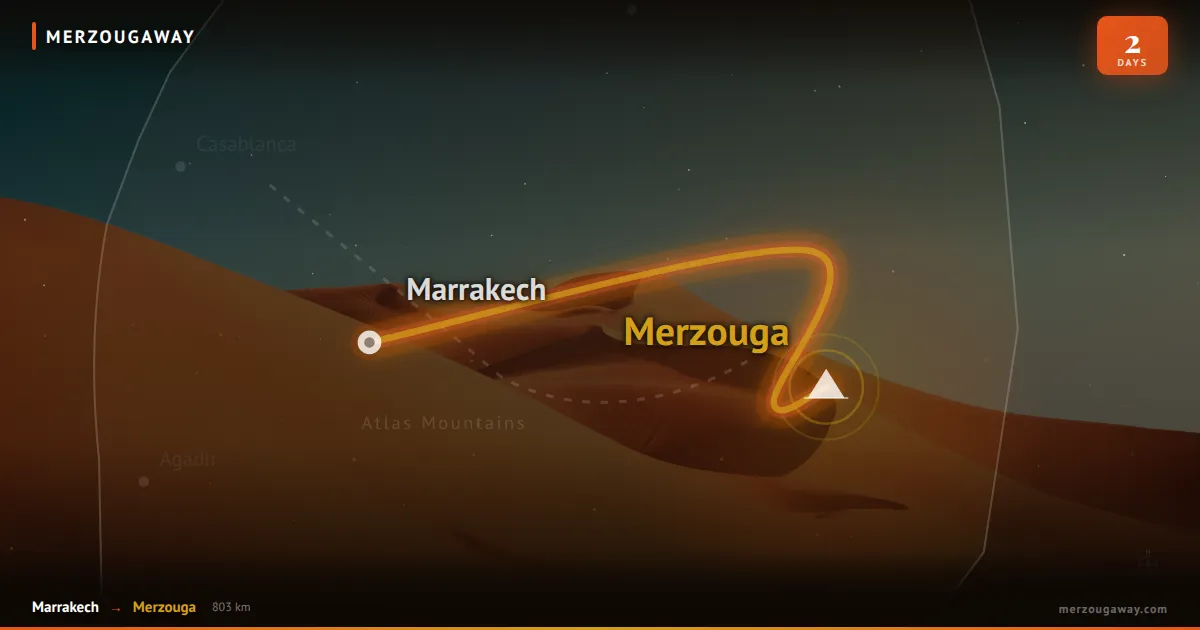
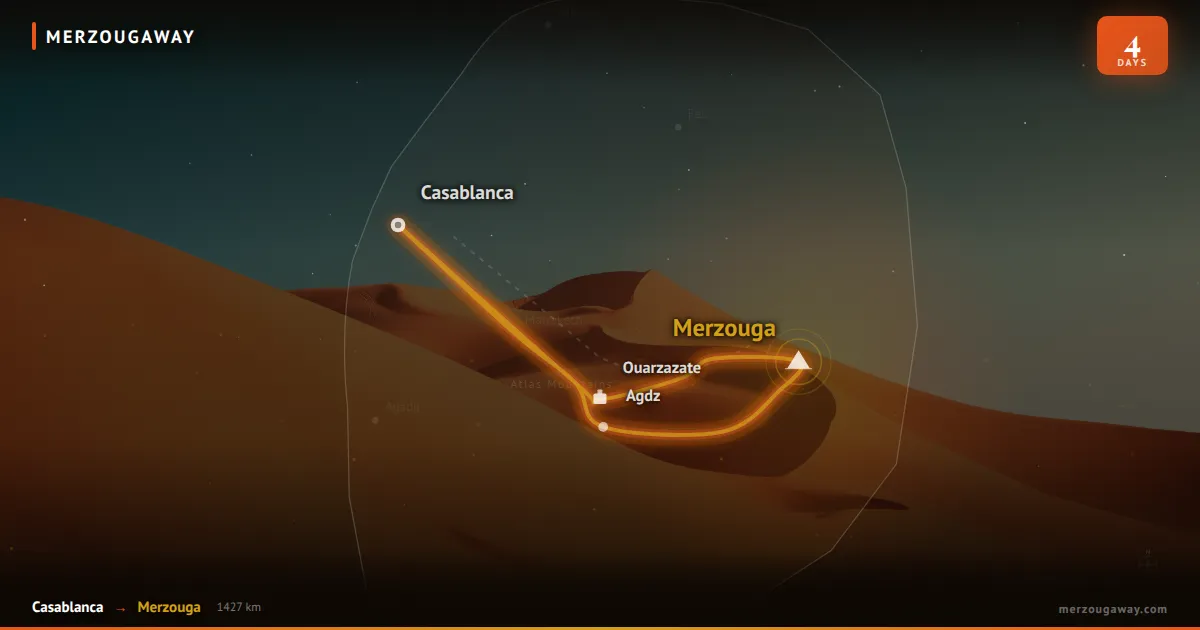
From Marrakech, the classic option is a 2-day, 1-night tour — an ambitious but genuinely rewarding itinerary crossing the High Atlas via the Tizi n'Tichka pass, with a stop at the UNESCO-listed kasbah of Aït Ben Haddou, before reaching Merzouga in time for a sunset camel trek and a night in a desert camp. If your schedule allows a third day, the 3-day version adds an overnight in the Dades Valley on the way down, breaking up what is otherwise a very long single day of driving, plus a private Gnawa music performance in Khamlia village and a full 4x4 desert excursion the following morning. Families traveling with children tend to prefer the 4-day version, which spreads the same core route over shorter driving days with more stops.
From Fes, the equivalent is an express 2-day, 1-night tour through the Middle Atlas — passing Ifrane's oddly alpine architecture and the cedar forests of Azrou, where wild Barbary macaques gather roadside, before descending through the Ziz Valley to Merzouga. It's a genuinely fast-paced two days, honest about the long drive involved, but it delivers the full desert night: sunset camel trek, dinner and music at camp, and a dawn climb up a dune for sunrise.
Whichever route you take, the desert night itself follows a similar shape: arrival in the late afternoon, a camel trek into the dunes timed for sunset, a traditional Berber dinner with music and drumming around the fire, and a sunrise camel trek or dune climb the next morning before the drive back.
Photography, family pacing, and shorter add-ons
Two other formats are worth knowing about if they match what you're actually looking for. A 3-day astrophotography and stargazing tour from Marrakech follows the same broad route as the standard 3-day trip but is built specifically around night-sky photography — dedicated shooting sessions, guidance on camera settings for the Milky Way, and a small-group format capped at eight people so there's real instruction time rather than a rushed group photo stop. And if you're already in Merzouga rather than planning a multi-day crossing, a one-night overnight camp experience delivers the sunset trek, dinner, music, and sunrise without the long drive — useful if you have just one spare night between destinations.
Once you're in Merzouga, quad biking or buggy dune-bashing (a half-day, roughly €40 per person) and sandboarding (a couple of hours, roughly €25 per person) are common add-ons to bolt onto any of the above, usually squeezed in before or after the main camel-trek-and-camp program.
What's typically included — and what isn't
Across our multi-day desert tours, the price generally covers private transport in an air-conditioned 4x4 or minivan, an English-speaking driver-guide, accommodation as specified in the itinerary (desert camp plus any mountain stopover), breakfast and dinner at each overnight stop, and the camel trek itself. Lunches along the route, entrance fees to optional monuments, tips for your guide and camp staff, and travel insurance are not included — these are standard exclusions across the industry, not something specific to us, and your guide will point out lunch stops with reasonable prices as you go.
| Tour | Route | Duration | From (per person) | |---|---|---|---| | Express desert tour | Fes → Merzouga | 2 days, 1 night | €200 | | Classic desert tour | Marrakech → Merzouga | 2 days, 1 night | €220 | | Classic desert tour | Marrakech → Merzouga | 3 days, 2 nights | €250 | | Astrophotography tour | Marrakech → Merzouga | 3 days, 2 nights | €420 | | Family-paced tour | Marrakech → Merzouga | 4 days, 3 nights | €450 | | Overnight desert camp only | Merzouga (no long drive) | 1 night | €75 |
These are starting rates and move with group size, season, and camp tier (standard vs. luxury en-suite tent) — the exact quote depends on your dates and party size, so treat the table as a way to compare shape and duration rather than a final price.
Choosing between them
If you only have a weekend, the 2-day option genuinely delivers the full desert night — sunset trek, camp, sunrise — it just asks you to accept two long driving days to get it. If you can spare a third day, take it: splitting the journey with a stopover in the Dades Valley turns a demanding drive into a proper part of the trip rather than something to endure, and it opens up stops like Todra Gorge and Khamlia village that the 2-day version skips entirely. Traveling with kids tips the calculation further toward the 4-day version, simply because shorter daily drives and more stops make a real difference to how the trip feels for younger travelers. And if photography is the actual point of your visit rather than a bonus, the dedicated astrophotography tour is worth the extra cost over a standard trip, since the itinerary and timing are built around clear-sky nights rather than fitted around them.
Master Tour Portfolio Matrix: Top Erg Chebbi Desert Excursions
Erg Chebbi in Merzouga is Morocco's ultimate natural playground. While many travelers visit simply for an overnight camp stay, the 28-kilometer-long sand sea and its surrounding pre-Saharan mineral plateau offer an extraordinary array of adventure, cultural immersion, and wildlife excursions.
The following master evaluation matrix details the premier guided excursions operating across the Merzouga region in 2025:
| Excursion Name & Activity | Duration & Schedule | Included Equipment & Services | Physical Intensity & Thrill Level | Typical Rate (MAD / EUR per person) | Best Suited Traveler Profile | | :--- | :--- | :--- | :--- | :--- | :--- | | 4x4 Desert Perimeter Safari | 3.5 to 4.5 Hours (Morning) | Private Toyota Land Cruiser, fuel, guide, fossil tour, Khamlia Gnawa stop | Moderate; exciting off-road driving across sand tracks | 600 – 1,000 MAD (€55 – €95) private | Families, photographers, culture lovers wanting full regional overview | | Sunset or Sunrise Camel Trek | 1.5 to 2.0 Hours | Dromedary camel, saddle blanket, professional indigenous camel handler | Gentle; relaxing meditative ride across high dunes | 250 – 400 MAD (€23 – €38) (Included in camp stays) | Everyone; iconic quintessential Sahara travel memory | | High-Dune Sandboarding | 1.0 to 2.0 Hours | Hardwood waxed sandboard, foot straps, safety briefing | Moderate to High (Requires hiking up dune slipfaces) | Complimentary at MerzougaWay camps (or 100 MAD) | Adrenaline lovers, teenagers, active couples | | Guided Quad Biking / Buggy Tour | 1.0 to 2.0 Hours | 450cc Yamaha quad or 800cc Polaris RZR buggy, helmet, goggles, guide | High; thrilling climbs over steep sand crests | 600 – 1,200 MAD (€55 – €110) per hour | Adventure enthusiasts seeking adrenaline dune driving | | Khamlia Gnawa Musical Immersion | 1.0 to 1.5 Hours | Visit to traditional village salon, mint tea, live spiritual Gnawa music | Low; relaxing cultural listening experience | Free entry (100 – 200 MAD donation/CD purchase customary) | Music enthusiasts, cultural travelers, history lovers | | Bortle 1 Stargazing & Astrophotography| 2.0 Hours (Nighttime) | High-powered telescope, astronomy laser guide, star charts | Low; peaceful starlit meditation | 350 – 600 MAD (€32 – €55) per person | Stargazers, romantic couples, nightscape photographers |
The Indigenous Berber Ownership Advantage
MerzougaWay is proudly founded, owned, and operated by native Amazigh families born and raised in Merzouga and Hassilabied:
- Dignified Local Wages: 100% of tour fees go directly to our local desert team, ensuring fair wages for drivers, camel handlers, camp chefs, and oasis maintenance staff.
- Genuine Cultural Storytelling: You are not guided by temporary commercial transit workers; you travel with indigenous Berber hosts whose families have lived in the Tafilalet oasis for generations, sharing personal stories of nomad heritage, survival, and Sahara history.
- Zero Middlemen Commissions: Booking directly on merzougaway.com bypasses aggressive medina street brokers and international booking aggregator commissions, guaranteeing you the finest luxury desert camp suites and private 4x4 vehicles at honest, transparent rates.
The Khamlia Cultural Encounter: Spiritual Gnawa Traditions
A signature cultural highlight included in MerzougaWay desert expeditions is a visit to the historic village of Khamlia:
- History of the Gnawa: Situated 7 km south of Merzouga village, Khamlia is home to approximately 400 residents whose ancestors originated from Mali, Senegal, and Sudan, having traveled across the Sahara on historic caravan routes.
- Spiritual Trance Music: Experience hypnotic live performances of traditional Gnawa music played with heavy iron castanets (qraqeb), three-stringed camel-hide bass lutes (guembri), and call-and-response vocal chants. Guests are welcomed with fresh mint tea and can purchase traditional instruments or music recordings to directly support the village community school.
The Historic French Lead Mines of M'Fis
During our 4x4 desert perimeter safari, explore the ghost settlement of M'Fis:
- Colonial Desert Mining: Located in the barren mineral hills at the southern edge of Erg Chebbi, M'Fis was established by the French military in the early 20th century to extract lead, zinc, and quartz crystals from open-pit shafts.
- Prehistoric Fossil Quarries: The surrounding black hammada contains ancient marine fossil beds where travelers can find 400-million-year-old ammonite and orthoceras fossils preserved in stone.
The Sacred Art of Berber Mint Tea (Atay)
In Amazigh culture, serving tea is far more than refreshment—it is a sacred ritual of welcome and friendship:
- The Ingredients: Chinese gunpowder green tea pearls, fresh spearmint leaves (naana), wild desert herbs (wormwood chiba or mountain thyme zaatar), and pure cane sugar cones.
- The Theatrical Pour: Tea is brewed in ornate curved silver teapots and poured from heights of up to two feet above small glass tumblers. This theatrical pouring aerates the tea, creating a frothy crown of foam (regga) that locks in the aromatic herbal bouquet.
Desert Flora and the Miracle of Life in the Sand
Despite extreme aridity, Erg Chebbi supports remarkable botanical life:
- Saharan Tamarisk Trees (Tamarix aphylla): Deep-rooted desert trees that tap into subterranean aquifers dozens of meters below the surface, providing vital shade for nomadic herds.
- Desert Melons (Colocynthis): Hardy ground creepers with round yellow-green fruits adapted to thrive in harsh mineral soils.
- Spring Wildflower Blooms: Following rare desert showers, the gravel plains burst into brief, radiant blooms of purple crucifers and yellow daisies.
Desert Wellness: Sand Baths (Psammatotherapy) in Summer
During the hot summer months of July and August, indigenous Berber healers in Merzouga practice traditional Saharan sand baths:
- The Healing Ritual: Guests are buried up to the neck in warm desert sand for 10 to 15 minutes under careful medical supervision.
- Therapeutic Benefits: The intense mineral heat stimulates circulation, relieves chronic joint pain, and eases rheumatic symptoms, followed by rest in a shaded tent with warm herbal teas.
Ethical Camel Handling & Animal Welfare in Erg Chebbi
At MerzougaWay, animal welfare is a foundational value. Our dromedary camels are treated with dignity, receiving regular veterinary checkups, high-quality grain feeds, plentiful freshwater, and adequate rest periods between gentle sunset treks. Our indigenous camel handlers use soft padded woolen blankets and traditional saddles to ensure both rider comfort and animal health.
Frequently Asked Questions (FAQ)
What are the most popular tour packages to Merzouga?
The three most popular packages are: 1) 3-Day Marrakech to Merzouga round-trip; 2) 3-Day Marrakech to Merzouga to Fez one-way; 3) 4-Day Slow Travel Sahara & Kasbahs route with an extra night in Dades or Skoura.
How do I reach Merzouga if I am already in Erfoud or Rissani?
Merzouga is only 50 km from Erfoud and 35 km from Rissani via highway N13. MerzougaWay can arrange private 4x4 transfers from any hotel, bus station, or airport in the region.
What months are desert tours operational in Merzouga?
Merzouga tours operate all 12 months of the year. Spring (March–May) and Autumn (September–November) offer peak comfort, while winter provides crisp clear skies, and summer features cooler morning and evening schedules.
Are private desert tours safe for elderly travelers?
Yes. Private tours allow travelers of any age to travel at their own pace, avoid camel riding by using 4x4 dune transport, and stay in comfortable luxury camps with real beds and private bathrooms.
Contact Us
Not sure which route fits your trip? Tell us your dates, where you're starting from, and who's travelling, and we'll put together the right itinerary and a firm quote.
Email: hello@merzougaway.com WhatsApp: +212675203319 / +212668534981
Sahara Route & Drive-Time Estimator
Calculate realistic driving hours across the High Atlas (Tizi n'Tichka pass), compare scenic stops (Dadès, Todra, Ziz), and plan your custom desert itinerary.
MerzougaWay Team
We are a passionate team of local guides dedicated to sharing the beauty and culture of our home, Morocco. Our journey began with a simple desire to offer authentic, memorable experiences that go beyond the typical tourist trails.