Where to Stay Between Marrakech and Merzouga: Accommodation Guide
The Marrakech–Merzouga drive is 9-10 hours, so most people split it with an overnight stop. Here's how to choose between Ouarzazate, Dades Valley, and Todgha Gorge, and what to actually look for when booking.
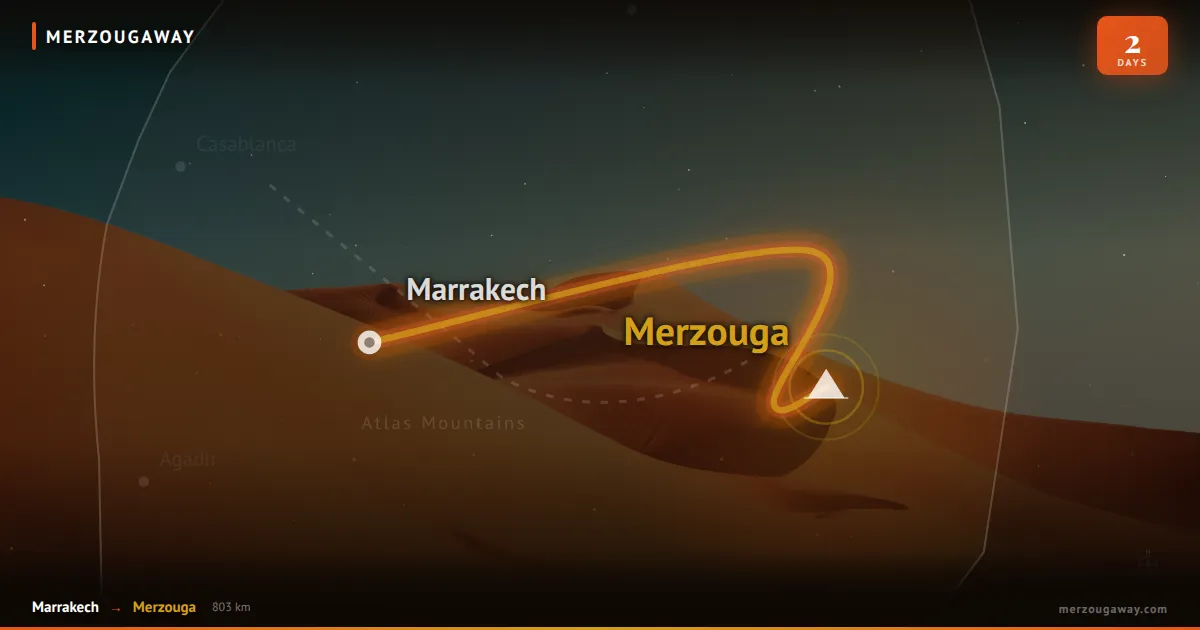
The drive from Marrakech to Merzouga runs 9-10 hours over the Tizi n'Tichka pass and across a few hundred kilometers of increasingly dramatic scenery, and doing it in one uninterrupted push is neither safe nor particularly enjoyable — driver fatigue on mountain switchbacks is a real concern, and you'd miss the landscape entirely by racing through it exhausted. Almost everyone splits the journey into two days with an overnight stop somewhere in between. The question isn't really whether to stop, it's where.
[!NOTE] Fast-Facts & Direct Answer Summary
A desert journey from Marrakech to Merzouga spans ~560 km across the High Atlas Mountains (Tizi n'Tichka pass, 2,260m). The drive takes 9–10 hours, making a 3-Day or 4-Day tour the minimum recommended duration for safety and comfort.
- Recommended Duration: 3 Days (Classic) or 4 Days (Relaxed & In-Depth)
- Primary Road Routes: N9 across the Atlas ➔ N10 through Dadès Valley ➔ N13 to Erg Chebbi
- Realistic Pricing: 1,800–4,500 MAD (€180–€420) per person for private tours with luxury desert camp
- Key Highlights: Aït Benhaddou UNESCO ksar, Todra Gorge canyons, sunset camel trek, and Erg Chebbi dunes
- Local Expert Tip: Avoid 2-day Merzouga tours (18–20 hours driving in 48h). Opt for Agafay Desert if you only have 1–2 days.
Ouarzazate: the default, and for good reason
Ouarzazate sits roughly 130 km from Marrakech and about 360 km from Merzouga, making it a natural midpoint with the area's best range of accommodation and amenities — it's the largest town on the route by a wide margin, known partly for the film studios that have shot desert and historical scenes here for decades. Arriving mid-afternoon after the Tizi n'Tichka crossing and a stop at Ait Ben Haddou leaves time to explore the Taourirt Kasbah or just rest before an early departure the next morning, since day two from Ouarzazate to Merzouga is still a long 9-to-10-hour push. This is the right choice if you want the most reliable range of comfortable, well-reviewed hotels and don't mind a stop that's more practical than scenic.
Dades Valley: more scenic, a longer stop-to-Merzouga distance cut down
Push on from Ouarzazate for a few more hours and you reach the Dades Valley, roughly 170 km from Marrakech and about 280 km from Merzouga — meaning your second day gets noticeably shorter (around 6-7 hours instead of 9-10). The valley itself is the real draw: a dramatic gorge lined with kasbahs and Berber villages, with an easy canyon walk available right from most guesthouses if you arrive with daylight to spare. This is generally the better pick if photography or scenery matters more to you than having the widest hotel selection — accommodation here leans toward smaller guesthouses and restored kasbahs rather than full-service hotels.
Todgha Gorge: the most dramatic scenery, fewer crowds
A little further along, Todgha Gorge (around 200 km from Marrakech, 250 km from Merzouga) offers arguably the most striking landscape of the three — towering canyon walls you can walk directly between, with a river running through the base. It sees fewer tourists than Dades, partly because it's slightly further off the main road, and it's a well-known spot for rock climbing if that's of interest. Like Dades Valley, expect guesthouses and small kasbah-style lodges rather than large hotels.
Erfoud/Rissani: only if you're already committed to a long first day
Erfoud sits much closer to Merzouga — about 480 km from Marrakech but only 90 km (roughly 2-3 hours) from the dunes — which only makes sense as an overnight stop if you left very early and covered most of the distance already on day one. Accommodation options here are noticeably more limited than in Ouarzazate, so this is a fallback for an unusual schedule rather than a first choice.
Comparing the options
| Stop | From Marrakech | To Merzouga | Scenery | Accommodation choice | Best for | |---|---|---|---|---|---| | Ouarzazate | 130 km | 360 km | Moderate | Widest range, most reliable | First-timers, comfort | | Dades Valley | 170 km | 280 km | Excellent | Guesthouses, kasbahs | Scenery, shorter day 2 | | Todgha Gorge | 200 km | 250 km | Best on the route | Guesthouses, kasbahs | Photographers, quieter stop | | Erfoud/Rissani | 480 km | 90 km | Modest | Limited | Only after a very early, long day-1 |
For most first-time travelers, Ouarzazate is the safest choice simply because it has the deepest bench of decent, reviewed hotels. If you've done this route before or scenery matters more than convenience, Dades Valley or Todgha Gorge are worth the trade-off.
What to actually look for when booking
Rather than chasing a specific hotel name off a list, look for the basics that actually vary by property in this part of Morocco: reliable hot water (not universal outside the larger hotels), a private bathroom if that matters to you (shared facilities are still common at the budget end), recent reviews rather than old ones, and — in smaller towns especially — realistic expectations about WiFi, which can be patchy even at otherwise good properties. Direct booking with a guesthouse by email sometimes gets you a better rate than an OTA, but confirm details in writing either way. If you'd rather not manage this yourself, any multi-day tour that includes the overnight stop will have already vetted the property.
Practical things to pack for the stop
A flashlight or phone light for occasional power flicker, your own toilet paper and hand sanitizer as backup, and a phone charger — charging opportunities can be less reliable the further you get from Marrakech. None of this is a hardship, just worth having rather than assuming every property matches city-hotel standards.
Master Overnight Staging Matrix: Intermediate Lodging Hubs
The 560-kilometer overland crossing from Marrakech to Erg Chebbi in Merzouga requires traversing the High Atlas mountains and the pre-Saharan river valleys. Trying to drive the entire route in a single day takes over 10 hours behind the wheel, resulting in severe physical fatigue and missing all the magnificent historic kasbahs, canyons, and palm oases along the way. Selecting the optimal intermediate overnight hub divides the journey into two balanced, highly enjoyable 4-to-5-hour driving segments.
The following master evaluation matrix compares the five primary intermediate overnight staging hubs:
| Intermediate Overnight Hub | Distance from Marrakech | Elevation Profile | Atmosphere & Landscape Character | Average Room Rate (MAD / EUR per night) | Best Suited Traveler Profile | | :--- | :--- | :--- | :--- | :--- | :--- | | Dades Valley (Boumalne Dades) | 325 km (6.0 hrs drive) | 1,600 meters | Towering red canyon walls, "Monkey Fingers" rock formations | 700 – 1,800 MAD (€65 – €165) half-board | The Classic Benchmark: Perfect 50/50 distance split; breathtaking canyon views | | Skoura Oasis (Palmeraie) | 240 km (4.5 hrs drive) | 1,180 meters | Lush 4,500-hectare palm grove, tranquil mud-brick fortresses | 900 – 2,500 MAD (€85 – €230) boutique | Romantic couples, honeymooners seeking boutique oasis tranquility | | Ksar Ait Benhaddou / Ouarzazate | 185 km (3.5 hrs drive) | 1,160 meters | Iconic UNESCO clay citadel, cinematic desert film studios | 600 – 2,200 MAD (€55 – €200) heritage | Cinema buffs, travelers departing Marrakech late morning | | Todra Gorge (Tinghir) | 365 km (6.5 hrs drive) | 1,350 meters | Monumental 300m vertical limestone cliffs, cold mountain springs | 500 – 1,400 MAD (€45 – €130) auberge | Rock climbers, hikers wanting morning slot canyon light | | N'Kob (The Kasbah Capital - N12)| 350 km (via Draa Valley) | 1,050 meters | 45 intact adobe mud kasbahs, date palms, volcanic Saghro peaks | 600 – 1,500 MAD (€55 – €140) kasbah | Off-the-beaten-path travelers following the Southern Return Loop |
Spotlight on Top Boutique Kasbah Hotels
On a private tour with MerzougaWay, your intermediate overnight stay is curated for authentic architectural beauty, excellent food, and relaxing swimming pools:
- Chez Pierre (Dades Valley): Renowned across Morocco as one of the country's finest culinary lodges. Perched along the steep rock face of the Dades Gorge, Chez Pierre features intimate terraced gardens, heated swimming pools, and an unforgettable five-course French-Moroccan gastronomic dinner prepared by passionate chefs.
- Ksar Ighnda (Ait Benhaddou): A five-star luxury earthen retreat situated near the UNESCO fortress. Features an outdoor swimming pool, private hammam, museum-grade Berber art, and sunset dining overlooking the desert riverbed.
- Les Jardins de Skoura (Skoura Palm Grove): A peaceful boutique guesthouse nestled amidst olive trees, pomegranate orchards, and singing birds. Offers farm-to-table dining, charming rooms with carved cedarwood, and exceptional personalized hospitality.
- Hotel Xaluca Dades (Boumalne Dades): A dramatic mountain resort carved from local stone and timber, featuring panoramic cliffside infinity pools, extensive wellness spas, and sweeping views across the Dades canyon valley.
In-Depth Kasbah Hotel Reviews: Skoura, Dades, and Todra
- Kasbah Ait Ben Damiette (Skoura Palm Grove): A boutique oasis sanctuary nestled within acres of fruit orchards and palm trees. Features handcrafted adobe suites, a refreshing swimming pool surrounded by rose bushes, and gourmet candlelit dinners served beneath date palms.
- Hotel Babylon Dades (Dades Gorge): Perched directly beside the Dades River with direct views of the "Monkey Fingers" rock formations. Known for warm Amazigh hospitality, cozy fireplace salons, and delicious home-cooked Berber tagines.
- Auberge Le Festival (Todra Gorge): Built directly into the limestone cliffs of Todra Canyon, featuring natural cave suites carved from living rock, eco-friendly solar electricity, and direct access to mountain climbing trails.
Wine and Gastronomy at Intermediate Kasbah Lodges
Many boutique kasbah hotels between Marrakech and Merzouga hold liquor licenses, allowing guests to pair their multi-course evening tagines with premier Moroccan vintages:
- Domaine de Sahari Reserve (Meknes Region): A full-bodied red blend of Cabernet Sauvignon and Syrah featuring dark fruit and spicy notes, pairing wonderfully with slow-cooked lamb Mechoui.
- Château Roslane Coteaux de l'Atlas: Morocco's premier AOC premier cru wine, aged in French oak barrels.
- Gris de Guerrouane: Morocco's famous crisp, salmon-pink blush wine, ideal for refreshing poolside sipping after a day of mountain travel.
Seasonal Lodging Realities: Summer Pools vs Winter Fireplaces
Choosing your intermediate lodging requires considering seasonal climate realities:
- Summer Visits (June to August): In the heat of summer, temperatures along Highway N10 reach 38°C to 40°C. Selecting a boutique kasbah equipped with a large freshwater swimming pool (such as Hotel Xaluca Dades or Ksar Ighnda) provides essential afternoon relaxation.
- Winter Visits (December to February): Nighttime temperatures in high-altitude valleys like Dades (1,600m) drop to 3°C to 5°C. Booking rooms equipped with active reverse-cycle heating, electric blankets, or wood-burning fireplaces is critical for a cozy, restful night.
Oasis Hydrology & Ancient Khettaras of the South
Staying in intermediate oases like Skoura and Tinghir offers fascinating insights into ancient water engineering:
- The Seguia Canal System: Traditional earthen gravity canals (seguias) distribute snowmelt water to date palm groves according to strict communal timetables monitored by elected water masters (Amghar n’Waman).
- Subterranean Khettaras: Near Tinjdad and Jorf, underground aqueducts transport cool spring water across arid plains without evaporative loss, sustaining agriculture for over 600 years.
Evening Campfires and Acoustic Lute Music in the Gorges
Many boutique kasbah hotels in the Dades and Todra valleys host intimate evening gatherings around outdoor stone fire pits. Guests sip freshly brewed mint tea while listening to local Amazigh musicians perform gentle melodies on the acoustic loutar lute, accompanied by traditional desert percussion and storytelling beneath towering red canyon walls.
Architectural Restoration of Historic Mud Ksour
Many of the boutique kasbah hotels along the Ouarzazate and Dades corridor are celebrated examples of adaptive architectural heritage reuse. Restored by international architects in partnership with local Amazigh master builders, these properties employ ancient rammed-earth (pisé) techniques to create luxurious accommodations while preserving centuries-old desert building traditions.
Sustainable Tourism in the Pre-Saharan Oases
Choosing eco-certified kasbah hotels that employ local village residents and source organic produce from adjacent palm groves directly preserves traditional oasis agriculture and supports rural mountain communities across southern Morocco.
Frequently Asked Questions (FAQ)
Where is the best town to sleep between Marrakech and Merzouga?
For a 3-day tour, the Dadès Valley (Boumalne Dadès) is the optimal overnight stop. It splits the driving perfectly: ~6 hours of driving on Day 1 (leaving Marrakech at 8:00 AM, crossing Tizi n'Tichka, visiting Aït Benhaddou) and ~4.5 hours of driving on Day 2 (visiting Todra Gorge in the morning and reaching Merzouga in time for the sunset camel trek).
Is it better to stay in Ouarzazate or Dadès Valley?
Dadès Valley is significantly more picturesque and relaxing than Ouarzazate. Ouarzazate is a practical modern administrative town, whereas Dadès Valley places you inside a stunning mountain canyon lined with ancient adobe kasbahs and river palmeraies, cutting off 2 hours of driving from your second day.
What kind of accommodations exist in the Dadès and Todra valleys?
The valleys feature boutique kasbah hotels, charming riads, and traditional Berber guesthouses (such as Hotel Xaluca Dades, Chez Pierre, or Auberge Le Festival). Most offer panoramic canyon-view terraces, swimming pools, private en-suite bathrooms, and multi-course Moroccan dinners with fresh local produce.
Do hotels in Dadès Valley have heating in winter?
Higher-altitude mountain valleys get very cold from December to February (night temperatures drop to 2–5°C). Established kasbah hotels have split-unit air conditioning/heating or central radiators in guest rooms, as well as wood-burning fireplaces in common lounges. Budget auberges rely on heavy wool blankets, so confirm room heating if traveling in winter.
Can I stay at Aït Benhaddou instead of Ouarzazate?
Yes! Aït Benhaddou is only 30 minutes before Ouarzazate and has exceptional heritage kasbah hotels (like Ksar Ighnda or Riad Caravane) with views of the illuminated 11th-century clay fortress at night. It is a much more atmospheric, romantic alternative to staying in downtown Ouarzazate.
Book it as part of your tour, or arrange it yourself
Most of our multi-day Marrakech–Merzouga tours already include the overnight stop, vetted and booked for you as part of the package. If you're organizing your own trip and just want the overnight leg sorted, we can also arrange standalone accommodation at whichever stop fits your route.
Contact us:
- Email: hello@merzougaway.com
- WhatsApp: +212 675 203 319
Sahara Route & Drive-Time Estimator
Calculate realistic driving hours across the High Atlas (Tizi n'Tichka pass), compare scenic stops (Dadès, Todra, Ziz), and plan your custom desert itinerary.

MerzougaWay Team
We are a passionate team of local guides dedicated to sharing the beauty and culture of our home, Morocco. Our journey began with a simple desire to offer authentic, memorable experiences that go beyond the typical tourist trails.