Where to Stop Between Marrakech and Merzouga: Best Stops & Breaks
The Marrakech-Merzouga road trip runs through Ait Ben Haddou, Ouarzazate, and the Dades or Todgha gorges before reaching the dunes — here's how to break the 560km route into stops that are worth the time, not just bathroom breaks.
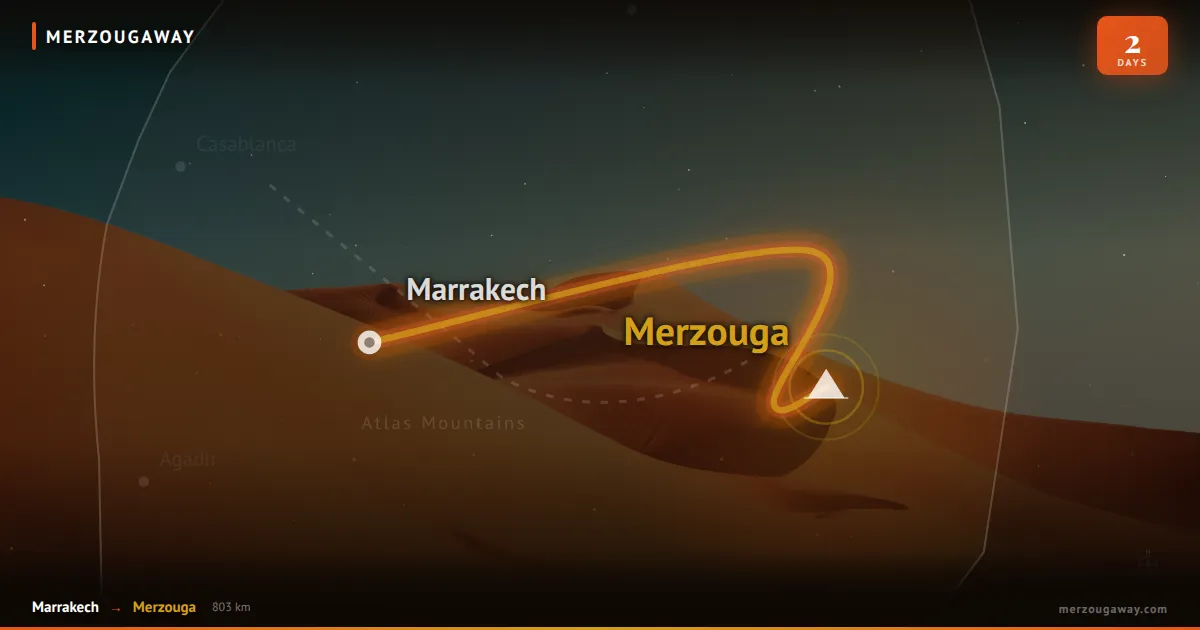
The road from Marrakech to Merzouga covers around 560km and 9-10 hours of driving, and it's one of the more scenic stretches of road in Morocco — which is exactly why treating it as something to rush through is a mistake. Most people cover this route over two to three days as part of a private tour, and the stops along the way aren't just rest breaks, they're a real part of the trip. Here's how the route actually breaks down and what's worth building time around.
[!NOTE] Fast-Facts & Direct Answer Summary
A desert journey from Marrakech to Merzouga spans ~560 km across the High Atlas Mountains (Tizi n'Tichka pass, 2,260m). The drive takes 9–10 hours, making a 3-Day or 4-Day tour the minimum recommended duration for safety and comfort.
- Recommended Duration: 3 Days (Classic) or 4 Days (Relaxed & In-Depth)
- Primary Road Routes: N9 across the Atlas ➔ N10 through Dadès Valley ➔ N13 to Erg Chebbi
- Realistic Pricing: 1,800–4,500 MAD (€180–€420) per person for private tours with luxury desert camp
- Key Highlights: Aït Benhaddou UNESCO ksar, Todra Gorge canyons, sunset camel trek, and Erg Chebbi dunes
- Local Expert Tip: Avoid 2-day Merzouga tours (18–20 hours driving in 48h). Opt for Agafay Desert if you only have 1–2 days.
Tizi n'Tichka pass
The first couple of hours out of Marrakech climb steadily into the High Atlas, topping out around 2,260m at the Tizi n'Tichka pass — the highest point on the whole route. It's cold up here even when Marrakech is warm, so a layer is worth having in the car before you start. There are small roadside cafés at the top selling coffee and Berber women selling argan oil along the roadside; the views back over the mountains are the real draw, and fifteen to thirty minutes is usually enough unless you want to linger for photos in good light.
Ait Ben Haddou
About three hours from Marrakech, this fortified mud-brick village is the most photographed stop on the route for good reason — it's a genuine UNESCO World Heritage Site, still partly inhabited, and familiar from a long list of film productions shot here. Crossing the river to the far bank gives the classic postcard view back at the kasbah; climbing up into the narrow streets gives you the interior. An hour is enough for a quick look, but if your schedule allows ninety minutes to two hours you'll actually get to explore rather than just photograph the outside.
Ouarzazate
A short drive further on, Ouarzazate is the largest town on the route and the natural lunch stop — it has the best selection of restaurants and facilities of anywhere between Marrakech and Merzouga. The Taourirt Kasbah is worth a look if you have the time, and the town's film-studio history (it's been used as a stand-in location for decades) gives it more character than its size would suggest. Budget an hour and a half to two hours here if lunch and the kasbah both matter to you.
Dades Valley or Todgha Gorge
Past Ouarzazate the route splits toward one or both of Morocco's dramatic canyon landscapes. Dades Valley is known for its winding road through red rock formations and small Berber villages tucked into the valley; Todgha Gorge further east has taller, narrower canyon walls and a cool microclimate that's a welcome break from the heat. Many multi-day tours use Ouarzazate or the Dades/Todgha area as the overnight stop between the mountain crossing and the final push to the desert, which breaks up what would otherwise be a brutal single day of driving.
Erfoud and Rissani
As the landscape flattens out and the vegetation thins, Erfoud marks the real transition into desert country — it's known locally for its date palms and fossil trade, and it's a sensible last stop for fuel and a bathroom break before the final stretch. Rissani, a little further on, has a genuinely local souk (particularly lively on Tuesdays and Sundays) that sees far fewer tourists than anywhere else on the route, if you have time for a short detour.
How to actually plan the stops
If you're doing this as a single very long day, realistically you can fit in Ait Ben Haddou and a lunch stop in Ouarzazate and still arrive at a reasonable hour — but that's a hard day, not a relaxed one. Spread the same route over two days with an overnight in Ouarzazate or the Dades Valley, and you can comfortably add Todgha Gorge or a proper look around Ait Ben Haddou without feeling rushed anywhere. That's the pacing most of our own private tours use, since it turns the drive itself into part of the trip rather than something to get through.
A few practical notes regardless of pace: bring more water than you think you'll need, expect temperatures to swing noticeably with altitude on the mountain sections, and don't try to push straight through after dark — night driving on unlit mountain roads isn't worth the time saved.
Master Waypoint Ranking: The Top 10 Stops from Marrakech to Merzouga
The 560-kilometer overland crossing from Marrakech across the High Atlas mountains to Erg Chebbi is not merely a transit corridor; it is an extraordinary open-air museum of geography, geology, and ancient clay architecture. Breaking your journey at carefully selected historical and natural waypoints transforms the long drive into an enchanting multi-chapter odyssey.
The following master evaluation matrix ranks the top 10 intermediate stops along the route:
| Rank & Waypoint Name | Highway Location & Distance from Marrakech | Recommended Dwell Time | Admission Fee (MAD / Approx USD) | Primary Cultural & Scenic Highlight | | :--- | :--- | :--- | :--- | :--- | | 1. Ksar Ait Benhaddou (UNESCO) | 30 km off N9 near Ouarzazate (185 km total) | 1.5 to 2.0 Hours | Free entry across river; 20 MAD kasbah museum | 11th-century earthen clay fortress of Gladiator & Game of Thrones | | 2. Todra Gorge (Tinghir) | 15 km off N10 near Tinghir (365 km total) | 1.0 to 1.5 Hours | Free public access (0 MAD) | Monumental 300-meter vertical limestone canyon slot | | 3. Dades Gorge & Monkey Fingers | 25 km off N10 from Boumalne Dades (325 km) | 1.0 to 2.0 Hours | Free public access (0 MAD) | Surreal bulbous red rock erosion & Tisdrine hairpin switchbacks | | 4. Skoura Oasis & Kasbah Amridil | On N10 Highway (240 km from Marrakech) | 1.0 to 1.5 Hours | 50 MAD (~$5 USD) entry with guide | Exceptionally preserved 17th-century adobe fortress on the 50 MAD note | | 5. Tizi n'Tichka Pass Summit | N9 Highway (115 km from Marrakech) | 15 to 25 Minutes | Free public access (0 MAD) | 2,260-meter alpine panoramic viewpoint & French colonial monument | | 6. Telouet Kasbah (Glaoui Palace) | P1506 scenic detour off N9 (135 km total) | 1.0 to 1.5 Hours | 20 MAD (~$2 USD) entry | Ruined mud fortress hiding exquisite carved Carrara marble & zellij | | 7. Erfoud Fossil Quarries & Ateliers | N13 Highway (505 km from Marrakech) | 45 to 60 Minutes | Free workshop tour (Shopping discretionary) | 400-million-year-old ammonite & orthoceras marble cutting workshops | | 8. Rissani Spice Market & Souks | N13 Highway (525 km from Marrakech) | 1.0 to 1.5 Hours | Free market exploration | Ancient trans-Saharan caravan trading post; famous Madfouna meat pizza | | 9. Kelaat M'Gouna (Valley of the Roses) | On N10 Highway (290 km from Marrakech) | 30 to 45 Minutes | Free cooperative visits | Female-run distillation cooperatives producing organic Damask rose water | | 10. Taddert Roadside Grills | N9 Highway Northern Climb (85 km total) | 45 to 60 Minutes (Lunch) | 35 – 50 MAD (~$3.50 – $5 USD) | Sizzling roadside lamb tagines & argan oil cooperatives |
Deep Dive into the Top Three Must-See Landmarks
- Ksar Ait Benhaddou (The Earthen Citadel): Situated along the ancient Ounila Valley caravan trail, this monumental cluster of earthen clay kasbahs and fortified towers is Morocco's most famous filming location. Wander through narrow clay arches, photograph hand-woven Berber carpets hanging from mud walls, and climb to the ruined fortified communal granary (Agadir) at the summit for a 360-degree panoramic view of the snow-capped High Atlas.
- Todra Gorge (The 300-Meter Limestone Slot): Near the oasis town of Tinghir, the Todra River slices through the High Atlas limestone barrier. The canyon walls rise vertically 300 meters (nearly 1,000 feet) into the sky, narrowing to a dramatic 10-meter slot where natural mountain spring water runs along the road. Walk between the sheer rock faces, watching international rock climbers scale multi-pitch routes overhead.
- Skoura Oasis & Kasbah Amridil: The 4,500-hectare palm grove of Skoura shelters dozens of ancient mud-brick fortresses fed by subterranean irrigation channels. Kasbah Amridil provides a fascinating glimpse into medieval fortified life, showcasing original olive oil presses, ancient grain mills, bread ovens, and residential living quarters.
Hidden Gem Stops That Most Commercial Buses Bypass
Beyond the famous marquee sights, the overland corridor between Marrakech and Merzouga hides several lesser-known cultural treasures:
- The Salt Mines of Telouet (Mines de Sel): Located along the scenic P1506 Ounila Valley road between Telouet and Ait Benhaddou, these ancient artisanal salt mines have operated for centuries. Berber miners extract pink and white rock salt crystals from subterranean brine springs, which were historically traded pound-for-pound for sub-Saharan gold and ivory.
- The Ancient Khettara Subterranean Aqueducts (El Jorf / Tinjdad): Rising from the flat desert floor between Tinghir and Erfoud are hundreds of mysterious conical mounds of earth. These mark the shafts of ancient khettara—a sophisticated subterranean irrigation system engineered in the 14th century to transport cool mountain spring water dozens of kilometers across the desert without evaporation loss. You can climb down into the cool subterranean shafts to marvel at medieval hydrological engineering.
- Clean Restrooms and Recommended Highway Rest Stops: For comfortable, hygienic restroom breaks and quality espresso, look for modern Afriquia Oasis Cafe service plazas and the riverside restaurant terraces along the Dades and Todra gorges.
Recommended Stopping Schedule for a 3-Day Itinerary
To balance sightseeing with driving safety, follow this optimized dwell-time timetable:
- 08:00 AM: Depart Marrakech via Highway N9.
- 10:30 AM: Quick 20-minute espresso & panoramic photo stop at Tizi n'Tichka summit (2,260m).
- 12:30 PM – 14:00 PM: Lunch and exploration of UNESCO Ksar Ait Benhaddou (90 minutes).
- 15:30 PM – 16:15 PM: Kasbah Amridil tour in Skoura Oasis (45 minutes).
- 18:00 PM: Arrive at Dades Valley hotel for dinner and restful sleep.
- Next Day 09:00 AM: Tisdrine hairpins photo stop (15 mins), followed by Todra Gorge walk (60 mins), arriving in Merzouga by 16:30 PM for sunset camel departure.
Oasis Agriculture & Date Culture of the Tafilalet
As you approach the final stretch between Tinghir, Erfoud, and Merzouga, the landscape transforms into the vast Tafilalet oasis basin:
- The World's Largest Continuous Oasis: The Tafilalet oasis encompasses over one million date palm trees (Phoenix dactylifera) fed by the seasonal waters of the Ziz and Gheris rivers.
- Majhoul Dates (The King of Dates): Erfoud and Rissani are the historic homeland of the coveted Majhoul date, prized globally for its jumbo size, succulent amber flesh, and caramel sweetness. Stopping at roadside date merchants in Erfoud allows you to sample various grades of fresh dates, from Boufeggous to premium Majhoul, directly from local harvesting cooperatives.
- Traditional Adobe Architecture of Ksar Haroun: Located near Rissani, Ksar Haroun is an authentic fortified mud settlement where centuries of date-farming families have lived within thick earthen walls designed to naturally regulate harsh desert temperatures.
Photography Etiquette at Southern Waypoints
When photographing landscapes, monuments, and local communities:
- Earthen Architecture & Landscapes: Fortresses, mountain canyons, and sand dunes are free to photograph without restriction.
- Portraits of Local Residents: Always ask polite permission (Mumkin soura? in Moroccan Arabic) before taking portraits of market vendors, nomadic herders, or artisans. Respect their wishes if they decline, or offer a modest tip (10 to 20 MAD) for their time.
- Flying Drones in Morocco: Drone flight without prior ministerial authorization is strictly illegal in Morocco, and drones are routinely confiscated at airport customs. Keep camera photography ground-based.
Frequently Asked Questions (FAQ)
What are the best stops between Marrakech and Merzouga?
The top essential stops along the 560 km route are:
- Tizi n'Tichka Pass (2,260m): High Atlas panoramic vistas and mint tea.
- Aït Benhaddou: UNESCO World Heritage earthen ksar and film location.
- Ouarzazate: Taourirt Kasbah and Atlas Film Studios.
- Dadès Valley & Todra Gorge: 300-meter-high limestone canyons and hairpin mountain roads.
- Rissani Souk: Ancient desert trade capital and traditional Berber market.
Is it possible to drive from Marrakech to Merzouga in one day?
While technically possible, driving straight through takes 9 to 10 hours of intense mountain driving without stopping. We strongly discourage same-day crossings. It leaves travelers exhausted, misses spectacular sights like Aït Benhaddou and Todra Gorge, and often forces you to drive dangerous mountain curves after dark.
Where is the best place to stop for lunch between Marrakech and Merzouga?
Ouarzazate (3.5 to 4 hours from Marrakech) is the most popular lunch stop on Day 1, offering excellent restaurants like Chez Dimitri or Le Jardin des Arômes. On Day 2, Tinghir or the entrance of Todra Gorge offers lovely riverside terrace dining under shaded date palms.
Should I stop at Dadès Valley or Todra Gorge?
Both are stunning and easily visited together! Dadès Valley is famous for the "Monkey Fingers" geological cliffs and the iconic Tisdrine hairpin curves. Todra Gorge is famous for sheer 300-meter vertical limestone cliff walls carved by the crystal-clear Todra River. Most 3-day tours sleep in Dadès on Night 1 and visit Todra Gorge on the morning of Day 2.
What road do you take from Marrakech to Merzouga?
Take Route Nationale 9 (N9) from Marrakech across the High Atlas via the Tizi n'Tichka pass to Ouarzazate. From Ouarzazate, follow Route Nationale 10 (N10) east through Skoura, Kelaat M'Gouna (Valley of Roses), Dadès, and Tinghir. At Goulmima or Tinjdad, connect to Route Nationale 13 (N13) through Erfoud and Rissani straight to Merzouga.
Want us to build these stops into your Marrakech-Merzouga trip?
- WhatsApp: +212675203319 / +212668534981
- Email: hello@merzougaway.com
Last updated: August 2026.
Sahara Route & Drive-Time Estimator
Calculate realistic driving hours across the High Atlas (Tizi n'Tichka pass), compare scenic stops (Dadès, Todra, Ziz), and plan your custom desert itinerary.

MerzougaWay Team
We are a passionate team of local guides dedicated to sharing the beauty and culture of our home, Morocco. Our journey began with a simple desire to offer authentic, memorable experiences that go beyond the typical tourist trails.