Morocco Visa Requirements 2026: Do You Need a Visa? Full Guide by Nationality
Complete breakdown of Morocco's visa policy: which passports travel visa-free for 90 days, who needs an e-visa or embassy visa, passport validity rules, and how to extend your stay if you need more time.
[!NOTE] Fast-Facts & Direct Answer Summary
Complete breakdown of Morocco's visa policy: which passports travel visa-free for 90 days, who needs an e-visa or embassy visa, passport validity rules, and how to extend your stay if you need more time.
- Destination Focus: Authentic Moroccan culture, scenic routes, and local travel insights
- Currency & Payments: Moroccan Dirham (MAD; ~10 MAD ≈ €1 / $1.08 USD). Cash is essential outside major hotels
- Best Travel Window: October through April offers ideal temperate weather across Morocco and the desert
- Local Hospitality: Berber culture is renowned for warm hospitality, mint tea welcoming rituals, and rich musical heritage.
Quick Answer
Most Western travelers do not need a visa for Morocco. Roughly 70 nationalities can enter visa-free for tourism and stay up to 90 days, including all EU/Schengen countries, the UK, the US, Canada, Australia, New Zealand, Japan, South Korea, and the GCC states. If your passport isn't on that list, you'll need a visa arranged in advance through a Moroccan embassy or consulate — Morocco does not currently offer visa-on-arrival for non-exempt nationalities.
Who Can Enter Morocco Without a Visa (90 Days)
This list is illustrative of the major regions covered — always confirm your specific nationality on your country's embassy site or Morocco's consular pages before booking, since exemption lists are updated periodically.
- Europe: all 27 EU member states, plus Iceland, Liechtenstein, Norway, Switzerland, and the UK
- North America: United States, Canada, Mexico
- South & Central America: Brazil, Argentina, Chile, Peru, Colombia, and several others
- Middle East / Gulf: Bahrain, Kuwait, Oman, Qatar, Saudi Arabia, United Arab Emirates
- Asia-Pacific: Australia, New Zealand, Japan, South Korea, China, Malaysia, Indonesia, the Philippines, Singapore
- Africa: Algeria, Tunisia, Senegal, Côte d'Ivoire, Mali, and several other nations with reciprocal or historical agreements
If you don't see your nationality here, don't assume — check officially. Visa policy also occasionally distinguishes between passport holders and residents/permit holders of the same country (for example, UK Biometric Residence Permit holders who aren't British citizens typically still need a visa even though British passport holders don't).
Passport Validity
Requirements here vary by source and by nationality — some guidance says 3 months of remaining validity beyond your entry date, other sources (and some airlines' own check-in systems) apply a stricter 6-month rule. The safest practice is to travel with at least 6 months of passport validity remaining, which satisfies every version of the rule and avoids any risk of being denied boarding by an airline applying the stricter standard.
If You Need a Visa
For nationalities not on the exemption list, you'll need to apply at a Moroccan embassy or consulate before you travel — bring:
- A passport valid for the intended stay plus buffer
- Passport-sized photos
- Proof of accommodation (hotel booking or invitation letter)
- Proof of return/onward travel
- Proof of sufficient funds
Processing times and exact document lists vary by embassy, so start this well before your travel dates — this is not something you can sort out on arrival.
Extending Your Stay Beyond 90 Days
If you want to stay longer than the visa-exempt 90 days (or your visa's validity):
- Apply at the Bureau des Étrangers (Foreigners' Office) at the local police headquarters — every major Moroccan city has one.
- Start the process at least 15 days before your current permitted stay expires — don't wait until the last few days.
- Bring your passport, proof of funds, a letter explaining your reason for extending, and any other requested documentation.
- A tourist stay can typically be extended once for up to another 90 days — it isn't indefinitely renewable as a way to live in Morocco long-term.
Overstaying is a real risk to avoid. If you exceed your permitted stay without an approved extension, Moroccan immigration law treats this as a violation — consequences can include fines, being required to appear before a judge before you're allowed to leave the country, and potential future entry bans. If your travel plans are even slightly uncertain, start the extension process early rather than risk running out the clock.
Entry and Exit Stamps
Whether you're visa-exempt or visa-holding, you'll receive an entry stamp at the border — keep it valid and legible, since you'll need it (or the record it creates) when you exit. Don't lose track of your entry date; it's the anchor for your 90-day count.
Comprehensive Nationality Eligibility and Entry Matrix
Morocco maintains an open travel policy for citizens of over 70 sovereign nations, permitting stay durations of up to 90 continuous days without requiring advance consular visas. However, entry criteria vary significantly depending on whether your home country falls under the visa-exempt treaty agreements, the digital electronic visa (e-Visa) framework launched via the official Accès Maroc portal, or standard consular visa mandates processed through Kingdom of Morocco diplomatic embassies abroad.
The following reference matrix outlines entry protocols, processing timeframes, and official consular fees across principal traveler categories:
| Passport Category / Origin | Entry Framework | Maximum Stay | Processing Time | Official Fee (MAD / Approx USD) | Key Documentation Required | | :--- | :--- | :--- | :--- | :--- | :--- | | United States, Canada, UK, EU/EEA, Australia, New Zealand, Japan | Visa-Exempt (Bilateral Treaty) | 90 Days | Instant at Border | Free (0 MAD) | Passport valid ≥ 6 months, return ticket, hotel/tour booking | | India, Philippines, Thailand, Jordan (Holders of US/UK/Schengen Visas) | Digital e-Visa (Accès Maroc) | 30 Days (Single Entry) | 24 to 72 Hours | 770 MAD (~$77 USD) standard / 1,100 MAD (~$110 USD) express | Valid primary visa (min. 90-day validity), flight itinerary, passport scan | | Ordinary Passport Holders (Non-Exempt, No Western Visas) | Consular Tourist Visa | Up to 90 Days | 10 to 20 Business Days | 330 MAD (~$33 USD) short-stay / 550 MAD (~$55 USD) long-stay | Criminal record check, 3 months bank statements, invitation letter, biometrics | | GCC Citizens (Saudi Arabia, UAE, Qatar, Bahrain, Kuwait, Oman) | Visa-Exempt | 90 Days | Instant at Border | Free (0 MAD) | Valid biometric passport, proof of onward travel | | Transit Passengers (< 24 Hours in International Zone) | Airport Transit Visa (ATV) | Max 24 Hours | Instant / Consular | Free if staying airside (Check nationality requirements) | Confirmed connecting boarding pass; airside stay mandatory |
Step-by-Step e-Visa Application Walkthrough via Accès Maroc
Introduced to modernize border clearance, the Moroccan electronic visa (e-Visa) operates entirely through the official government portal (acces-maroc.ma). Travelers eligible for this digital pathway include nationals of eligible countries (such as Thailand, India, and the Philippines) who possess an active residence permit or a valid multi-entry visa from the United States, the United Kingdom, Canada, the Schengen Area, Australia, New Zealand, or Japan with at least 90 days of validity remaining upon entry into Morocco.
To complete your digital submission without administrative rejections, adhere to the following sequence:
- Account Registration and Document Preparation: Access the official portal at least 7 to 10 days before your intended travel date. Prepare high-resolution color PDF scans of your passport biographical page, your valid qualifying visa or residency permit sticker, a recent passport-standard biometric photograph against a clean white background, and your confirmed return flight confirmation.
- Tier Selection: Select either the Standard Processing Tier (fee: 770 MAD, processed within 72 business hours) or the Express Processing Tier (fee: 1,100 MAD, processed within 24 to 48 business hours). Payments are processed securely via international credit cards (Visa, MasterCard, or Moroccan CMI gateway).
- Verification and Printout: Once approved, your e-Visa arrives as a downloadable PDF document featuring a secure encrypted QR verification code. Crucial Local Tip: You must print physical paper copies of this document. Moroccan airport border control officers at Casablanca (CMN), Marrakech Menara (RAK), and Tangier Ibn Battouta (TNG) will not scan smartphone screens; they require a physical paper copy to stamp and archive during passport control.
Overstay Consequences, Legal Sanctions, and Judicial Hearings
Overstaying your permitted 90-day visa-exempt window or electronic visa duration in Morocco is an infraction treated with strict judicial formality. Morocco does not operate automated fine booths at airport departure gates where travelers can simply settle a nominal penalty on their credit card before boarding their homeward flight.
If you exceed your authorized departure date by even 24 hours, the following legal consequences apply:
- Border Gate Interception: Moroccan border police (Police des Frontières) at passport control will detect the overstay immediately upon scanning your entry stamp number and system entry record. You will be denied boarding on your departure flight and escorted to the airport police station.
- Judicial Summons (Tribunal de Première Instance): You will be instructed to report to the local Court of First Instance (Tribunal de Première Instance) in the administrative jurisdiction where your overstay occurred or near the departure airport. A presiding judge will review your file to determine whether the overstay was fraudulent, intentional, or provoked by medical force majeure.
- Monetary Fines and Exit Visas: If no criminal intent is found, the judge issues an administrative judicial ruling ordering payment of a fine—typically ranging between 1,000 MAD and 3,000 MAD (~$100 to $300 USD)—settled at the court registry. The court then issues a certified judicial clearance order (Jugement de régularisation).
- Police Exit Clearance: You must take the judicial certificate to the regional Préfecture de Police (Foreigners' Bureau / Bureau des Étrangers) to obtain a formal exit authorization permit (Autorisation de Sortie). Only after presenting this physical clearance letter will border police stamp your passport and allow you to purchase a new departure ticket.
- Future Re-entry Bans: Significant unauthorized overstays (exceeding several weeks or months) frequently result in entry ban flags (Signalement d'interdiction de séjour) entered into the central national security database, preventing re-entry into the Kingdom for periods spanning 1 to 5 years.
Step-by-Step Formal Extension Blueprint (Bureau des Étrangers)
If you fall in love with Morocco and wish to extend your legal tourist residency beyond the initial 90-day threshold without leaving the country, you must apply for a Prorogation de Séjour (Tourist Stay Extension) through the Bureau des Étrangers located within the central Préfecture de Police of the province where you reside (such as Marrakech, Casablanca, Rabat, or Fes).
You must initiate this bureaucratic filing at least 15 to 20 days prior to your 90th day of stay. Submitting within the final week before expiry frequently results in outright administrative rejection. Prepare the following physical dossier in duplicate:
- Formal Request Letter (Demande Manuscrite): A polite letter written in French or Arabic addressed to the Monsieur le Préfet de Police, explaining your valid justification for extending your tourist stay (e.g., in-depth cultural exploration, completing a non-accredited private Darija language course, or recuperating from an illness).
- Passport and Stamp Documentation: Original passport plus three complete photocopies of all stamped pages, biographical pages, and the original Moroccan entry stamp showing your date of entry and serial file number.
- Certified Proof of Lodging (Certificat d'Hébergement): A certified municipal contract of lease (contrat de bail légalisé), a notarized affidavit of accommodation from a Moroccan resident host, or an official stamped receipt and letter from your registered hotel or riad certifying your reservation for the extended duration.
- Financial Solvency Guarantee: Three months of bank statements demonstrating substantial international financial reserves (recommended minimum: 15,000 to 20,000 MAD / ~$1,500 to $2,000 USD per month of extension), or certified international wire transfer receipts (Bordereaux de change) demonstrating legitimate funds brought into Morocco.
- Medical and Travel Insurance: A valid comprehensive international travel insurance policy covering repatriation and emergency medical expenses across Morocco for the entire extended timeframe.
- Judicial Stamped Photographs and Fiscal Duty: Four recent passport photographs on white background and a 100 MAD national revenue fiscal tax stamp (Timbre Fiscal), obtainable from local tobacconist kiosks (Bureau de Tabac) or post offices.
Land Border, Maritime Ferry, and Enclave Crossing Protocols
Morocco's entry protocols extend beyond international aviation hubs to include complex maritime and terrestrial crossing points:
- Tangier Med and Tangier Ville Maritime Ferries: Travelers arriving by car or foot passenger ferry from Tarifa, Algeciras, or Barcelona complete Moroccan immigration clearance aboard the ferry vessel itself during the maritime crossing on high-speed FRS and Balearia lines, or at the terminal building in Tangier. Look for the onboard police control counter (Bureau de Contrôle des Passeports) immediately after embarkation; waiting until the ship docks will result in hours of delayed debarkation.
- Spanish Plazas de Soberanía (Ceuta and Melilla): The terrestrial borders between mainland Morocco and the Spanish autonomous enclaves of Ceuta (via Bab Sebta / Fnideq) and Melilla (via Beni Enzar / Nador) require dual border control. You must clear Spanish National Police exit checks and then walk through the pedestrian or vehicular corridor to Moroccan border police control. Ensure your passport receives an official ink entry stamp with the correct date; entering without an ink stamp will trigger severe legal complications when attempting to exit the country later.
- The Southern Border (Guerguerat to Mauritania): For overland Saharan adventurers driving the Trans-Saharan highway southward into Mauritania, the border post at Guerguerat (located 380 km south of Dakhla) is the sole official land crossing. Moroccan passport control, customs (Douane), and vehicle export inspection operate daily between 08:00 and 18:00. Processing vehicular paperwork and dog-sniffing narcotics scans can take 2 to 4 hours. Ensure your Moroccan vehicle temporary import permit (Fiche D16ter) is formally discharged by customs before crossing the 3.5 km buffer zone into Mauritanian immigration.
Strict Customs Prohibitions: Drones, Satellite Phones, and Currency Controls
Moroccan customs legislation (Administration des Douanes et Impôts Indirects) enforces stringent prohibitions that take many foreign tourists by surprise:
- Strict Aerial Drone Prohibition: Recreational and commercial aerial camera drones (DJI Mavic, Mini, Phantom, etc.) are strictly prohibited in Moroccan territory without advance ministerial authorization from the Directorate General of Civil Aviation (DGAC) and the Ministry of Interior. Baggage X-ray scanners at all Moroccan airports will detect drones immediately. If discovered, your drone will be formally confiscated at customs, an administrative seizure protocol (Procès-Verbal de Saisie) will be drawn up, and you may face significant customs fines. Confiscated drones can theoretically be reclaimed upon departure, but storage fees and bureaucratic hurdles make recovery difficult.
- Satellite Communications Gear: Satellite phones (Iridium, Inmarsat, Thuraya) and satellite personal tracking messengers (Garmin inReach) require advance import licenses from the National Telecommunications Regulatory Agency (ANRT). Bringing unlicensed satellite transmitters across the border can result in confiscation and security questioning.
- Currency Declaration Limits: The Moroccan Dirham (MAD) is a closed, non-convertible currency that cannot legally be exported or imported in significant quantities. Non-resident foreign travelers may not export more than 2,000 MAD in physical local cash notes. Any foreign physical currency (USD, EUR, GBP) entering or exiting Morocco with a total value equal to or exceeding 100,000 MAD (approximately €9,300 or $10,000 USD) must be declared formally to customs on the standard declaration form upon entry. Retain your currency exchange receipts (Bordereaux de Change) or ATM withdrawal slips if you intend to convert leftover dirhams back into foreign currency prior to departure.
Frequently Asked Questions (FAQ)
Do US citizens need a visa for Morocco?
No — US passport holders can enter visa-free for tourism or business and stay up to 90 days.
Do UK citizens need a visa for Morocco?
No — British passport holders are visa-exempt for stays up to 90 days. Note this applies to full British citizen passports; UK residents on a Biometric Residence Permit who aren't British citizens usually still need a visa.
Can I extend my 90-day stay in Morocco?
Yes, typically once, for up to another 90 days, by applying at the Bureau des Étrangers at least 15 days before your current stay expires.
What happens if I overstay my visa in Morocco?
You risk fines, having to appear before a judge before departure, and possible future entry bans. If your trip might run long, start an extension well before the 90 days are up rather than waiting.
Is Morocco visa-on-arrival for non-exempt nationalities?
No — if your nationality isn't on the visa-exempt list, you need to arrange your visa in advance through a Moroccan embassy or consulate; there's no visa-on-arrival option for those nationalities.
Ready to Plan the Rest of Your Trip?
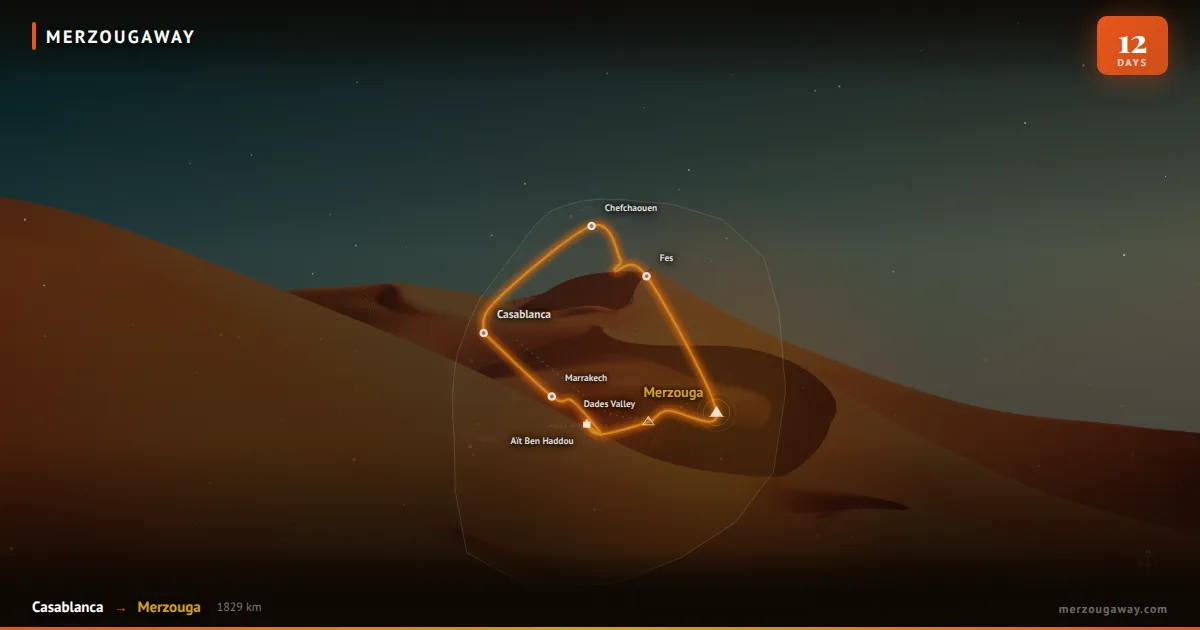
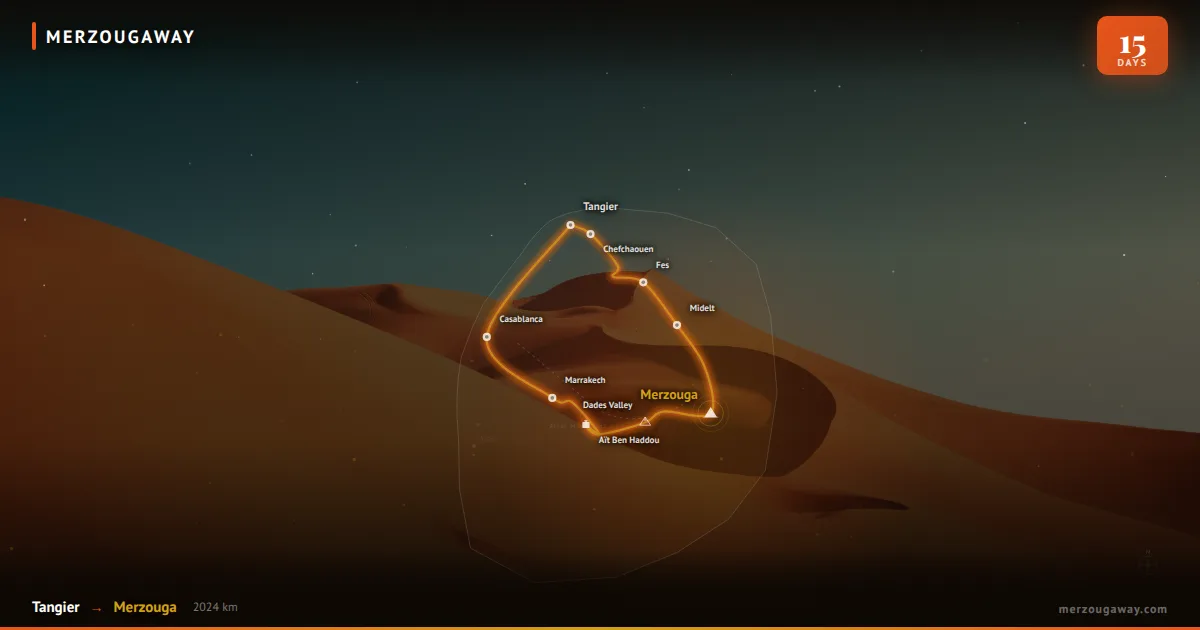
Once your entry paperwork is sorted, the fun part starts. Browse our Morocco tours — from 2-day Sahara add-ons to the 12-day Grand Morocco Circuit — or check our guide on what a Morocco trip actually costs to help plan your budget alongside your visa timeline. Also see is Morocco safe, driving in Morocco, and getting a local SIM or eSIM.
Email: hello@merzougaway.com WhatsApp/Phone: +212675203319 / +212668534981
This guide summarizes general policy as of mid-2026 and is not a substitute for official confirmation. Visa rules can change and vary by nationality — always verify your specific requirements with a Moroccan embassy/consulate or your own government's travel advisory before booking non-refundable travel.
Sahara Route & Drive-Time Estimator
Calculate realistic driving hours across the High Atlas (Tizi n'Tichka pass), compare scenic stops (Dadès, Todra, Ziz), and plan your custom desert itinerary.
MerzougaWay Team
We are a passionate team of local guides dedicated to sharing the beauty and culture of our home, Morocco. Our journey began with a simple desire to offer authentic, memorable experiences that go beyond the typical tourist trails.